
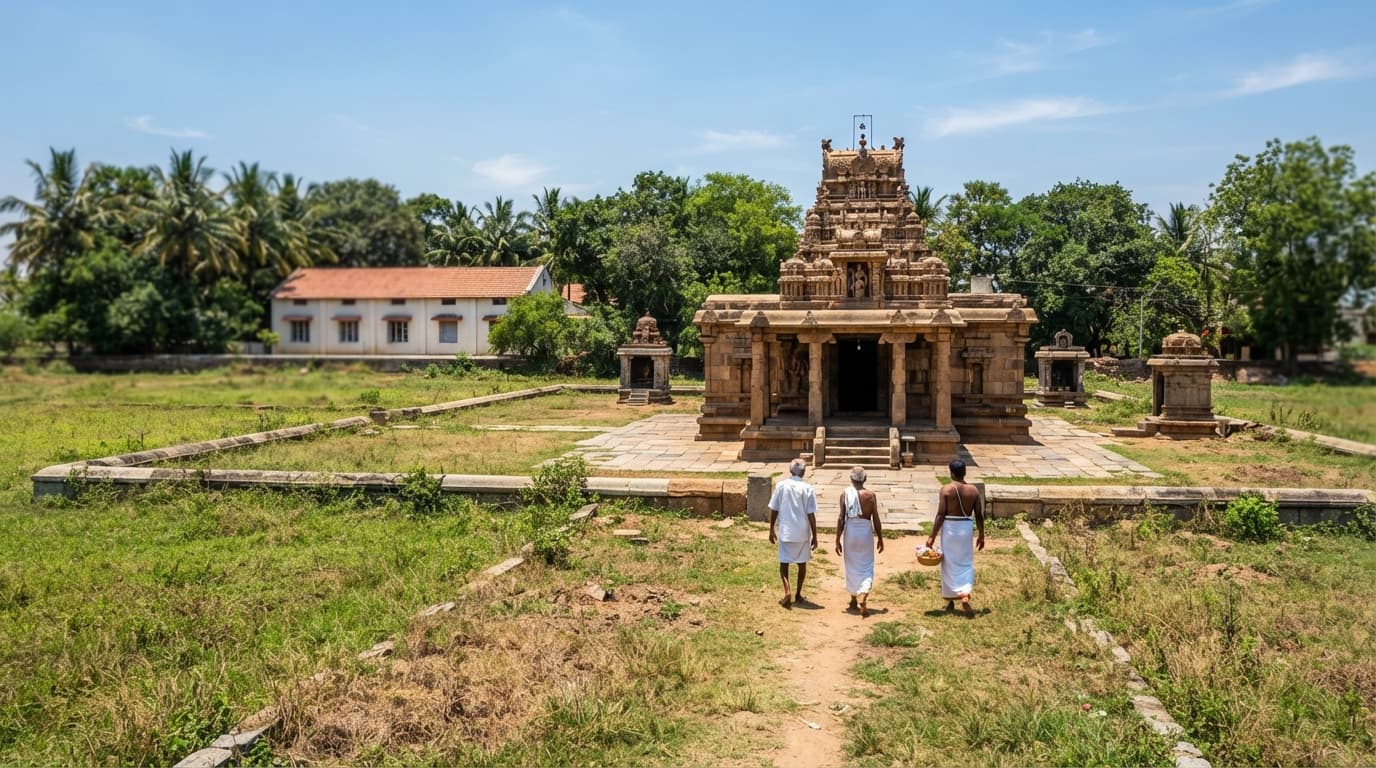
The Supreme Court has voided a 2017 gift of about one acre of temple inam land in Erode district to the Tamil Nadu government. Deciding gift deed validity on these facts, the bench said registration of the deed did not pass ownership and the land continues to belong to the temple. The decision was rendered in K. Ramalingam v. Government of Tamil Nadu, 2026 INSC 1144.
Described in the records as temple inam land attached to a village temple, the parcel was handed over in August 2017 by a temporary trustee. The registered gift deed named the State as donee and cited the need for a taluk office. Before the Court, the question was whether that registered gift had any effect in law. The answer was no — the deed was void and title never moved.
Justice Pamidighantam Sri Narasimha and Justice Alok Aradhe anchored the result in two statutes. Section 41(1) of the Tamil Nadu Hindu Religious and Charitable Endowments Act, 1959, restricts alienation of endowment property. Section 22-A of the Registration Act as applicable in Tamil Nadu bars documents of the kind attempted here. Registration, the bench said, did not cure a transfer forbidden by those provisions.
In practical terms, the State cannot claim ownership on the strength of the 2017 deed. Revenue and registration entries that showed the State as owner on that basis will now have to be read subject to the declaration that title never passed. For the temple administration, the land stands restored in law to the endowment, though possession and use on the ground will need follow-up by the authorities concerned.
Questions of gift deed validity after registration
Registration records the fact that a document was executed. It does not decide whether the executant had the right to transfer the property. Where the law forbids a transfer, registering the instrument does not lift the bar. The Court placed the 2017 gift in that category and gave the registration no legal effect.
Under Section 22-A as it applies in Tamil Nadu, registration of certain classes of documents connected with government and endowment lands is refused or treated as without effect. The bench treated the temple inam land in Erode as property that could not be gifted away in the manner attempted. Once the transfer was found to be forbidden, the consequence followed: no title passed to the donee.
Lawyers advising buyers, banks and government departments often test a registered gift against case laws on validity of gift deed before relying on it. The Court restated the test in plain terms. A court first asks whether the donor had legal capacity to give. It then asks whether the law permits a gift of that property to that donee. Only if both answers are yes does registration complete the transfer. Failure at the first or second step leaves nothing for registration to save.
Even a clear public purpose did not change that test here. The land was given for a taluk office, an everyday administrative need the Court did not question. Public purpose by itself, the bench said, does not create power to accept temple property by gift where statute denies it. A department that needs land must use a legally permitted route after checking ownership and limits on alienation.
One acre in Erode for taluk office
Spread over about one acre in Erode district, the land bore a tenure linked to the support and services of the village temple. The donor was a temporary trustee. The donee was the State. The instrument was a gift deed registered in August 2017, and the stated object was the construction or functioning of a taluk office.
Temporary trustees manage day-to-day affairs and protect the institution and its properties until a regular arrangement is made. That role does not include power to permanently alienate endowment land by sale or gift. The Court held the temporary trustee here had no authority to give the land away, so the deed was void from the start.
Inam tenure added a further layer. Inam lands attached to temples are not the personal property of a trustee or manager. They are held for the temple, and income or use from them supports worship, upkeep and related services. Because of that dedicated character, the law restricts transfer. Anyone dealing with such land must check its classification and see whether alienation is allowed and, if so, under what procedure and with whose sanction.
A taluk office touches daily life — certificates are issued there, land records are kept there, revenue matters are heard there. Locating such an office on land with defective title creates difficulty for the administration as well as the temple. Buildings may have come up, staff may have been posted, public money may have been spent. With the declaration that title never passed, those ground realities will have to be addressed within the law governing temple properties.
Temple property protection in Tamil Nadu
Section 41(1) of the Tamil Nadu Hindu Religious and Charitable Endowments Act, 1959, restricts alienation of endowment property. Its object is to stop loss of temple assets through sales, gifts, exchanges or other transfers made without authority and without following prescribed safeguards. The Court applied that protection to the Erode gift and held the prohibition was attracted.
Officials of the Hindu Religious and Charitable Endowments Department, hereditary trustees, fit persons and interim managers cannot gift temple land for any purpose, however worthy, except in accordance with the Act. Want of authority is not made up by registration, by long use, or by the public character of the donee. Recovery and correction of records will have to proceed under the procedures provided by law, with due notice to all concerned.
Conveyancers in Tamil Nadu will have to look beyond a search showing a registered gift deed in favour of a vendor. Title examiners must trace tenure, check whether land is classified as inam or endowment property, examine the authority of the executant, and confirm compliance with Section 41(1) of the 1959 Act and Section 22-A of the Registration Act. Encumbrance certificates and registration extracts show what was registered. They do not show whether registration was legally permitted.
Banks that lend against rural and semi-urban land face the same discipline, as do buyers of plots carved out of larger holdings. Where the root of title includes a gift from a trustee or manager of a temple, the file must contain proof of competence and statutory compliance. Absence of such proof is a red flag. A registered deed in the chain, standing alone, will not answer ownership if the transfer was barred.
Government departments that receive land by gift will also need tighter intake checks. A gift from a private owner with clear title stands on a different footing from a gift of endowment land by a person holding only a temporary managerial role. Before acceptance, the department must confirm the classification of the land and the status of the donor and whether the law allows the transfer. Where doubt exists, acquisition under the land acquisition law or transfer from another department with clear title is safer than a trustee's gift.
The judgment itself does not order eviction on the material available. It declares the 2017 gift void and the land temple property. Correction of revenue entries, resumption of possession, regularisation of any public construction strictly as permitted by law, or provision of alternative land for the taluk office will fall to the State government and the endowment authorities under the 1959 Act and other applicable laws, subject to orders of the competent forum.
Comments
Sign in to read the discussion and share your thoughts.
Latest from LawWorld
News
View all- Supreme Court Seeks Centre, ECI Reply On Plea Against Immunity For CEC And ECs4 Nov 2026
- Supreme Court Directs MP Speaker To Decide Bina MLA Disqualification Plea In Two Months4 Nov 2026
- Supreme Court Orders Special Cell To Monitor Child Labour Law Enforcement4 Nov 2026
- Bail Cannot Rest On Judge's Personal Notions Of Morality, Rules Supreme Court4 Nov 2026
- Supreme Court Refers Two-Child Norm Penalties To Larger Bench As Outdated4 Nov 2026