
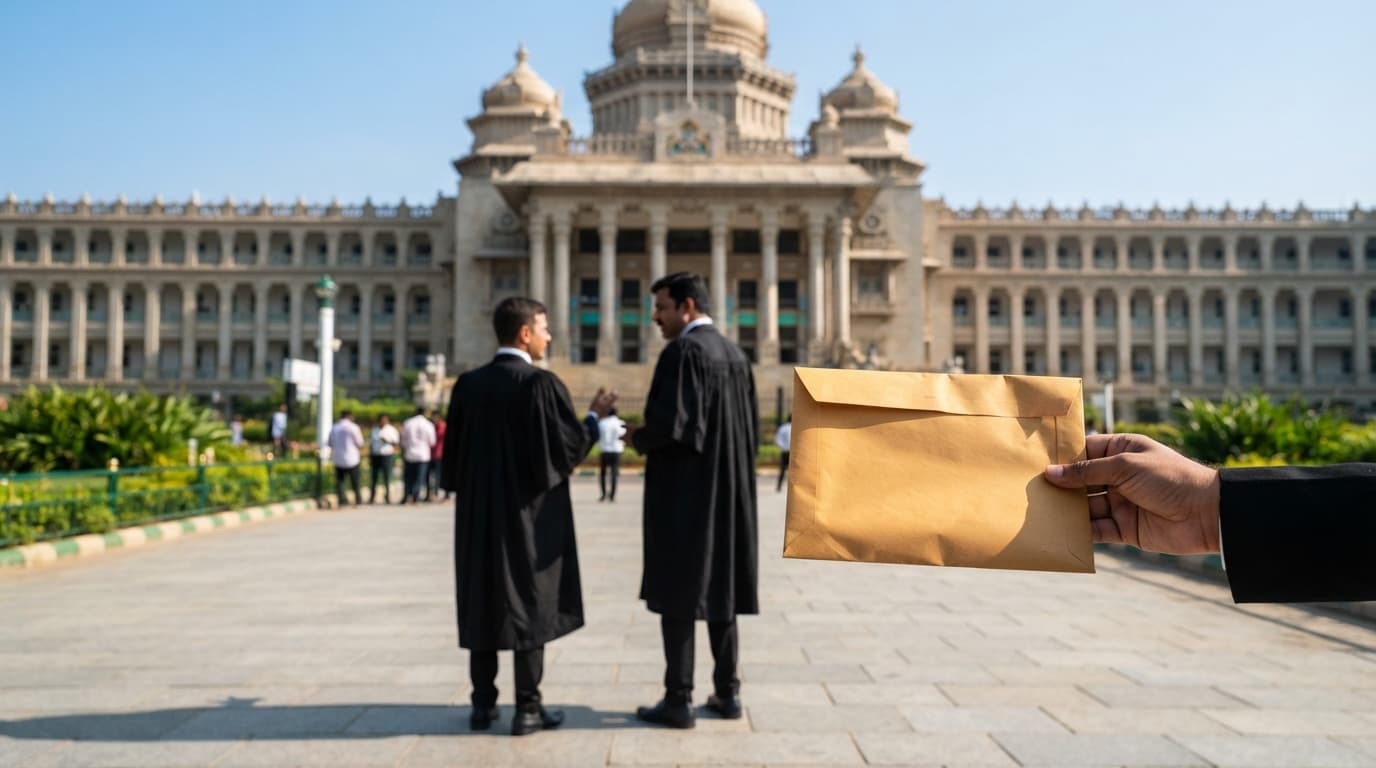
Bengaluru: The Karnataka High Court has granted bail to an advocate booked by the Vidhana Soudha police for allegedly demanding money in the name of a judge to secure a favourable bail order, a case the bench said involved advocate misconduct of the gravest kind. Justice Anant Ramanath Hegde passed the order in a case registered under Sections 318(4), 79 and 3(5) of the Bharatiya Nyaya Sanhita, 2023. The Court said such conduct tarnishes the judge named and the institution itself. It recorded that two co-accused were already on bail, call records had been secured, and investigation against the petitioner was still incomplete.
The prosecution alleged the lawyer acted with two others and sought illegal gratification by claiming influence over a judicial proceeding. The demand, it said, was for a favourable order on bail in a pending matter. The Vidhana Soudha Police Station registered the case under the three BNS provisions on that complaint. The advocate then moved the High Court for release pending investigation and trial.
Justice Hegde heard the plea alone and tested the need for custody against the material collected so far. He did not play down the charge. A lawyer who uses a judge's name to extract money commits the highest form of professional misconduct, he said. Such an act, the order states, harms the reputation of the judge whose name is misused and lowers public confidence in the courts.
Still, the Court drew a line between the gravity of the charge and the need for further custody. It weighed the stage of investigation, the evidence already in hand, and the position of the co-accused. On those factors it ordered release on conditions. The order states bail must not be used as punishment before trial.
Prosecution alleged demand for favourable order
The complaint came within the jurisdiction of the Vidhana Soudha police in Bengaluru, which covers offences reported in and around the seat of government. The allegation, as recorded in the order, was that the petitioner claimed proximity to the judicial process and asked for money for a favourable bail order. Sections 318(4), 79 and 3(5) of the BNS were invoked. The Court gave no finding on the truth of the charge. A bail hearing does not decide guilt.
Opposing bail, the State argued that misuse of judicial office for gain strikes at the integrity of the system and calls for a firm response. The defence said the petitioner was falsely implicated, custodial interrogation was not needed, and further detention would serve no purpose. The Court studied the case diary to decide if detention remained necessary.
In plain terms, what is bail in law in India comes down to this: release from custody on conditions, with an assurance the accused will attend investigation and trial and will not tamper with evidence or influence witnesses. It is not an acquittal. The accused still faces trial. Breach of conditions can lead to cancellation and return to custody.
Co-accused already enlarged, records secured
Parity weighed heavily. The order records that the two other accused in the same case had already been granted bail. Where the roles attributed are similar, courts often extend the same relief unless a clear distinction justifies different treatment on custody. The bench said no such distinction had been shown here.
The state of the evidence was the second reason. The investigating agency had already secured the telephone conversations and call details cited by the prosecution. In a case built on demand and communication, call data, recordings and related electronic records form much of the proof. With that material in the investigator's custody, the risk of loss at the hands of the accused falls. The Court found further detention to secure it was not required.
The third factor was time. Investigation against the petitioner was incomplete and would take longer to finish. The law on bail in India treats conditional release as the norm where investigation has moved substantially, the accused has roots in the community, and there is no concrete material showing flight risk or likely tampering. The prosecution placed no material to show the petitioner would abscond or stay away from trial if released on conditions.
Court flags advocate misconduct as grave
In granting relief the Court used stern language on professional ethics. It said any misconduct by advocate that trades on a judge's name is viewed with particular severity. A lawyer is an officer of the court and the link between litigant and system. Litigants trust counsel to act within law and ethics. Use of a judge's name to demand money betrays that trust and spreads the false impression that orders can be bought.
The order has raised the familiar query outside courtrooms — what is professional misconduct of an advocate under Indian law. The Advocates Act, 1961 and the Bar Council of India rules lay down standards towards court, client, opponent and colleagues. Dishonesty, fraud, misleading the court, taking illegal gratification or misusing influence fall in the disciplinary domain. Punishment there is separate from criminal liability and can range from reprimand to suspension or removal from the rolls after inquiry and proof.
A related issue is when does negligence by advocate amount to professional misconduct. Not every error, wrong advice or missed appearance qualifies. Disciplinary bodies distinguish ordinary negligence or error of judgment from gross negligence, deliberate default or conduct involving moral turpitude. A missed date without explanation may draw an adverse remark, but misconduct action generally needs more — dishonest intent, breach of trust, collusion, or reckless disregard for the client's interests. Here the allegation was not mere negligence. It was a deliberate demand for money by invoking judicial authority, which is why the Court placed it in the highest category.
The bench made clear those remarks did not decide the criminal charge. The petitioner remains an accused. The allegation must be proved by evidence at trial. The remarks describe how the law treats such conduct if proved, and leave it to disciplinary authorities to examine the matter separately. The bail order expresses no final view on conviction or acquittal and does not bar Bar Council proceedings.
Bail conditions and stage of investigation
Release was made subject to conditions meant to secure presence and protect the probe. The full list is not set out in the research material, but such orders typically require a personal bond, sureties, cooperation with the investigator, attendance when summoned, no tampering with witnesses or evidence, and no travel outside the jurisdiction without permission. Breach gives the prosecution liberty to seek cancellation.
Investigation will now continue against the petitioner alongside the case against the other accused. Police will finish collecting evidence, record statements, obtain technical or forensic reports where needed, and file a final report before the competent court. That court will then consider cognizance, frame charges if a prima facie case is made out, and move to trial. The petitioner will have full opportunity to contest, cross-examine witnesses and lead defence evidence.
The order has two immediate effects. The criminal case moves ahead without pre-trial detention now that key electronic material is secured. The disapproval of lawyers trading on judges' names stays on record. Members of the Bar in Bengaluru track such orders for their bearing on liberty during trial and on professional reputation. The Bar Council remains the statutory body to take disciplinary notice on proved facts, apart from the criminal trial.
Custody in the Vidhana Soudha police case will end once bail formalities are completed before the trial court. The prosecution can seek cancellation if conditions are breached or fresh material shows interference. The trial will decide whether the charge of demanding money in a judge's name is proved beyond reasonable doubt.
Comments
Sign in to read the discussion and share your thoughts.
Latest from LawWorld
News
View all- Supreme Court Seeks Centre, ECI Reply On Plea Against Immunity For CEC And ECs4 Nov 2026
- Supreme Court Directs MP Speaker To Decide Bina MLA Disqualification Plea In Two Months4 Nov 2026
- Supreme Court Orders Special Cell To Monitor Child Labour Law Enforcement4 Nov 2026
- Bail Cannot Rest On Judge's Personal Notions Of Morality, Rules Supreme Court4 Nov 2026
- Supreme Court Refers Two-Child Norm Penalties To Larger Bench As Outdated4 Nov 2026