
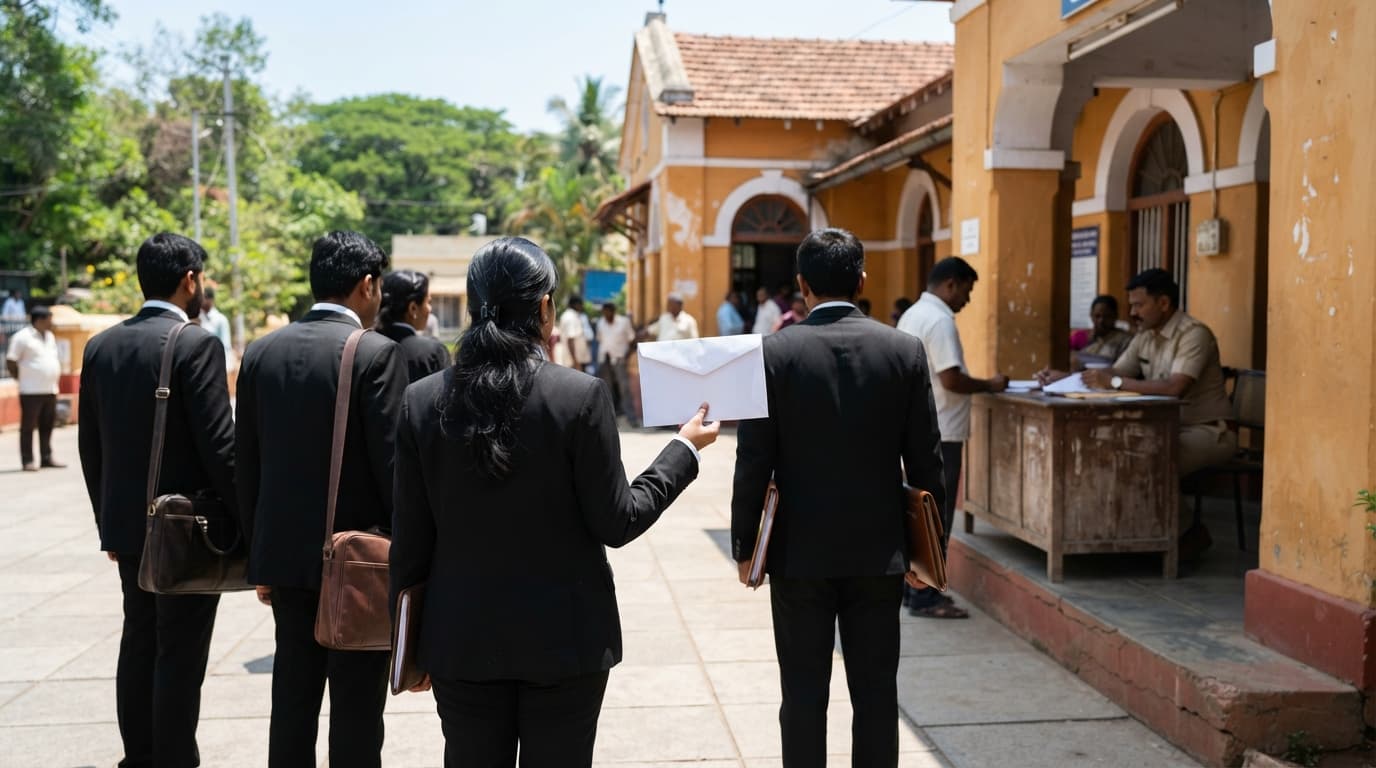
The High Court of Karnataka initiated a suo motu PIL on November 3, 2026, over three recent attacks on advocates in the State and complaints from the Bar about police conduct.
A Division Bench registered the public interest litigation on its own motion. Before it were concerns raised by the Advocates Association of Bengaluru about the safety of lawyers, how complaints involving advocates are handled, and enforcement of the statutory protection available to the profession.
Three incidents form the core of the case. Advocate Sriram V. was murdered on October 9, advocate Manjunath was murdered on October 18, and advocate Venkataramanappa Sannakki survived an attempt on his life on October 28. The Court treated the three attacks in less than three weeks as a pattern. It said the pattern called for a structured judicial response, not only separate criminal investigations.
On police functioning, the Bench recorded the allegation that police stations were acting as parallel courts. The Association told the Court that civil disputes were being called to police stations and settled there, outside civil courts and outside the procedure laid down by law. No final finding was recorded. The Court said the allegation was serious enough to be examined in the public interest litigation.
A second complaint concerned how advocates are treated at police stations. The Court noted the Bar's account that lawyers faced disrespectful treatment when they appeared for clients or sought to assist them in the course of work. The Bench said the working relationship between the Bar and the police bears directly on access to justice, fair investigation and the daily functioning of courts.
The Court has asked the State government to file a statement of the measures it proposes to strengthen protection for advocates. The State must spell out, in concrete terms, the administrative and legal steps it plans to prevent attacks, to act promptly when attacks occur, and to give effect to the Prohibition of Violence Against Advocates Act, 2023.
Lawyers' bodies had pressed that demand before the Court intervened. The Karnataka State Bar Council, the Advocates Association of Bengaluru and other associations called protest action seeking clearer enforcement machinery, quicker response to complaints of threats and assaults, and accountability where protection fails.
Why the suo motu PIL was registered
Registration of a suo motu case means the High Court acted without a formal writ petition from an aggrieved person. The Court can take cognisance of a public interest matter on the basis of incidents brought to its notice, letters, representations or developments that call for judicial supervision. Once registered, the State and the authorities concerned are made respondents and must reply through affidavits and reports.
Here the dates weighed with the Court. Sriram V. was killed on October 9. Manjunath was killed nine days later, on October 18. Ten days after that, on October 28, came the attempt on Sannakki. Three attacks on advocates in nineteen days raised questions about deterrence, policing and the working of the protective law.
Guilt in those individual criminal cases is still to be decided. Investigation and trial will continue before the competent court under the criminal law. The public interest litigation is confined to the wider questions of prevention, protection and institutional response.
Those questions include how threats to advocates are recorded and acted on, what precautionary or security measures are available when a lawyer reports intimidation linked to a case, how fast first information is registered, and how the police coordinate with the Bar when an advocate is a victim or a complainant. The State has been asked to answer each of these points.
The parallel courts allegation will need a detailed reply. If civil disputes are settled inside police stations, questions arise on jurisdiction, voluntariness, documentation and the rights of parties who may be without legal advice at that stage. The Court is expected to ask what standing instructions govern police handling of civil complaints, what registers are kept, and what supervision senior officers exercise over such intervention.
Lawyers say the practice puts them at a disadvantage. When a client is called to a police station in a civil matter, counsel cannot participate as in a court. Any pressure to settle, any refusal to register a complaint, or any discourteous conduct affects client and counsel alike. The High Court has brought that concern within the scope of the case.
Court hall disruption sparks contempt case
On the same day, November 3, 2026, a Division Bench of Chief Justice Vibhu Bakhru and Justice K.S. Hemalekha started suo motu contempt proceedings over alleged disruption of proceedings in the Chief Justice's court hall during a lawyers' protest.
The Court took a prima facie view that the conduct was contemptuous. It told the registry to identify those involved from CCTV footage of the court hall. Notice was issued to the Advocates Association of Bengaluru. The contempt case is listed for further hearing on November 19.
The protest had been called by the Karnataka State Bar Council, the Advocates Association of Bengaluru and other associations to press for strengthening and effective implementation of the Prohibition of Violence Against Advocates Act, 2023. The Court has kept the two tracks separate. Safety and police conduct will be dealt with in the public interest litigation. The alleged disruption inside the courtroom will be dealt with under the contempt jurisdiction.
The line matters for members of the Bar. Representations can still be made, work can still be abstained from in accordance with law, and legislative and executive action can still be sought. Inside the courtroom, decorum applies and the Court can act to secure orderly proceedings. The contempt hearing will examine who did what, whether it interfered with the administration of justice, and what responsibility attaches to office-bearers, if any.
Use of CCTV footage means the Court will go by an objective record rather than rival oral accounts. Identification from the footage, followed by an opportunity to reply to the notice, will come next. No final finding of guilt has been recorded against any individual.
What the State must explain
The main direction in the public interest case is for the State to file an affidavit setting out proposed measures on statutory protection for advocates. In practice, the reply is expected to cover the present enforcement framework under the 2023 Act, gaps flagged by the police and prosecution departments, and steps the government will take within a fixed timeline.
The Court will look for detail. A general assurance of protection is rarely treated as enough in a suo motu public interest matter. The State is likely to be asked to explain the reporting mechanism for violence or threats against advocates, the rank of the officer responsible for immediate response, the time frame for action, and the system for checking compliance. Coordination between district police, the prosecution and Bar associations will also figure.
Training and conduct form another part of the inquiry. The complaints of disrespectful treatment point to the need for clear instructions on how police personnel deal with advocates who come to stations for clients or to lodge complaints. The State reply may have to state what circulars already exist and whether fresh guidelines are needed.
The 2023 Act stays at the centre. The associations want it enforced, and the Court has asked the State to show how the statute works on the ground. The questions include how cases under the Act are registered, investigated and prosecuted, what data is kept, and what support victims get during investigation and trial. The Court has not yet interpreted the provisions.
For the three cases involving Sriram V., Manjunath and Sannakki, investigation will run its own course. The public interest litigation does not replace investigation by the jurisdictional police or trial by the competent criminal court. It gives the High Court a forum to monitor systemic steps while those cases proceed under the Bharatiya Nyaya Sanhita, 2023, the Bharatiya Nagarik Suraksha Sanhita, 2023, and the Bharatiya Sakshya Adhiniyam, 2023, as applicable.
Advocates in Bengaluru and other districts will watch the affidavit closely. Many practise in trial courts and before quasi-judicial authorities, where land, money, tenancy, family and criminal defence disputes turn tense and threats can follow directly from the brief. For them, a working system for complaint, protection and prosecution is a question of daily safety.
Procedure comes next. The State will file its affidavit on proposed measures. The associations will get a chance to respond and to place further material on incidents and on difficulty in getting complaints registered. The Court will then decide if the measures are adequate or if further directions and periodic reporting are needed. In the contempt matter, the registry will place the CCTV material and identification report before the Bench on November 19.
Comments
Sign in to read the discussion and share your thoughts.
Latest from LawWorld
News
View all- Supreme Court Seeks Centre, ECI Reply On Plea Against Immunity For CEC And ECs4 Nov 2026
- Supreme Court Directs MP Speaker To Decide Bina MLA Disqualification Plea In Two Months4 Nov 2026
- Supreme Court Orders Special Cell To Monitor Child Labour Law Enforcement4 Nov 2026
- Bail Cannot Rest On Judge's Personal Notions Of Morality, Rules Supreme Court4 Nov 2026
- Supreme Court Refers Two-Child Norm Penalties To Larger Bench As Outdated4 Nov 2026