
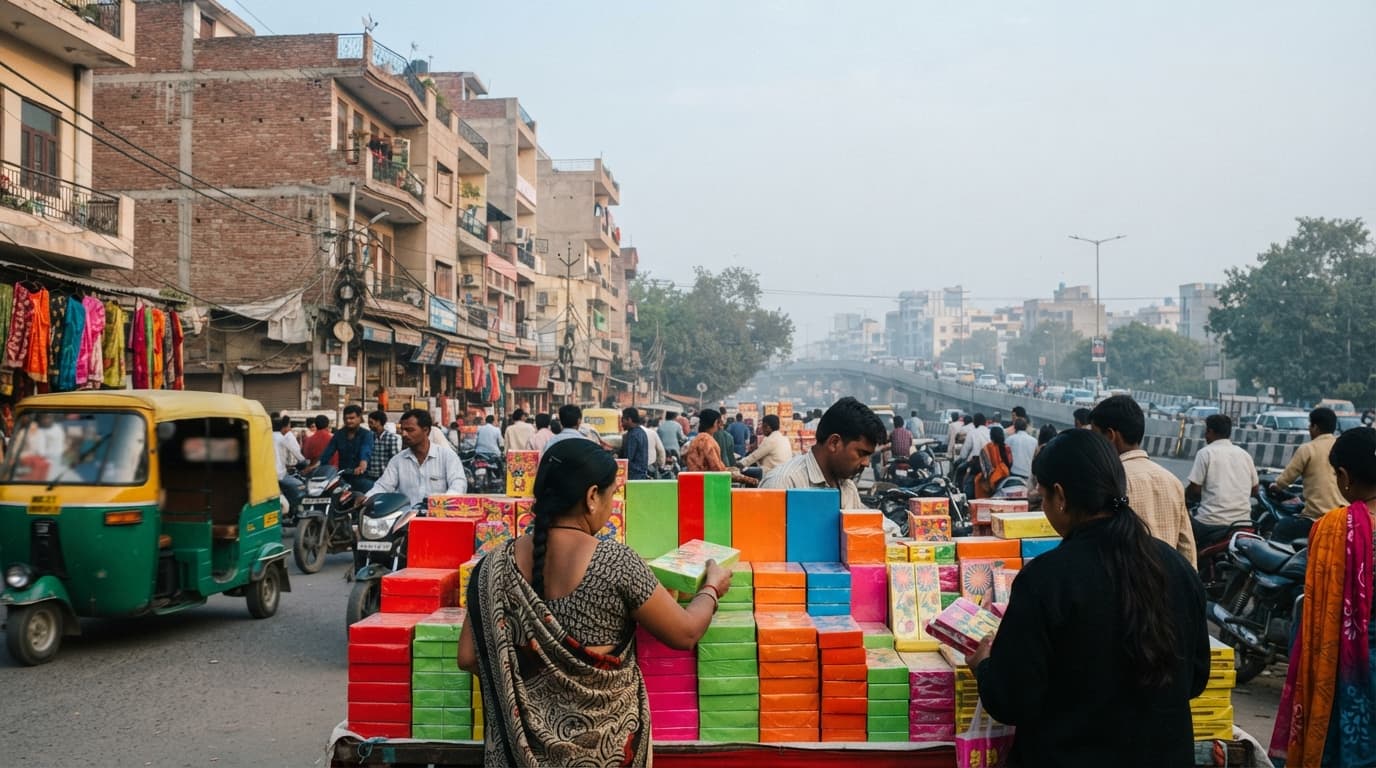
New Delhi, October 29: The Supreme Court is scheduled to take up on Thursday the continuing case on air pollution in Delhi and the National Capital Region, with questions of stubble burning and the manufacture and sale of so-called green firecrackers listed for consideration ahead of Diwali. The hearing will deal with firecracker manufacturing and use, along with other steps aimed at controlling pollution during the festive season, when smoke, traffic, construction dust and weather conditions combine to worsen air quality across the region.
The outcome is being watched closely by residents, traders, manufacturers, enforcement agencies and state governments in and around the capital. For households, it will decide what, if anything, can be burst during the festival. For the police and pollution control bodies, it will decide what has to be enforced on the ground. For manufacturers, it will decide whether the stock permitted to be produced can be sold in the Delhi-NCR market this season.
At the centre of the hearing is a distinction the court had drawn earlier between manufacture and sale. According to the order history placed before the court, an earlier directive had imposed a complete prohibition on the manufacturing, storage and use of all types of firecrackers to combat air pollution in the Delhi-NCR region. During a later hearing, the court indicated a limited relaxation that would permit manufacturers to produce green firecrackers for Delhi-NCR, but made clear that permission to manufacture would not automatically mean permission to sell. The question of allowing sale is expected to be a key focus of the proceedings.
The court had also directed the Central Government to consult all relevant groups before a final view is taken on sale. That consultation process, and whatever response the Centre places on record, is likely to shape the arguments on Thursday. The court will have to weigh the claims of manufacturers about livelihood and approved green products against the concerns of public health, enforcement difficulties and the seasonal rise in pollution that follows Diwali night.
Complete ban and limited manufacturing window
The background to the present hearing lies in a series of directions passed over several years to control winter pollution in the capital. The court had earlier ordered a complete prohibition on manufacture, storage and use of all types of firecrackers in Delhi-NCR. The intent, as recorded in the proceedings, was to address the sharp deterioration in air quality that coincides with the festival and the start of winter.
What changed, in limited terms, was the position on production. During a prior hearing, the court indicated that manufacturers could be permitted to manufacture green firecrackers for Delhi-NCR. The court was careful to add that this would not by itself authorise sale. In practical terms, that meant factories could keep lines running and retain workers, but shops could not yet stock or sell the product in the region and buyers could not lawfully purchase it there.
That distinction matters for enforcement. Manufacture is concentrated in a small number of licensed units that can be inspected. Sale and use are dispersed across thousands of shops, markets, residential colonies and public spaces. Police and pollution control officials have in past years pointed to the difficulty of checking at the point of sale whether a cracker is a permitted green product or a conventional product, especially when packaging and labelling are disputed. The court will now have to decide whether a conditional permission for sale can be framed in a way that field officers can actually apply during a busy festival week.
Manufacturers, on their part, are expected to argue that green firecrackers are different from conventional crackers in composition and emissions, and that a regulated sale with certification and labelling would meet the court’s concerns. Resident groups and health experts opposing any relaxation are expected to argue that even reduced emissions add to an already severe load in late October and November, when ventilation is poor. Much of the public discussion ahead of the hearing has turned on the Delhi ncr air pollution level and how it is expected to move during the festival week.
Why air pollution in Delhi worsens in October
The timing of the hearing is tied to seasonal factors that the court has addressed in earlier pollution matters. October marks the transition from monsoon to winter in north India. Wind speeds fall, temperatures drop at night, and a layer of cool air traps pollutants close to the ground. Local sources such as vehicles, road dust, construction activity, waste burning and industrial emissions therefore have a larger effect than in other months.
Residents checking the air pollution index in Delhi today will see readings that move sharply within a single day, with mornings and late evenings often worse than afternoons. The court’s pollution docket has for years dealt with this pattern through a mix of short-term responses, such as restrictions on certain activities during severe days, and longer-term directions on vehicles, fuels, construction norms and waste management. The present hearing on firecrackers and stubble burning sits within that wider frame, rather than as an isolated festival issue.
The proceedings will effectively decide the shape of the diwali firecracker ban this year in the capital region. A continuation of the complete prohibition on sale and use would keep the legal position simple for enforcement, though past experience shows that illegal sale and cross-border purchase remain problems. A conditional permission for green crackers would require a clear definition of what qualifies, a system for approval and marking, limits on time and place of bursting, and accountability for violations. The court may also consider interim arrangements for this season while leaving broader policy questions for later orders.
Stubble burning remains part of case
Alongside firecrackers, the case covers stubble burning in states around Delhi. The practice of burning paddy residue after harvest in October and November has been a recurring subject in the court’s pollution hearings. The smoke travels with prevailing winds and adds to the region’s burden at a time when local dispersion is already weak.
The court has in the past called for records on fires, enforcement actions, incentives for machines that manage residue, and use of funds meant to support farmers in shifting away from burning. State governments have pointed to a decline in the number of fire counts in some years, distribution of equipment, and penalties imposed in specific cases. Farmer organisations have pointed to the short window between paddy harvest and wheat sowing, the cost of machines and fuel, and the need for workable alternatives at the field level.
Thursday’s hearing is expected to review where that effort stands this season. The court is likely to ask what preventive steps have been taken, what support has reached the field, and what the monitoring data shows. Any direction on stubble would sit alongside directions on urban sources, because the court has treated winter pollution as a combined problem that cannot be addressed by acting on one source alone while others remain unchecked.
Sale question will decide festive enforcement
The immediate question before the court is narrow but has wide effects. If sale remains prohibited, Delhi-NCR will enter Diwali under the same complete prohibition on manufacture, storage and use that the court had earlier ordered, subject only to the limited manufacturing window already indicated. Police, municipal bodies and pollution control committees would then enforce a clear ban, with seizures and cases against illegal stocking and bursting.
If the court permits sale of green firecrackers on conditions, the order will need to spell out the details. Those would include which products are covered, which agency certifies them, how shops and buyers can verify approval, whether bursting is limited to specific hours or days, and what penalties apply for selling or bursting non-approved products. The court may also address online sale, transport from neighbouring states, and temporary licences issued by local authorities during the festival.
The wider debate on firecracker ban in India has seen different approaches in different states and cities. The legal history includes the firecracker ban in Delhi 2018, when the court restricted the sale and use of conventional crackers and addressed the concept of green and low-emission products, time limits for bursting, and e-commerce controls. That experience is often cited in arguments about whether time-window restrictions and product standards can be enforced in a crowded urban setting.
A comparison is often drawn with the firecracker ban Mumbai and restrictions imposed in other urban centres during Diwali and New Year, where state governments and high courts have issued time slots, designated zones and product conditions. Lawyers appearing in the Delhi case refer to those examples both to support and to oppose relaxation, depending on whether they stress compliance levels or enforcement gaps. The Supreme Court’s choice for Delhi-NCR, which has distinct winter weather and a larger airshed problem, will be read closely by other states framing their own festival orders.
Manufacturers and traders argue that a regulated channel for approved green products offers a workable firecracker ban solution that protects health while avoiding a complete shutdown of a seasonal trade. Those supporting a continued full ban argue that any opening in the market makes it harder to distinguish lawful from unlawful stock and encourages large-scale bursting that wipes out marginal gains from cleaner products. The court will have to decide which account fits the enforcement record placed before it.
For the public, the practical message will come from the operative part of Thursday’s order. Until the court speaks, the earlier position stands: manufacture of green firecrackers was indicated to be permitted in limited terms, but sale was not automatically permitted. Whether that changes, and on what terms, will determine what residents can buy, what shopkeepers can stock, and what the police can seize in the days leading to Diwali. The next date, if the matter is carried forward, and the compliance reports sought from the Centre and the NCR states, will show how the court plans to monitor the festival period and the peak stubble season that follows.
Comments
Sign in to read the discussion and share your thoughts.
Latest from LawWorld
News
View all- Supreme Court Seeks Centre, ECI Reply On Plea Against Immunity For CEC And ECs4 Nov 2026
- Supreme Court Directs MP Speaker To Decide Bina MLA Disqualification Plea In Two Months4 Nov 2026
- Supreme Court Orders Special Cell To Monitor Child Labour Law Enforcement4 Nov 2026
- Bail Cannot Rest On Judge's Personal Notions Of Morality, Rules Supreme Court4 Nov 2026
- Supreme Court Refers Two-Child Norm Penalties To Larger Bench As Outdated4 Nov 2026