
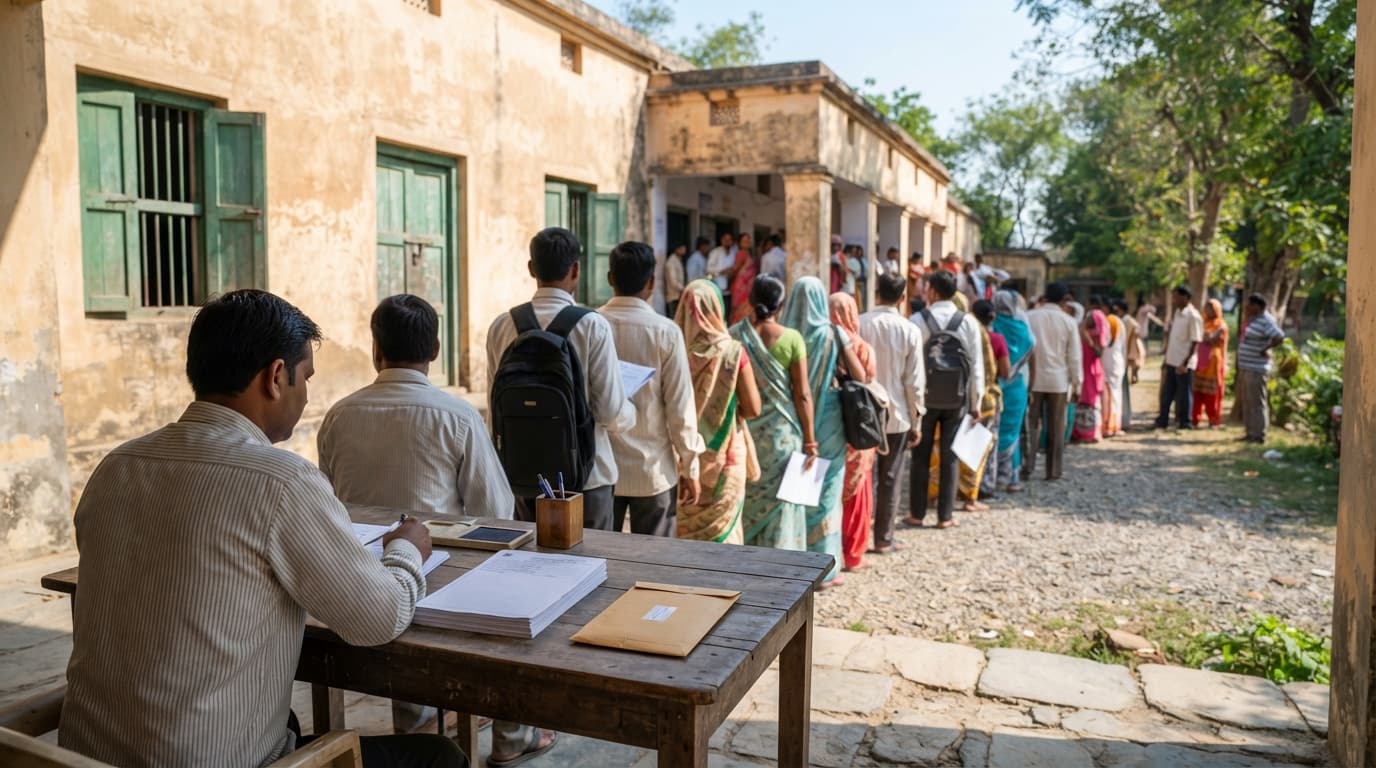
The Supreme Court on October 30 said the completion of the special intensive revision of electoral rolls does not freeze the rolls and names can still be added till nominations are filed for an election. A bench headed by Chief Justice Surya Kant with Justices Joymalya Bagchi and V. Mohana gave the clarification while hearing petitions against the exercise in Uttar Pradesh, Kerala and Chhattisgarh. It refused to extend the deadline. It ordered the Election Commission of India to check complaints of wrongful deletions and place corrective steps on record.
Petitions from three states were before the bench. In Uttar Pradesh, the challenge was to large-scale irregularities in receiving applications for deletion. In Kerala, the claim was that genuine voters were still out of the rolls after the exercise. In Chhattisgarh, the questions were about manner and timing. It refused to stay the process in any of the three states. Voters who do not find their names, the bench said, have remedies during the exercise and after it.
Counsel told the bench that even after publication of the rolls following revision, an eligible person can apply for inclusion. The bench accepted that stand and recorded it. No voter, it said, should assume that the end of the exercise shuts the door to enrolment. Additions, corrections and reasoned objections to wrongful deletions remain available under the law for upkeep of the rolls.
Free and fair elections depend on correct and credible rolls, the bench said. It called the rolls the foundation of the franchise. At the same time it said the Election Commission draws the power of revision from the Representation of the People Act, 1950 and Article 324 of the Constitution. It recalled that it had upheld the Commission's Bihar revision in May 2026 on that basis. That was the backdrop to its refusal to stop the present exercises while pressing for checks against wrongful exclusion.
What special intensive revision means for voters
The draft roll process was spelt out in court. The revision yields a draft roll, calls for claims and objections, and ends in a final roll. That sequence, the Court said, does not close enrolment. A person who meets the conditions of citizenship, age and ordinary residence can seek inclusion after final publication too. The cut-off remains the filing of nominations for the poll concerned.
For a voter, the effect is plain. A missing name in the draft roll is not the last word on the right to vote. The person can file a claim for inclusion with proof. A person who learns of a wrongful move to delete his name can object and seek a hearing before the electoral registration officer. The Court said these remedies live past the intensive phase and must work on the ground.
Petitioners were asked to use that route for entries in dispute. They can bring individual and constituency-level errors to the Commission. The Commission must then check those complaints under the law and correct the record where the complaint is right. Shortage of time or scale of the work, the Court said, is no ground to leave mistakes as they are.
Uttar Pradesh drew the sharpest exchange on facts. Congress MP Tanuj Punia and others have challenged the exercise in the state. Their counsel alleged bulk filings in Form 7, the form used to seek deletion from the draft roll, were taken in breach of procedure. In one constituency, 32 forms were put in together in a way that targeted members of one community, it was alleged. Such filings, without separate verification and hearing, could lead to wrongful deletions.
The Election Commission said there were lapses by its officials in Uttar Pradesh in taking bulk Form 7 applications. Corrective action has been taken and the officials at fault have been proceeded against, it said. The irregular acceptances will not stand, and the statutory steps of notice and inquiry before deletion will be followed. The Court told the Commission to examine the claims in full, take the needed corrective steps and file a compliance report.
Petitioners in the Uttar Pradesh case were told to hand the Commission a written note on the irregularities they say are still unresolved. Constituencies, booths and the nature of each complaint must be named so the record can be checked. The Court said this two-way course — a pointed complaint and a verified reply — will let it judge compliance at the next hearing. The case comes up on October 31.
Court seeks details on Kerala exclusions
Numbers dominated the Kerala arguments. Advocate G. Prakash, for the petitioners, submitted that about 24 lakh voters stayed excluded in the state. Many could not file enumeration forms in the time given, and the short time led to exclusion, it was argued. The Election Commission replied that the Kerala revision was over in February and the last Assembly polls were held on rolls made after that. The prescribed stages were followed, it said.
The Court recorded no finding on the 24 lakh figure. It asked the petitioners to give names and addresses of voters who, in their case, could not file enumeration forms for want of time. The Commission can then review those cases and give relief where due. It was not a general reopening of the exercise. It was a check of the exclusion claim on verifiable details.
Appearing for another petitioner, senior advocate Raju Ramachandran alleged widespread deletions in the Kerala revision and asked for a full affidavit from the Commission on the deletions. The Court asked the Commission to answer. Its affidavit must state how deletions were dealt with, what notices went out and what inquiries preceded removal of names. Deletion touches the right to vote and needs due procedure with papers to back it, the bench said.
Across both states, the line was the same. The revision frame stays, and the timetable was not stretched. But the Commission must meet pointed factual complaints with documents. For Kerala, that is names said to be left out for want of time, then a review. For Uttar Pradesh, that is a check of bulk Form 7 filings, proof that unlawful acceptances stand reversed, and action against officers who broke instructions.
Counsel for the petitioners pressed for more time to stop lasting disenfranchisement. The Court turned down the plea. The law already allows continuous updating of rolls, so no extension was needed, it said. The guard lay in enforcing the rules for inclusion, objection and deletion at each stage. The Commission said its machinery stays open to claims for inclusion and objections to wrongful deletion.
October 31 is now the next date. The Commission will check the Uttar Pradesh bulk deletion claims and file its report after corrective action. The Kerala petitioners will give particulars of alleged wrongful exclusions for review, and the Commission will file its reply on deletions. The bench will then take up the note on unresolved irregularities, the Kerala details and the compliance position.
Comments
Sign in to read the discussion and share your thoughts.
Latest from LawWorld
News
View all- Supreme Court Seeks Centre, ECI Reply On Plea Against Immunity For CEC And ECs4 Nov 2026
- Supreme Court Directs MP Speaker To Decide Bina MLA Disqualification Plea In Two Months4 Nov 2026
- Supreme Court Orders Special Cell To Monitor Child Labour Law Enforcement4 Nov 2026
- Bail Cannot Rest On Judge's Personal Notions Of Morality, Rules Supreme Court4 Nov 2026
- Supreme Court Refers Two-Child Norm Penalties To Larger Bench As Outdated4 Nov 2026