
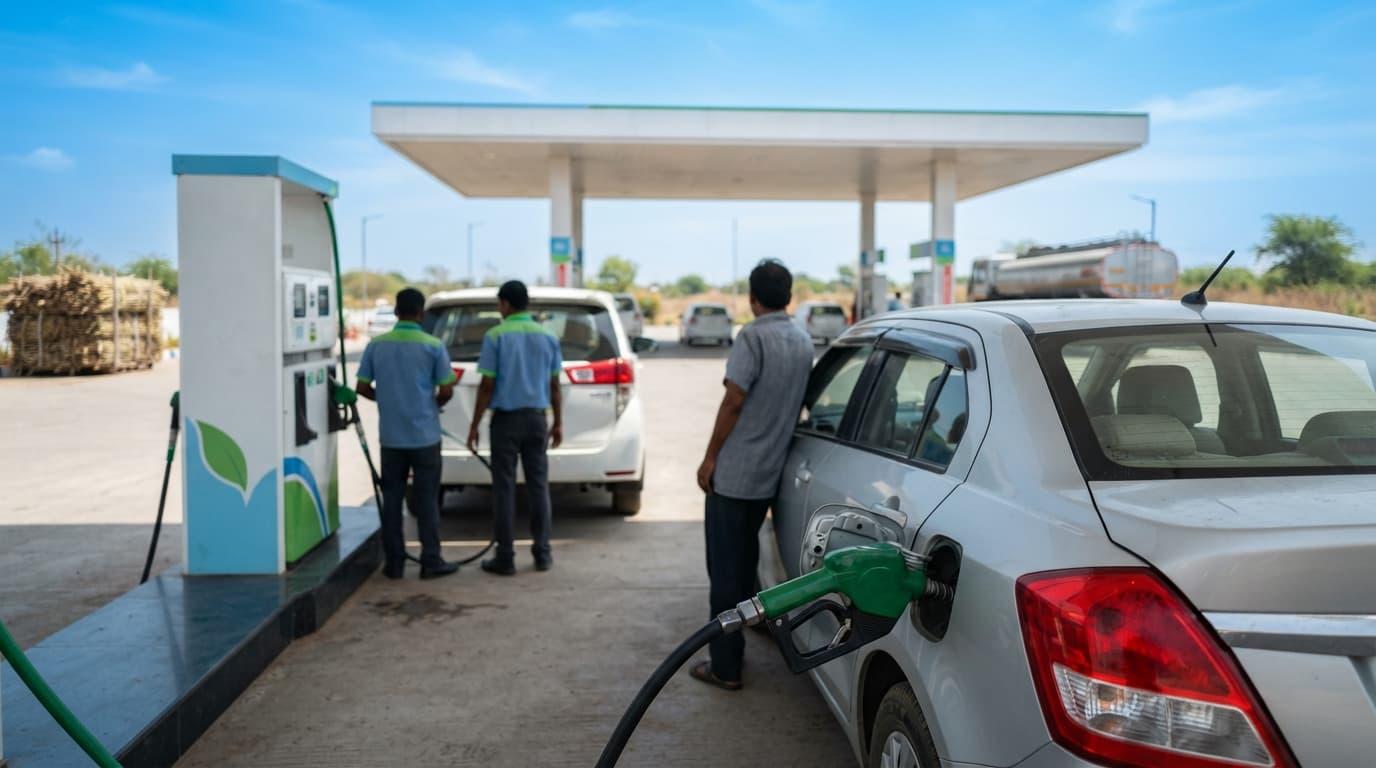
New Delhi, October 29: The Supreme Court on October 29 asked the Centre where ethanol for 100 per cent ethanol vehicles will come from, putting the Ethanol Blending Policy India at the centre of a fight over fuel allocation for ESY 2025-26. The question was put to the government during a challenge by an oil marketing company to enhanced allocation ordered for the current supply year. The Court said it wanted to know how the system would cope if the E100 fleet grows while the petrol blending programme is still being stabilised.
At issue was a notification dated October 26 from the Ministry of Road Transport and Highways permitting E100 vehicles that run entirely on ethanol. The Bench asked how supply would be ensured for such vehicles on a wider scale. The concern was not vehicle technology. It was availability, sourcing and distribution at a time when ethanol volumes are already committed to petrol blending.
The petition before the Court was filed by an oil marketing company. It challenges a Karnataka High Court direction for enhanced ethanol allocation for ESY 2025-26. Diversion of additional volumes under that direction, the company said, would disturb the national programme for 20 per cent blending. A status quo order passed by the Supreme Court on June 30 on the High Court direction continues to operate.
E100 notification sparks supply question
Under the October 26 notification, a new category of flex fuel vehicles is cleared to run on E100, or fuel with up to 100 per cent ethanol. Current flex-fuel models in the market run largely on lower blends, using petrol-ethanol mixtures in varying proportions. A vehicle cleared for neat ethanol will need assured E100 at retail outlets, separate storage and handling, and consistent fuel quality across regions.
Judges wanted to know how that assurance would be given. The government will have to explain where additional ethanol will come from, how it will reach dispensing stations, and how shortages will be avoided where blending claims the available stock. Fuel supply turns on procurement planned months in advance, so the questions are administrative as much as legal.
To set the context, it helps to recall what is ethanol blending policy in India. Oil marketing companies must blend ethanol with petrol sold at retail, working to a national target of 20 per cent. The government has described the aims as cutting crude imports, opening another market for farm produce, and lowering emissions from transport. Allocation for the Ethanol Supply Year, the procurement cycle, is watched closely by distilleries, farmers and fuel retailers.
How Ethanol Blending Policy India works
Under the Ethanol Blending Policy India framework, demand is tied to projected petrol use across the country. Oil companies invite tenders and sign supply deals with distilleries, with quantities allocated state-wise and supplier-wise to meet the target. The total pool in a supply year is finite and tied to lifting schedules. A direction that changes allocation for one region or set of suppliers ripples through the chain.
In this case, the oil marketing company has argued the enhanced allocation ordered at the High Court stage would upset that balance. Ethanol set aside for the higher regional allocation, it said, would come from the common pool for the national 20 per cent programme. Such diversion, it contended, would destabilise the plan, leave availability uneven between states, and complicate compliance on petrol composition.
The Karnataka High Court direction concerns ESY 2025-26. The Supreme Court passed a status quo order on June 30 while hearing the challenge. The effect is to freeze the position, barring further steps under the High Court direction until the top court takes a further view. Such orders are common where early implementation would create changes that are hard to reverse if the challenge succeeds.
There are two layers to the dispute. The first is whether the enhanced allocation direction for the supply year is correct. The second is whether E100 vehicles can be supported while the blending programme runs. The Court linked the two, asking if the system can take fresh demand for neat ethanol when existing allocation is itself contested.
Status quo order frames allocation dispute
Much will turn on papers and dates. The Court will look at the High Court direction, the reasons for enhanced allocation, the supply position projected for ESY 2025-26, and the government stand on availability. It will also examine the October 26 notification and the conditions for E100 sale, labelling and compliance at fuel stations.
Farm interest is part of the backdrop. Ethanol buying gives distilleries a market for sugarcane, maize and other feedstocks, and timely lifting by oil companies feeds into payments down the line. Fuel security needs steady supply across states and protection of the blending target that refiners, marketers and vehicle makers have planned around. Makers need policy clarity before putting money into engines, warranties and service for neat-ethanol models.
Allocation fights throw up practical problems, lawyers familiar with fuel regulation said. Ethanol moves under contracts with delivery dates, quality checks and penalties for shortfall. Depot and outlet storage is limited. Moving fuel from surplus to deficit areas takes time. A mid-year change in quantities can mean fresh tenders, re-routed tankers and new quality certification. The Court query suggests it wants that full picture on record.
Centre to explain fuel supply roadmap
The government must now file a response on how E100 supply would be organised if the October 26 permission is used. The Court is likely to seek details on the source of extra volumes, the split between ethanol for petrol blending and ethanol for direct sale as E100, and safeguards to stop one use draining the other. Pricing, dealer margins and readiness of dispensing points may also need detail, since E100 cannot be sold through the same set-up as blended petrol without changes.
That reply will also have to cover the status quo in force since June 30. The Court may ask if the national 20 per cent petrol target is on track for ESY 2025-26, what volumes stand contracted and lifted, and if any surplus can back a limited E100 rollout without hitting blending. With no surplus, it may have to weigh a phased rollout, defined corridors, or a link to fresh production.
For oil firms, the answer will shape buying and retail plans. For distilleries, it will bear on output and contract commitments. For vehicle makers and buyers, it will decide if E100 models can run as daily transport or stay in pilot use. For growers, it will affect feedstock demand this cycle and the next.
The matter will come up again after the government puts its explanation on file and parties address the Court on the High Court direction. Till then, the June 30 status quo holds, and no further steps under the enhanced allocation direction can be taken.
Comments
Sign in to read the discussion and share your thoughts.
Latest from LawWorld
News
View all- Supreme Court Seeks Centre, ECI Reply On Plea Against Immunity For CEC And ECs4 Nov 2026
- Supreme Court Directs MP Speaker To Decide Bina MLA Disqualification Plea In Two Months4 Nov 2026
- Supreme Court Orders Special Cell To Monitor Child Labour Law Enforcement4 Nov 2026
- Bail Cannot Rest On Judge's Personal Notions Of Morality, Rules Supreme Court4 Nov 2026
- Supreme Court Refers Two-Child Norm Penalties To Larger Bench As Outdated4 Nov 2026