
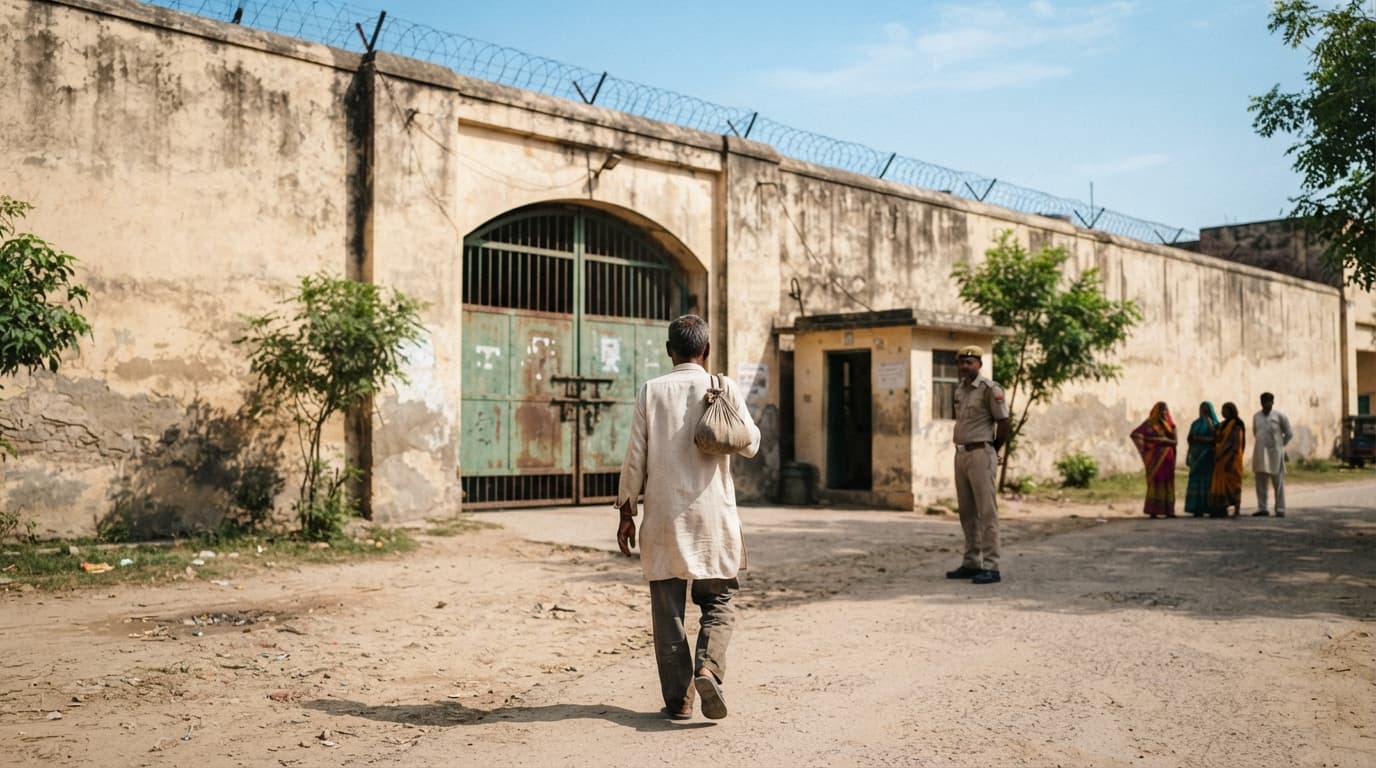
The Supreme Court has ordered Uttar Pradesh to pay Rs 6 lakh as compensation after wrongful imprisonment to a man who spent six years in jail as an undertrial before acquittal. The Court tied the custody directly to lapses in police work and said the Uttar Pradesh Police needed education in investigation.
He had remained behind bars for six years while the trial went on. He was then cleared of the charges. The Court said the investigation lacked the care and professionalism the law requires, and ordered monetary relief for loss of liberty, income and normal life in those years.
Six years behind bars without a finding of guilt separates a man from family and work. It brings social stigma and the daily rigour of jail. The Court answered that delay and failure with compensation, along with criticism of the investigation.
Court backs compensation after wrongful imprisonment
Indian law starts from the rule that personal liberty under Article 21 of the Constitution cannot be taken away except by a just, fair and reasonable procedure. Arrest, remand and continued detention must rest on legal grounds and proper material. Where a man is held for years and then acquitted, courts have asked whether the procedure was fair, whether the arrest was justified, and whether the investigation was honest and competent.
Compensation in such cases is paid by the State for breach of the fundamental right to life and personal liberty. It is not a sentence against individual officers. The Supreme Court developed this remedy in the 1980s and 1990s in cases of illegal detention, custodial violence and failure to protect life. In Rudul Sah v. State of Bihar, it ordered compensation for a man kept in jail for years after acquittal. In Nilabati Behera v. State of Orissa, it said monetary relief for violation of Article 21 is available under writ jurisdiction, distinct from a private suit for damages.
Later orders have taken the same path. Courts have granted relief where custody was without authority, where remand was mechanical, or where the State admitted delay and error. Amounts turn on the facts. Length of detention, age and family circumstances, loss of earnings and the nature of the violation all count. A sum of Rs 6 lakh for six years acknowledges each year lost, without pretending that money restores that time.
Defence lawyers and civil liberties groups have long said acquittal alone is not enough after long custody. An acquittal clears the criminal record. It does not bring back lost wages, repair broken family ties or remove the tag of jail. They describe compensation as the only practical remedy once the years have passed. This order follows that reasoning.
Payment does not follow every acquittal. Trial courts acquit for many reasons, including benefit of doubt where witnesses turn hostile or evidence falls short at trial. Courts granting compensation usually look for something more — illegal arrest, detention without legal basis, a wholly deficient investigation, or custody far beyond what the facts warranted. Here the comment on the need for education in investigation showed the Court viewed the police work as below the expected standard.
Six years lost to trial custody
Long undertrial detention has been a persistent concern in India. Prison figures placed before courts and Parliament have repeatedly shown a large share of prisoners held as undertrials, many for long periods. Some face charges that would carry sentences shorter than the time already spent in custody. Others stay in jail because bail is refused, hearings are adjourned, witnesses do not appear, or the charge sheet and trial take years.
Parliament addressed part of the problem through Section 436A of the Code of Criminal Procedure, 1973, which provided for release of undertrial prisoners who had undergone a specified portion of the maximum sentence. The provision has now been carried forward in substance in the Bharatiya Nagarik Suraksha Sanhita, 2023. The Supreme Court and High Courts have also issued directions for review of undertrial cases, speedier trials and bail where delay is excessive.
Legal aid lawyers say practical difficulties remain. Bail applications move slowly. Poor families struggle to arrange sureties. Trial courts with heavy dockets cannot give early dates. Where police investigation is weak, the charge sheet may still lead to committal and framing of charges, and the defects may surface only in cross-examination years later. By then the accused has spent a large part of his life in custody.
An acquittal after six years thus carries two harms. The detention itself. And the delay in the finding that it would not end in conviction. The order of Rs 6 lakh goes beyond recording the acquittal and grants relief for the period already undergone.
Police told to improve investigations
The remark about education in investigation goes beyond this case. Investigation is the foundation of a criminal trial. Under criminal procedure law, police officers must record information, visit the scene, collect material, examine witnesses, maintain case diaries and file a report on completion of investigation. Supervisory officers are expected to check the work before a charge sheet goes to a magistrate.
Careless investigation travels through the whole case. An incomplete site inspection can lose physical evidence. Delay in recording statements allows discrepancies to creep in. Failure to verify alibis, call records or medical evidence leaves gaps the defence will expose at trial. Failure to follow arrest guidelines can itself make custody unlawful. Trial courts cannot convict on suspicion, and a weak charge sheet often ends in acquittal after years of waiting.
The Supreme Court and High Courts have laid down safeguards for arrest and investigation in earlier orders. The guidelines in D.K. Basu v. State of West Bengal on arrest and custody, and the directions in Arnesh Kumar v. State of Bihar on restraint in arrests for offences punishable up to seven years, form part of police training. State police manuals also set out procedures for scientific evidence, identification and supervision. The comment in this case suggests that training had not translated into practice here.
Whether the observation will lead to departmental action is not clear from the material available about the order. In similar cases courts have sometimes sought compliance on record, identification of officers responsible or steps for training. At other times they have confined themselves to compensation and left discipline to the State government. What is plain is that the Court treated quality of investigation as central to protection of liberty, not as a technical matter.
Uttar Pradesh must pay Rs 6 lakh
The immediate effect is that the State of Uttar Pradesh must pay Rs 6 lakh to the acquitted man. The order is directed at relief to the person who suffered custody. Payment by the State does not bar internal action under service rules. For the recipient, the sum gives some financial support after years without earning. The acquittal restores his legal status as not guilty.
For trial courts and prison authorities, such cases renew attention on bail and speedy trial. Magistrates considering remand must apply their mind to the need for continued custody, rather than extend it as routine. Sessions courts must manage evidence and hearing schedules to avoid needless adjournments. Legal services authorities are expected to identify long-term undertrials and provide counsel for bail and review.
For the police, a charge sheet that cannot survive trial has a human cost. Officers who arrest and seek custody must ensure material exists to justify that step. Supervisors who approve prosecution must check that investigation is complete and lawful. In this case, that check failed, and the State must now pay for the six years the man spent in jail.
Comments
Sign in to read the discussion and share your thoughts.
Latest from LawWorld
News
View all- Supreme Court Seeks Centre, ECI Reply On Plea Against Immunity For CEC And ECs4 Nov 2026
- Supreme Court Directs MP Speaker To Decide Bina MLA Disqualification Plea In Two Months4 Nov 2026
- Supreme Court Orders Special Cell To Monitor Child Labour Law Enforcement4 Nov 2026
- Bail Cannot Rest On Judge's Personal Notions Of Morality, Rules Supreme Court4 Nov 2026
- Supreme Court Refers Two-Child Norm Penalties To Larger Bench As Outdated4 Nov 2026