
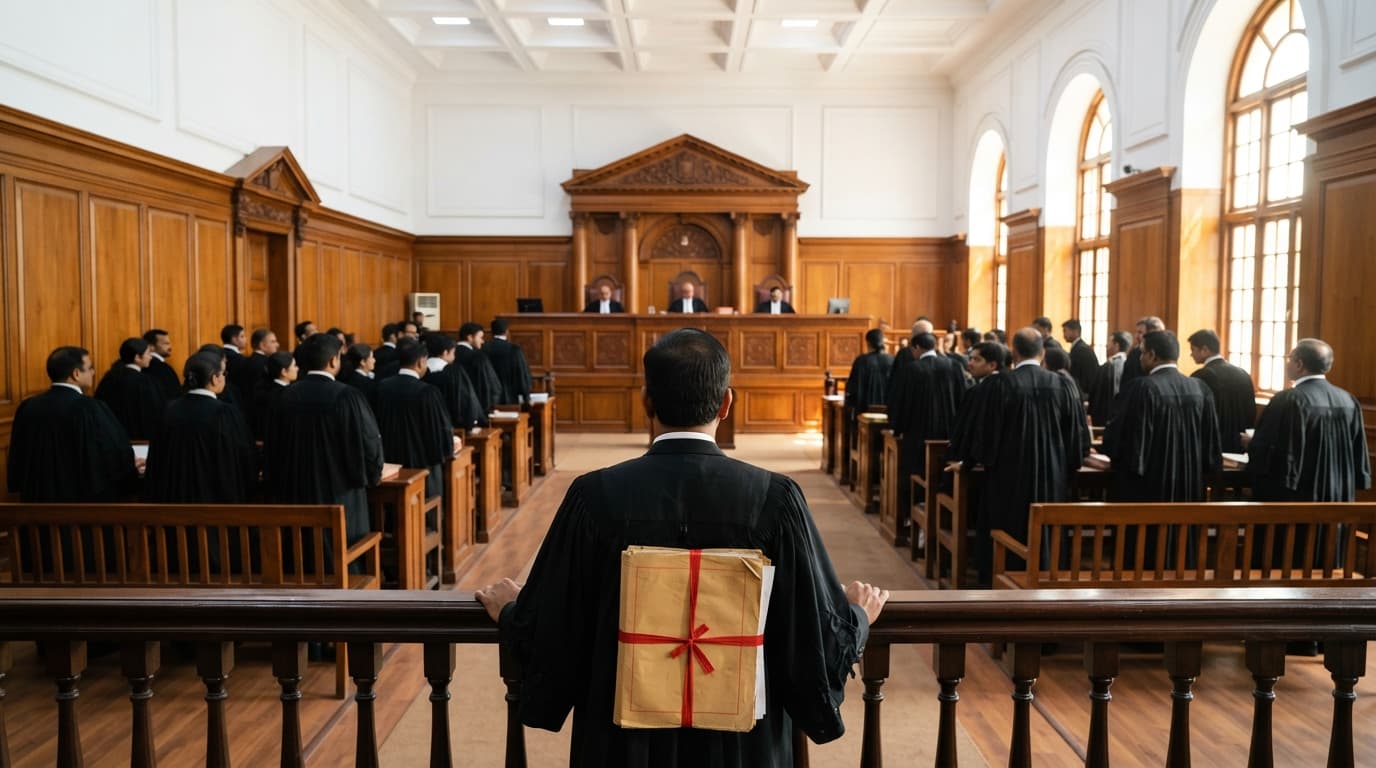
New Delhi: The Supreme Court has directed Member of Parliament Sanjay Raut to remain physically present before it on November 17 at 2 pm in contempt of court petitions linked to social media posts against Chief Justice of India Surya Kant.
Those petitions were filed by the Supreme Court Bar Association, which has asked for action over the posts. Journalist Nikhil Wagle was directed to join the proceedings on the same date and time through video conference.
No finding has been recorded on the merits. The Court has not said what view it takes of the contents. The replies of the respondents and the procedure the Court follows will become clear at the next hearing.
Raut told to appear in person
Raut must be in the courtroom himself on November 17. He was not given the option of a video link.
Wagle, by contrast, will join online. Courts in contempt matters often insist on the presence of the main respondent while permitting others connected with the case to appear virtually.
Presence serves a practical reason. The person facing the allegation has to be available to answer questions, confirm identity and hear the allegation put directly.
An order to appear does not decide guilt. Raut retains the full opportunity to file a reply, explain the context of the statements and engage counsel.
No coercive step has been taken. If a respondent fails to appear on the fixed date, the law permits a fresh direction, a bailable warrant or other coercive steps. So far the Court has fixed only the date, time and mode of appearance.
Contempt of court: what happens next
Under the Constitution, the Supreme Court is a court of record with power to punish for contempt of itself. Article 129 confers that power. Parliament has laid down the procedure in the Contempt of Courts Act, 1971. Searches for the statute sometimes use the phrase court of contempt act, though its formal title is the Contempt of Courts Act, 1971.
Section 2(c) of the Act defines criminal contempt to cover publication which scandalises the court, prejudices or interferes with judicial proceedings, or obstructs the administration of justice in other specified ways. Civil contempt concerns wilful disobedience of a judgment, decree, direction or undertaking given to a court. The present petitions, described as arising from remarks against the Chief Justice, fall in the area of criminal contempt.
A bar association petition follows a recognised route. Under Section 15, the Supreme Court can take cognizance of criminal contempt on its own motion or on a motion by the Attorney General, the Solicitor General or any other person with the written consent of the Attorney General or Solicitor General. Petitions by bar bodies are placed before the Court for it to consider whether to start formal proceedings.
If the Court decides to proceed, it issues notice and calls for a response. The alleged contemnor can file an affidavit explaining the facts. An unconditional apology, if offered, is considered by the Court, and acceptance lies in its discretion. Truth can be raised in limited circumstances where it is in public interest and made bona fide, subject to Section 13 of the Act.
Punishment on a finding of contempt can extend to simple imprisonment for six months or fine up to Rs 2,000 or both under Section 12. Courts have repeatedly said the power is to be used sparingly, to protect the administration of justice and public confidence in the system and not to shield individual judges from criticism.
Privilege stops at House doors
Members of Parliament have freedom of speech in Parliament under Article 105. No member is liable to proceedings in any court for anything said or any vote given in Parliament or its committees. Publication under the authority of either House is also protected.
The dispute here turns on how far parliamentary privilege travels. That protection is tied to work inside the House. Statements made outside, including interviews, press statements and posts on social media, do not carry the same immunity. Courts have treated outside speech by legislators like speech by any other citizen for contempt and defamation law, subject to the same tests.
That distinction matters because the allegation concerns social media posts. The petitions do not relate to anything said on the floor or to a vote cast in the House. A claim based on parliamentary privilege would have to explain why an outside publication should be treated as part of parliamentary proceedings. The Court has not ruled on that issue.
Fair and reasoned criticism of a judgment, its reasoning or its legal effect is permitted. The law draws a line where comment imputes improper motives, alleges bias without basis or seeks to lower the authority of the court in public eyes.
A post can be re-posted thousands of times within hours. Courts in recent years have taken note of the speed and scale of online circulation when deciding whether to take cognizance. In moving these petitions, the Supreme Court Bar Association appears to have asked the Court to examine the posts in that context.
Bar Association as petitioner
The Supreme Court Bar Association is the main body of advocates practising before the Supreme Court. It is not a party to the underlying disputes decided by the Court. It has in the past filed or supported petitions where it considers that comments or actions affect the dignity of the institution.
Such petitions are presented as being in defence of the system rather than of an individual judge. The Association typically states that unrestrained comment against a sitting Chief Justice affects public trust and the working of the Bar. The Court then decides independently whether the threshold for action is met.
Wagle's inclusion suggests the Court wants a complete picture before taking further steps. The order does not describe his role. It directs only the mode of his participation. Further clarity is likely when the matter is called out next.
For counsel, the immediate task is procedural. The respondents will need replies, records of the exact posts as published, with dates and context, and instructions on whether any explanation or apology is to be offered. Counsel for the petitioner will need to place the precise material relied upon before the Court.
The hearing on November 17 at 2 pm will show which course the case takes. The Court could hear the respondents, grant time for affidavits, frame specific charges if it decides to proceed, or pass other listing directions. Until then, Raut must arrange to be in Delhi that afternoon and Wagle must ensure virtual access for the same sitting.
Comments
Sign in to read the discussion and share your thoughts.
Latest from LawWorld
News
View all- Supreme Court Seeks Centre, ECI Reply On Plea Against Immunity For CEC And ECs4 Nov 2026
- Supreme Court Directs MP Speaker To Decide Bina MLA Disqualification Plea In Two Months4 Nov 2026
- Supreme Court Orders Special Cell To Monitor Child Labour Law Enforcement4 Nov 2026
- Bail Cannot Rest On Judge's Personal Notions Of Morality, Rules Supreme Court4 Nov 2026
- Supreme Court Refers Two-Child Norm Penalties To Larger Bench As Outdated4 Nov 2026