
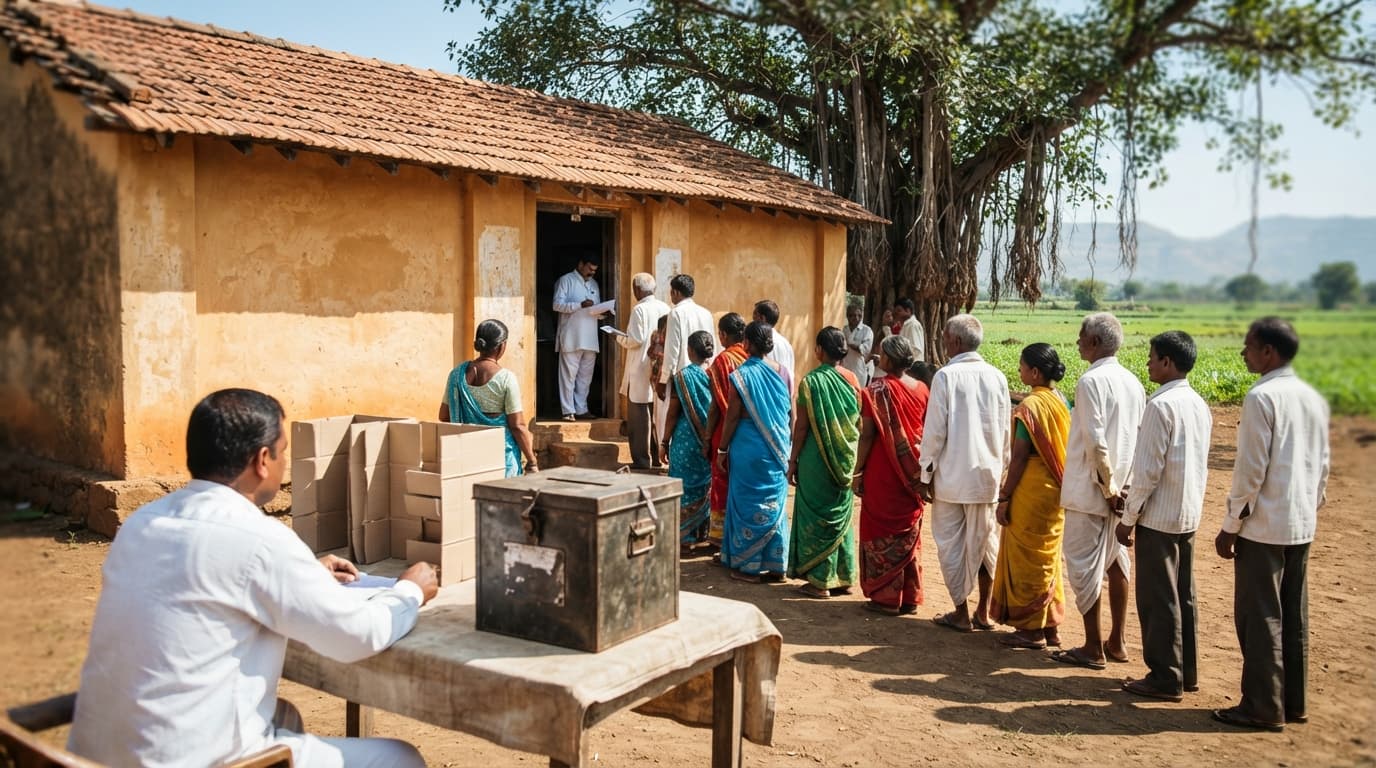
The Supreme Court has allowed local body elections for the remaining rural councils in Maharashtra to go ahead under the interim arrangement laid down by the court earlier, while the larger question of reservation of obc candidates remains pending for final decision. Led by Chief Justice Surya Kant, the Court said the poll process cannot be held back indefinitely till the quota question is settled. The direction covers the contests that are yet to be held in the State's three-tier panchayat system. The Court made it clear that the outcome of these polls will remain subject to its final ruling on reservation.
The position on the ground was placed before the bench during the hearing. Senior Advocate Indira Jaising informed the Court that polling had already been completed in 12 Zilla Parishads. She submitted that elections were still due for 20 Zilla Parishads and 211 Panchayat Samitis. The Court recorded that factual position and issued its direction for the balance seats. It did not disturb the polls already completed. Its order is confined to the councils where voting is still to take place.
Chief Justice Surya Kant observed that the democratic process cannot be kept waiting till every legal question is finally answered. The Court said elected bodies cannot be left without representation for long periods while litigation over quota continues. Vacancies in village, block and district councils affect day-to-day administration and delivery of schemes. The bench therefore took the view that voting must move forward under a workable interim formula. Final rights, it said, can be adjusted after the legal position is settled.
The Court clarified that the elections now permitted will be subject to the final determination of the case. In practical terms, this means the results, and the reservation applied in these polls, will have to fall in line with whatever the Court finally decides on the obc reservation percentage. Candidates contesting reserved or unreserved seats will do so with notice of that condition. The councils formed after counting will function, but their composition can be revisited if the final ruling so requires. Such conditional orders are often passed where polls and quota litigation overlap.
Polls for 20 ZPs to proceed
The direction brings continuity to a process that had already started in parts of the State. With 12 Zilla Parishads having completed polling, the Court did not consider it appropriate to halt the rest of the programme. Holding the remaining polls under the same interim arrangement avoids applying different rules to different districts in the same election cycle. For election officials, it provides a single set of instructions on seat allocation, rotation and reservation as earlier laid down. For voters and candidates, it removes uncertainty about whether the schedule will hold. The Court's approach keeps the focus on completion of the cycle rather than fresh disputes over procedure at this stage.
Zilla Parishads and Panchayat Samitis form two tiers of rural self-government in Maharashtra. Zilla Parishads function at the district level and take decisions on planning, development works, health, education and related subjects within their jurisdiction. Panchayat Samitis operate at the block level and link village panchayats with the district body. Membership of these bodies is filled through direct elections held on a ward or constituency basis. Reservation of seats for different categories, including Other Backward Classes, determines who can contest from which seat. Because delimitation, rotation and reservation directly shape the contest, any change in quota rules has an immediate bearing on candidates.
The dispute before the Court concerns how much reservation should be available in these local body elections. The question of quota in panchayats and municipalities has been litigated for several years across States, with courts examining both the extent of reservation and the data supporting it. While the legal tests continue to be argued, the day-to-day need for elected councils remains. Without elected members, decisions shift to administrators and long-term planning suffers. The Supreme Court's order seeks to balance these two concerns. It lets voting proceed so that councils can be formed and work can resume, without closing the legal debate on the correct quota figure.
Interim order on reservation of obc
An interim arrangement in such matters is a temporary working solution. It allows authorities to act on the basis of the court's provisional directions till the final judgment is delivered. It does not decide the underlying issue. Parties act under it with the understanding that adjustments may follow. In election litigation, courts often adopt this method to avoid a complete halt. The alternative would be to keep seats vacant for months or years while evidence is examined and arguments are concluded. By directing that the remaining Zilla Parishads and Panchayat Samitis go to polls under its earlier interim arrangement, the Court has chosen administrative continuity over a freeze.
For candidates, the 'subject to outcome' condition is the central feature of the order. A person elected from a seat reserved under the interim formula will hold office and exercise full powers, but the legal basis of that reservation remains open to review. If the Court finally fixes a different obc reservation percentage or lays down a different method for applying it, the State Election machinery will have to give effect to that ruling in the manner directed by the Court. This could affect tenure, rotation or future reservation of seats. Contestants were therefore put on notice that participation now does not create a vested right against the final decision.
The bench's observation that democracy cannot be stalled reflects a consistent approach in local poll cases. Courts have repeatedly said that prolonged supersession or administration by officials is not a substitute for elected representation. Development funds, approval of works, monitoring of schools and health centres, and grievance redress in rural areas all move through elected councils. When polls are delayed, these functions slow down. Allowing the remaining 20 Zilla Parishads and 211 Panchayat Samitis to complete voting enables the councils to be constituted across the State on a comparable timeline. It also avoids staggered tenures that complicate planning and budgeting.
What remains now is the final hearing on reservation. The Court will decide the percentage to be reserved for Other Backward Classes and the legal basis for that figure. Till then, the State election authorities will proceed with notifications, nominations, polling and counting for the seats still pending under the interim formula already in force. Results already declared for 12 Zilla Parishads will stand as they are for the present, subject to the same final ruling. Once the Court delivers its decision on the quota question, the State will have to align future seat reservation and, if directed, take consequential steps for the bodies formed in the interim.
Comments
Sign in to read the discussion and share your thoughts.
Latest from LawWorld
News
View all- Supreme Court Seeks Centre, ECI Reply On Plea Against Immunity For CEC And ECs4 Nov 2026
- Supreme Court Directs MP Speaker To Decide Bina MLA Disqualification Plea In Two Months4 Nov 2026
- Supreme Court Orders Special Cell To Monitor Child Labour Law Enforcement4 Nov 2026
- Bail Cannot Rest On Judge's Personal Notions Of Morality, Rules Supreme Court4 Nov 2026
- Supreme Court Refers Two-Child Norm Penalties To Larger Bench As Outdated4 Nov 2026