
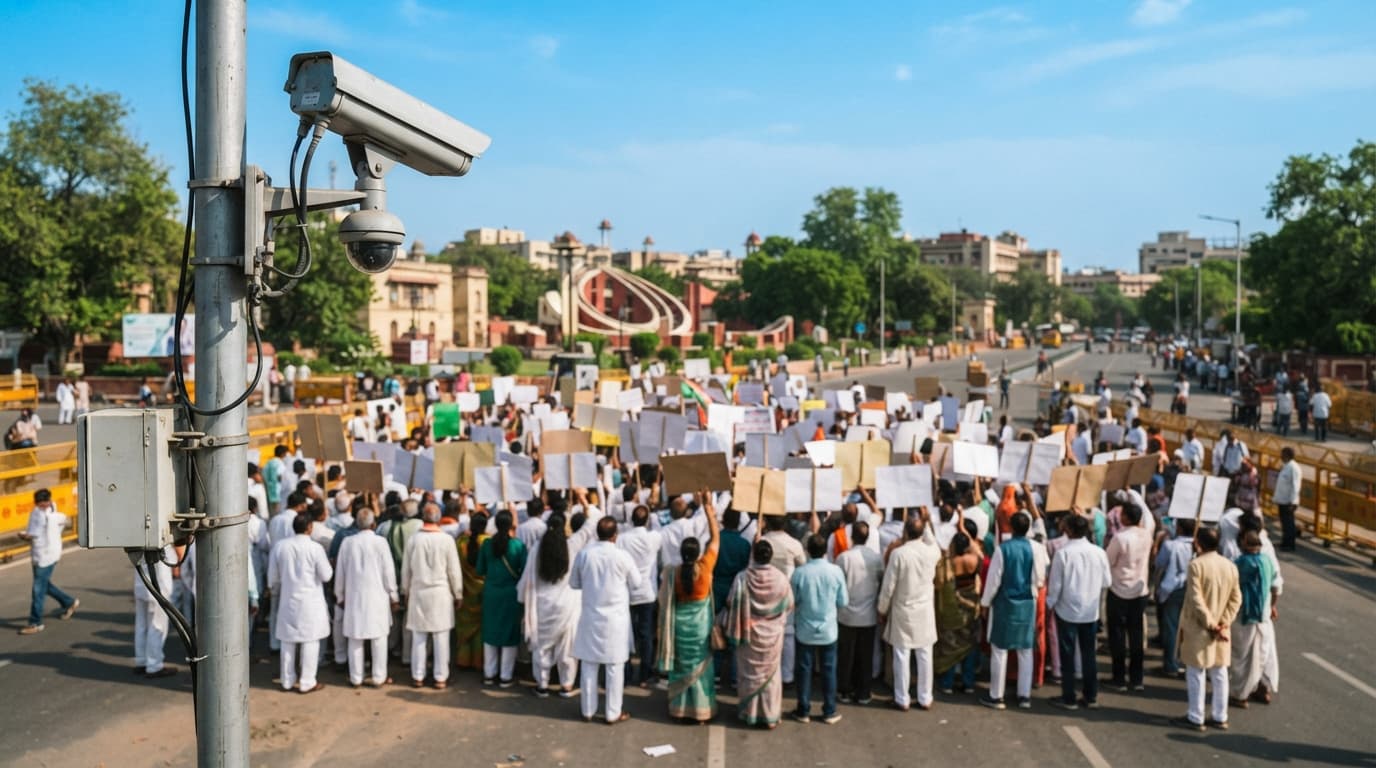
The Supreme Court on November 3 issued notice on a writ petition challenging the deployment of facial recognition and surveillance systems by law enforcement agencies at designated protest venues. A Bench of Chief Justice Surya Kant, Justice Joymalya Bagchi and Justice V. Mohana directed the respondents to file replies and said the plea would be heard with the connected writ petitions arising from recent protest demonstrations in Delhi. The order came after brief submissions on privacy, public assembly and policing powers.
For the petitioner, Advocate Prashant Bhushan told the Court that blanket camera-based identification at protest sites infringed privacy without a clear law to support it. He said the police had not disclosed what technology was in use, what data was collected and stored, how long it was retained, who could access it, and under what statutory authority the exercise was carried out. He sought directions for full disclosure of the technical nature of the systems and the governing legal framework, with safeguards against misuse.
Solicitor General Tushar Mehta, appearing for the Central Government, opposed the petition. He did not accept that the use of cameras and identification tools at a notified protest location called for judicial intervention at this stage. The Court recorded no finding on the merits of either position and confined itself to issuing notice, which means the Union and other respondents will now have to place their stand on affidavit.
Justice Joymalya Bagchi asked counsel to address what expectation of privacy remains for a person who voluntarily joins a public assembly. He referred to the open character of a protest held at a site set apart by the administration for that purpose and meant to attract attention. The Bench said the argument that recording faces in such a setting violates the right to privacy would need fuller argument and left the issue open.
Questions over facial recognition at protest venues
As described in court, the petition draws a line between general policing of a public gathering and systematic use of automated face matching. The petitioner contended that a police officer watching a crowd is different from a system that captures images, converts them into templates, compares them with databases and stores the results for later search. The first is limited by human memory and presence. The second creates a permanent record that can be reused, shared and analysed long after the protest has ended.
On disclosure, the plea wants the authorities to state whether live cameras are linked to a database, whether footage from protest venues is run through such software after the event, and whether persons identified in this manner are flagged in police records. It also seeks details of data protection measures, including purpose limitation, access controls, audit trails and deletion schedules. Without that information, the petitioner argued, neither protesters nor the Court can judge whether the practice is proportionate.
The government, through the Solicitor General, resisted that framing. Its position appears to be that security arrangements at sensitive locations in the capital cannot be equated with targeted surveillance of citizens for their views. The Court will have to decide how much detail the State must disclose in open proceedings when policing methods are involved, and whether any claim of confidentiality can stand without showing the law that permits the measure.
Court tags plea with Delhi protest cases
The Bench directed that the surveillance challenge be heard together with the batch of petitions arising from recent demonstrations in Delhi against Chief Election Commissioner Gyanesh Kumar. That batch, heard as MA Baby v. Union of India and connected matters in Writ Petition (Civil) No. 1333 of 2026, covers a wider dispute over how protests in the capital are regulated, policed and accommodated during a crowded public calendar.
That wider dispute includes petitions alleging mass detentions, police excesses and the imposition of prohibitory orders under Section 163 and Section 172 of the Bharatiya Nagarik Suraksha Sanhita. It also includes pleas from merchant associations who told the Court that prolonged gatherings near markets had caused commercial losses estimated at over 200 to 250 crores. Senior Advocates Indira Jaising and Mukul Rohatgi appeared for parties in that batch, in addition to Bhushan and the Solicitor General, reflecting the range of interests before the Court.
On the same day, the Bench orally observed that the constitutional right to protest does not entitle any organisation or group to occupy a designated protest site indefinitely. The Court said notified sites must be allotted for identified periods so that farmers, workers, trade unions and other groups can each use them in turn. It issued notice on an application by traders seeking restrictions on protests during the festive season but declined to pass an interim order without hearing the protest organisers. It also directed the impleadment of organisers and divided the matters into nine distinct categories for structured hearings.
In effect, the tagging order places the camera surveillance plea in that larger setting. Questions about cameras and identification will not be heard in isolation. They will be heard alongside questions about detention, permissions, time slots at designated venues, and the balance between protest rights and the rights of shopkeepers, commuters and residents. The approach of the Court suggests it wants a complete picture of how a protest site is managed, from allotment to dispersal, before ruling on any single element.
No interim order, replies sought
No interim restraint has been placed on the use of surveillance equipment for now. The existing arrangements remain in place while pleadings are completed. The order gives the police and the Union an opportunity to explain the legal basis for deployment, the standard operating procedure followed at venues such as Jantar Mantar and other notified locations, and the checks that exist against retention or sharing of data.
Much will turn on what the reply contains. It will show whether the government points to a specific statute, rule or notification that authorises face matching at protest sites, or relies on general powers for maintenance of public order and prevention of crime. It will also show whether a line is drawn between crowd management cameras, which stream video for control rooms, and identification systems, which match faces against stored images, and whether enforceable limits on storage, access and deletion are offered that a court can monitor.
The petitioner will then have to show why those limits, if offered, fall short of constitutional requirements. The exchange between the Bench and Bhushan indicates that the Court will press the petitioner on the public character of a demonstration. A person who shouts slogans in a public place expects to be seen and heard. The petitioner will need to explain why automated recognition alters that position, and whether consent, notice boards or an opt-out can ever work at a crowded venue.
Counters are to be filed by the respondents, after which the Bench will fix the matter for detailed hearing along with the nine categories of Delhi protest matters. Until then, protest organisers, traders and police will continue to operate under the present system of designated sites, time-bound permissions and prohibitory orders where issued.
Comments
Sign in to read the discussion and share your thoughts.
Latest from LawWorld
News
View all- Supreme Court Seeks Centre, ECI Reply On Plea Against Immunity For CEC And ECs4 Nov 2026
- Supreme Court Directs MP Speaker To Decide Bina MLA Disqualification Plea In Two Months4 Nov 2026
- Supreme Court Orders Special Cell To Monitor Child Labour Law Enforcement4 Nov 2026
- Bail Cannot Rest On Judge's Personal Notions Of Morality, Rules Supreme Court4 Nov 2026
- Supreme Court Refers Two-Child Norm Penalties To Larger Bench As Outdated4 Nov 2026