
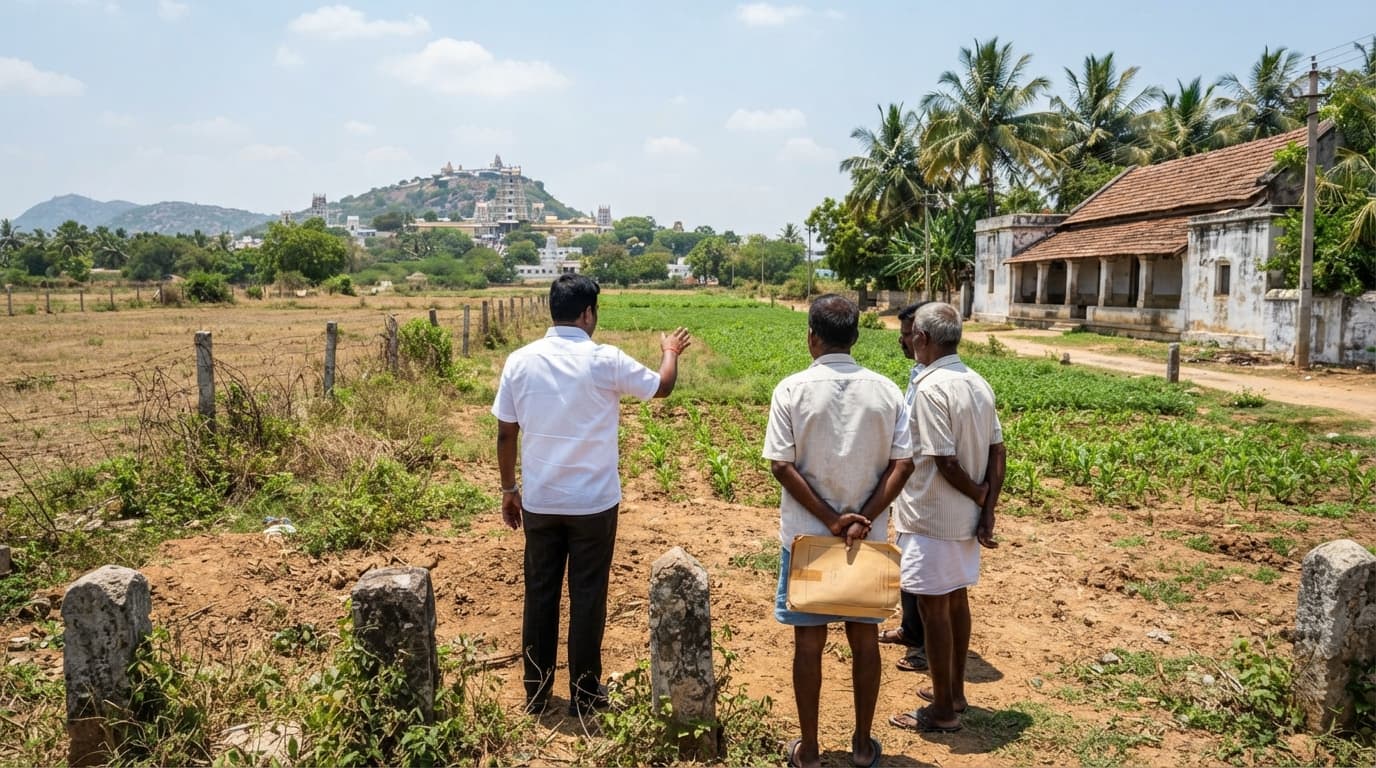
The Supreme Court on Monday, November 2, 2026, issued notice to the State of Tamil Nadu on a bail plea filed by K. Vellathurai, an accused in the alleged fraudulent registration and illegal sale of 1.40 acres of land belonging to Dhandapani Swamy Math in Palani, who has described himself before the court as a bona fide purchaser. A Bench headed by Justice B. V. Nagarathna called for the State's response on Vellathurai's challenge to the Madurai Bench of the Madras High Court's August 31, 2026 order dismissing his plea for bail. The Bench also issued notice to Vellathurai on an intervention plea filed by the State.
No relief was granted on Monday. The notice is a direction to the other side to put its case on record before the court decides the bail question. Tamil Nadu will now have to set out the stage of investigation, the material collected so far, the specific role attributed to Vellathurai, and why it says custody must continue. The petitioner’s case will be weighed alongside that reply after pleadings are complete. Until a further order, the High Court’s order of August 31, 2026 continues to hold the field.
Vellathurai has come to the Supreme Court as petitioner against the High Court’s refusal. After the trial court, the High Court is the forum that decides regular bail with detailed reasons on the facts presented, the criminal record, if any, the gravity of the charge, and the need for custodial interrogation or protection of witnesses and records. His challenge asks the apex court to test whether that discretion was exercised on the right considerations and whether continued custody is justified. The papers before the court will include the order under challenge, the case diary or investigation files, and the defence case on roots in the community, cooperation, and conditions to secure presence at trial.
A second notice went to Vellathurai on the State’s intervention plea. Such a plea is filed by a party that wants to be heard in addition to the main contest, or to place further facts and objections on record. Here Tamil Nadu is already the respondent to the bail petition and must answer the challenge to the High Court order. The extra plea shows the State also wants its own request or objections recorded on the same subject. Notice means Vellathurai will get a chance to reply. What the intervention plea contains was not spelt out in Monday’s order.
Bona fide purchaser claim to be examined
Vellathurai’s description of himself as a bona fide purchaser is the centre of his case for release. His argument is familiar in property cases with fraud alleged: he paid value, knew nothing of any defect in title, and had no criminal intent. Any question of title, he says, belongs in a civil court. He entered only as buyer, he says, and took no part in forgery, impersonation or unauthorised sale. Bail, he has asked, should follow while ownership and validity of the documents are decided by the competent forum.
The prosecution will test that account against the paper chain leading to the purchase. Who stood recorded as owner on the date of sale. Who signed the deed. Whether the seller had authority to convey. What consideration is shown to have passed. What inquiries the buyer made and what documents he relied on. Whether registration was secured on records later found false or manipulated. A bare claim of purchase counts for little by itself. In this case the State will be expected to place before the Supreme Court its version of Vellathurai’s role and the material linking him to the alleged illegal sale.
Bail in records cases often turns on custody already undergone and what is still to be recovered. The court will ask if Vellathurai was available for questioning and if any original record remains to be seized. Where land of a religious or charitable institution is involved, the court looks closely at whether public records were misused and whether the deal could have gone through without people who knew sale was barred. The defence points the other way — length in custody, nothing recovered from the petitioner, willingness to surrender his passport, report regularly, and not to alienate the disputed land.
Fraud allegation centres on 1.40 acres
The prosecution case concerns 1.40 acres said to belong to Dhandapani Swamy Math in Palani. The charge is illegal sale through fraudulent registration. Registration creates a public record of transfer. It does not confer title if the transaction is void or vitiated by fraud. Investigators in such cases compare revenue entries, settlement records, title deeds and the registers of the registering authority to see how institutional land came to stand in private names. They also examine whether officials or private persons helped false recitals go on record.
Math and temple lands have repeatedly come to court in Tamil Nadu. The endowments are old, the extents large, the historical records incomplete. Fights turn on whether a survey number formed part of the endowment, whether anyone held occupancy or leasehold rights, and whether a later sale deed could pass any valid interest. Fraudulent registration, as alleged here, means documents were created or used to show a lawful transfer where none was allowed. The defence answer is that the buyer acted on a registered deed and entries that looked regular at the time, and that any earlier irregularity was not of his making.
The extent here is defined — 1.40 acres. The legal questions do not turn on size alone. Even a small parcel raises title, authority to sell, and the value of registration if the land is claimed to be institutional property that could not be sold privately. The investigation will dwell less on market value and more on the paper trail. For bail, the court will not decide title. It will ask whether the accusation shows a prima facie link between the petitioner and the alleged fraud, and whether his liberty must be curtailed to protect the investigation or secure the trial.
Bail plea follows High Court refusal
The Madurai Bench of the Madras High Court dismissed Vellathurai’s bail plea on August 31, 2026. The Madurai Bench covers the southern districts and regularly hears bail petitions in property and fraud prosecutions. Its refusal means that, on the material placed before it at that stage, it did not find the petitioner entitled to release. Those reasons will matter before the Supreme Court, which will assess whether they call for interference. The order was not discussed in detail during Monday’s brief hearing in New Delhi.
A challenge to refusal of bail is not a regular appeal on facts. The Supreme Court asks whether discretion rested on relevant factors — nature of the accusation, punishment on conviction, risk of flight, chance of tampering with evidence or influencing witnesses, and time already spent inside. Past conduct, cooperation with the investigating officer, and whether a charge sheet has been filed or charges framed also count. The petitioner must show why the High Court’s view needs a second look. The State must explain why detention is still needed.
In document cases much depends on whether custodial questioning has served its purpose. If papers are seized and the statements of registering and revenue officials recorded, the defence says custody has run its course. The prosecution may cite absconding co-accused, originals still missing, or the risk of fresh encumbrances on the disputed land. Those rival claims will be taken up after the State files its reply to Monday’s notice.
Tamil Nadu will now file its objections with the relevant investigation record. Vellathurai can file a rejoinder and reply to the State’s intervention plea. The Bench headed by Justice B. V. Nagarathna will then take up the petition for interim relief or disposal of the bail question. No date for the next hearing and no direction on custody figured in the information available on Monday’s order. The petitioner remains under the High Court’s dismissal order until the Supreme Court hears both sides and passes a further order.
Comments
Sign in to read the discussion and share your thoughts.
Latest from LawWorld
News
View all- Supreme Court Seeks Centre, ECI Reply On Plea Against Immunity For CEC And ECs4 Nov 2026
- Supreme Court Directs MP Speaker To Decide Bina MLA Disqualification Plea In Two Months4 Nov 2026
- Supreme Court Orders Special Cell To Monitor Child Labour Law Enforcement4 Nov 2026
- Bail Cannot Rest On Judge's Personal Notions Of Morality, Rules Supreme Court4 Nov 2026
- Supreme Court Refers Two-Child Norm Penalties To Larger Bench As Outdated4 Nov 2026