
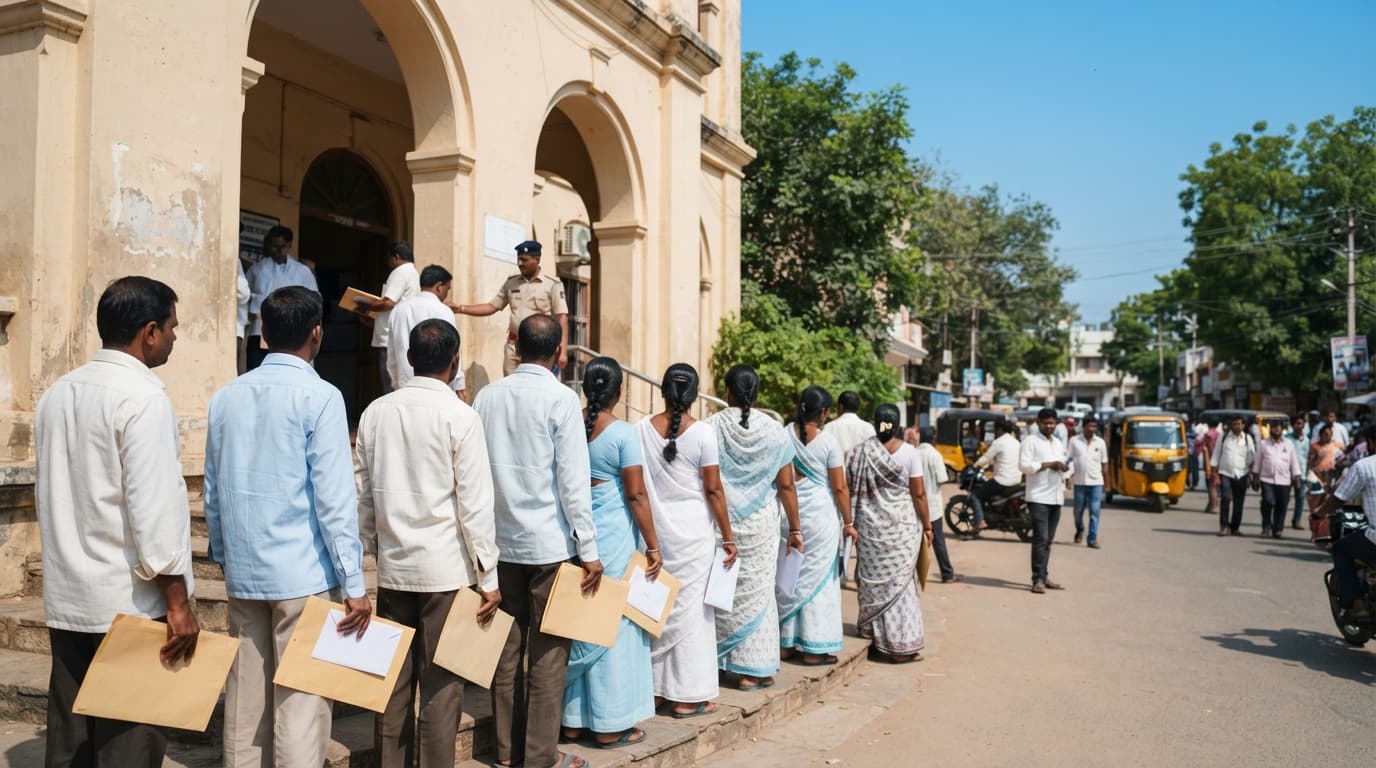
New Delhi, October 27, 2026: The Supreme Court on Monday asked the Andhra Pradesh State Election Commission to defer publication of the final list of candidates after the Yuvajana Sramika Rythu Congress Party said its candidates were stopped from filing nominations for the 2026 municipal elections in India. A Division Bench of Justices Joymalya Bagchi and V. Mohana said the usual rule against interference during polls does not bar action where coercion is alleged. Free and fair elections, the Bench said, are part of the basic structure.
The Yuvajana Sramika Rythu Congress Party approached the Court as the principal opposition in Andhra Pradesh. It alleged obstruction at the nomination stage and sought protection before the process moved to finalisation of candidatures and polling. The Bench took up the special leave petition on October 27, 2026 for interim relief. It did not decide the merits of individual allegations at this stage.
Restraint during elections, the order said, is a rule of caution and not an absolute bar. Courts ordinarily do not halt or reorder steps once an election has been notified. That approach, the Bench said, cannot prevent scrutiny where the complaint concerns force, intimidation or organised prevention of candidates from filing papers. In such a situation inaction would itself affect fairness.
Bench rejects hands-off argument
Against mid-election intervention stands a familiar rule in election law. Once the machinery has started, challenges to specific steps should generally wait for an election petition after the result. The idea is to avoid delay and disorder in a time-bound process. Counsel who favour that view would say any interim order risks upsetting the schedule fixed by the election authority.
The Bench did not accept that view as decisive here. It drew a line between disputes over acceptance or rejection of individual papers on technical grounds and complaints of a different kind. The first involves scrutiny by returning officers, objections by rivals and questions of eligibility. The second involves claims that candidates were physically stopped, threatened or otherwise coerced from reaching nomination centres. The Court said the second category hits equal opportunity to contest. No final finding was recorded on who was responsible for any incident.
In court, lawyers dwelt on what nomination-stage obstruction does in practice. An election can look regular on paper while choice shrinks on the ground. If candidates of a recognised party cannot file papers, voters lose options. Uncontested returns rise. The campaign loses substance. Access to nomination centres, the Bench said, is part of free contest and not a mere administrative detail.
Why municipal elections in India face court scrutiny
Urban local bodies in Andhra Pradesh go to polls under the superintendence of the State Election Commission. The Commission notifies the programme, fixes dates for filing and scrutiny, decides on symbols and polling arrangements, and publishes lists of contesting candidates. Returning officers and district machinery do the ground-level work. Police provide security at filing centres, strong rooms and polling stations.
Readers tracking the case often search municipal elections are held every how many years in India to place the dispute in the normal poll cycle. Under Article 243U of the Constitution, inserted by the 74th Amendment, every municipality is to continue for five years from the date of its first meeting unless dissolved sooner, and elections to constitute a new body are to be completed before expiry of that term. The five-year rhythm explains why nomination disputes carry weight. A denial at the filing stage is not easily cured later, because the elected body will hold office for a full term.
The Court left conduct of the elections with the Commission. It did not take over the process. It asked the constitutional authority for that task to pause one step, look at complaints, create space for filings that may have been blocked, and tighten protection at centres. Responsibility stays with the Commission, with verifiable action inside the election timetable.
Its intervention was interim. The order records a prima facie view that the allegations, if true, would call for corrective steps. It does not decide whether any particular candidate was obstructed, whether any officer failed in duty, or whether any rival group was involved. Those questions will turn on representations, records from returning officers, police reports and any inquiry the Commission holds.
What the interim directions require
Publication of the final list was put off until October 25, 2026. The deferral was meant to stop the process from becoming irreversible before complaints could be examined. The final list normally closes the door on new entries and defines the contest. By pausing that step, the Court kept room for correction.
Next, the Commission was directed to consider representations. Affected candidates and the petitioner party will place specific complaints before the authority, with ward, nomination centre, date and nature of obstruction. General claims will carry less weight than precise accounts backed by acknowledgements, video material, police complaints or witness statements. The Commission will need to separate tenable cases from vague or delayed claims.
Affected candidates are then to get a chance to file nominations under supervision. This is the operative relief. It means identifying genuine cases where filing was frustrated and allowing the process to be completed. The order does not say every late filing must be accepted without check. Eligibility, proposer requirements, deposit and affidavit disclosures will still apply. The point is to remove force or fear, not to waive legal conditions.
Security at nomination centres must be strengthened. The Court expected visible deployment, control of entry, prevention of crowding by unauthorised persons, and safe passage for candidates and proposers. In practice this will involve district collectors, superintendents of police and returning officers. Centres where complaints arose may need extra personnel, videography and a complaint desk. The record of steps on security is likely to be placed before the Court at the next hearing.
Basic structure and free polls
For lawyers, the Bench's use of the basic structure will invite close reading. To recall what is basic structure doctrine as developed by the court, Parliament's power to amend does not extend to altering essential features of the Constitution. Free and fair elections have been treated in that line as one such feature, because democratic choice gives legitimacy to the rest of the scheme. The order used that principle to explain why access to contest matters.
Discussion of the doctrine of basic structure here does not lay down new election law. It gives the reason for acting now rather than leaving parties to a post-poll remedy. If the field for filing is narrowed by coercion, an election petition later may come too late for voters who faced a reduced choice. Interim protection, the Bench indicated, fits the constitutional function of elections.
The reference to the basic structure doctrine of Indian Constitution will also be read with the limits the Bench kept. It did not stay the elections. It did not order repoll or cancel any step already completed. It did not direct registration of criminal cases or transfer of officials. Those executive decisions were left to the Commission and the State administration, subject to review.
For the Commission, the immediate job is administrative. It will need to issue a revised note on the date for the final list, invite and register representations inside a clear window, fix supervised filing slots where warranted, and publish centre-wise security arrangements. For candidates who say they were blocked, the job is to file precise complaints with supporting material and to appear at the time and place fixed for filing. For district officials, the job is to keep order at centres and keep contemporaneous records of filings, refusals and incidents.
At the next hearing the Court is expected to ask what representations came in, how many showed genuine obstruction, how many extra nominations were filed and accepted after the order, and what added security was put in place. If the Commission shows a transparent process with reasons for each decision, the programme can proceed with greater confidence. If gaps remain, the Court can consider further directions. The final list, once published after this exercise, will define the contest that goes to the voters.
Comments
Sign in to read the discussion and share your thoughts.
Latest from LawWorld
News
View all- Supreme Court Seeks Centre, ECI Reply On Plea Against Immunity For CEC And ECs4 Nov 2026
- Supreme Court Directs MP Speaker To Decide Bina MLA Disqualification Plea In Two Months4 Nov 2026
- Supreme Court Orders Special Cell To Monitor Child Labour Law Enforcement4 Nov 2026
- Bail Cannot Rest On Judge's Personal Notions Of Morality, Rules Supreme Court4 Nov 2026
- Supreme Court Refers Two-Child Norm Penalties To Larger Bench As Outdated4 Nov 2026