
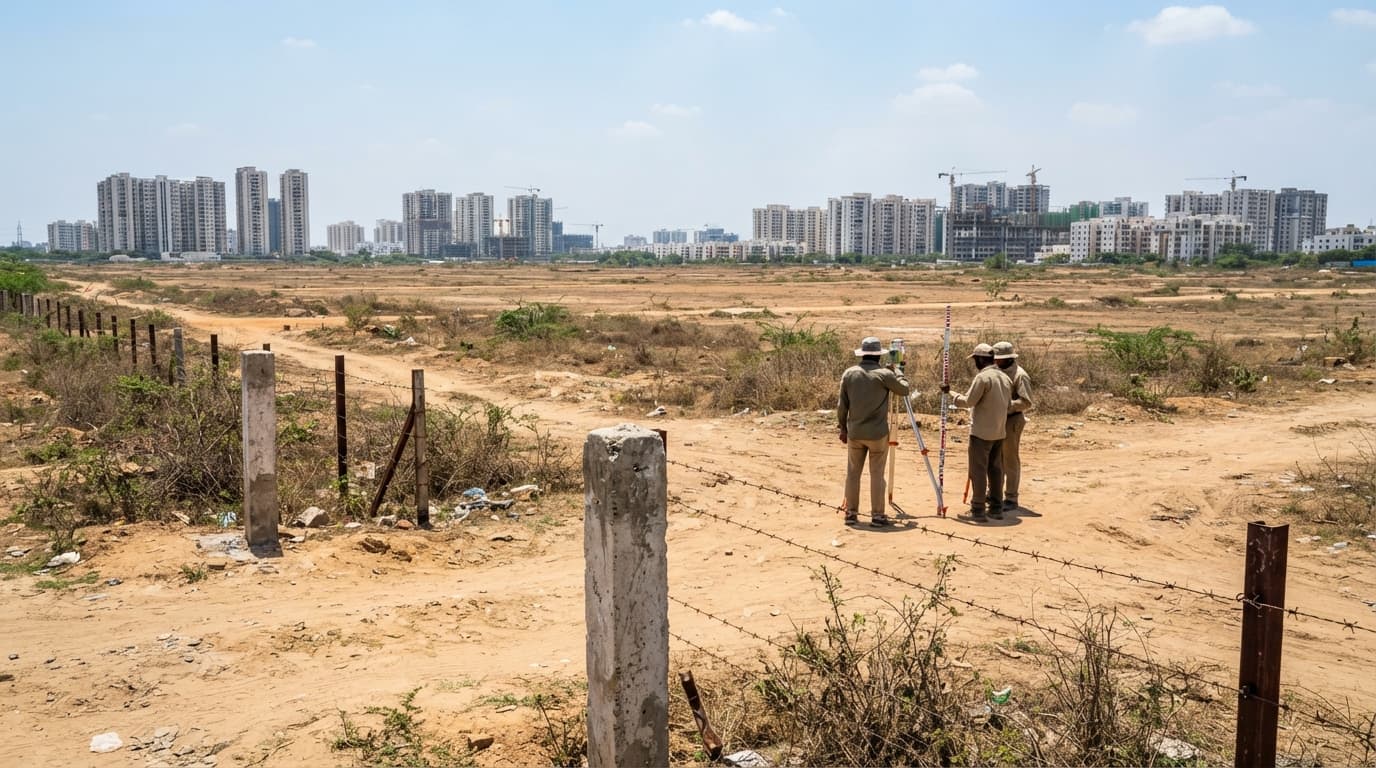
The Supreme Court has rejected private claims to about 550 acres at Miyapur in Telangana and declared the State government the rightful owner. It ruled that a jagir grant cannot be misconstrued as title and that this land title dispute closed in 1949, when jagirs were abolished and the lands vested in the State. A jagirdar is not a title-holder, the Court said, and a historic revenue grant cannot be turned into ownership of high-value urban land today.
No private title on jagir origin survived that vesting, the judgment said. The Court affirmed the declaration in favour of the government and refused to accept that long possession claimed through descendants, assignees or purchasers tracing back to a jagirdar could revive a right the law had extinguished. Abolition was a complete break. Any right claimed after it had to come from the statute and from a settlement made under it, not from the old grant.
Vesting in 1949 meant the intermediaries lost their revenue-collecting and administrative role and the lands comprised in jagirs came to the State. A former jagirdar could keep or receive only what the abolition law allowed, after scrutiny of claims, enquiry and grant of occupancy or patta rights where eligible. The rest became State land to be administered, protected and allotted under law. The Court applied that test to Miyapur and found no lawful survival of private title over the 550 acres.
Roots of the land title dispute in Miyapur
Miyapur now sits in a dense urban belt where every acre carries large commercial and residential value. That value explains why a pre-abolition claim persisted through decades of litigation, sale agreements, development claims and revenue paper. Advances changed hands, files were assembled, and old entries were produced as proof of ownership before authorities, banks and trial courts. The judgment cuts through that record. It says the first question is not who holds the latest endorsement in the revenue file, but who held lawful title after 1949.
The chain put forward by one set of claimants did not survive that test. Those claimants relied on revenue entries to show continuity of possession and ownership from jagir times. The Court found those entries bogus and not genuine. It described the record as fraud orchestrated by private persons acting in collusion with revenue officials. Once entries are held to be the product of collusion, they lose evidentiary value and cannot support a claim for declaration, injunction or protection against the true owner.
Jagir grant is not ownership
A jagir in Indian land law was essentially a grant of revenue, or of the right to collect and keep land revenue from a tract, often for service, maintenance or administrative delegation. It did not, by itself, make the grantee the owner of the soil as a private proprietor with heritable, transferable title good against the State. The Court restated that line in plain terms. A jagirdar is not a title-holder. Anyone who now asserts ownership must prove how a valid title was created or preserved after vesting, not merely point to the old status.
Vesting was given full effect. Intermediary interests stood extinguished on the notified date unless expressly saved. A claimant who says his interest was saved must show the enquiry, the order and the grant under the new law. General claims of continuous possession, family partition, oral gift, unregistered sale or long cultivation do not substitute for that proof, especially on urban government land where encroachment and paper creation are common. The Miyapur ruling follows that logic and refuses to reopen settled vesting by indirect means.
Revenue records cannot create title
Revenue records are kept for fiscal purposes and raise only a rebuttable presumption about possession. Mutation does not confer title, nor does it extinguish the title of the true owner. Entries can be corrected, set aside or ignored when made without jurisdiction, without enquiry or by fraud. Here the finding went further than error. The Court called the entries bogus and the outcome of collusion between private persons and officials. That finding strips away the usual deference to official records and leaves the burden on those who benefited from them.
Trial courts and revenue authorities dealing with similar claims will have to start from the vesting position. The abolition register, the record of protected tenants and granted pattadars, and the government land register will carry more weight than later pahani extracts or mutation orders that show no lawful origin. Where fraud is alleged, courts will ask who applied, who certified, what enquiry was held and whether notice went to the State. Gaps on those points, with sudden ownership claims over large extents, invite close scrutiny rather than acceptance at face value.
With ownership declared in favour of the government, the State regains the full bundle of rights to protect, survey, fence and manage the 550 acres and, subject to law and policy, to retain or allot it. Occupants who relied on the rejected chain cannot claim protection as owners. Questions of eviction, regularisation under any policy, and compensation for structures will be governed by the applicable statutes and by orders of the competent forum. Third-party buyers who paid on the assumption of private title must seek remedy, if available, against their sellers under contract and transfer law rather than against the State.
For future transactions around former jagir lands near Miyapur, registration of a sale deed, payment of stamp duty or an entry in a revenue column does not cure a defect in root title where the root vested in the State in 1949. Due diligence must begin with abolition and vesting records and government land lists, not with recent private documents. With State ownership affirmed and the jagir-based claim rejected, the authorities are now expected to correct the records to show the government as owner and to act against the bogus entries in accordance with law.
Comments
Sign in to read the discussion and share your thoughts.
Latest from LawWorld
News
View all- Supreme Court Seeks Centre, ECI Reply On Plea Against Immunity For CEC And ECs4 Nov 2026
- Supreme Court Directs MP Speaker To Decide Bina MLA Disqualification Plea In Two Months4 Nov 2026
- Supreme Court Orders Special Cell To Monitor Child Labour Law Enforcement4 Nov 2026
- Bail Cannot Rest On Judge's Personal Notions Of Morality, Rules Supreme Court4 Nov 2026
- Supreme Court Refers Two-Child Norm Penalties To Larger Bench As Outdated4 Nov 2026