
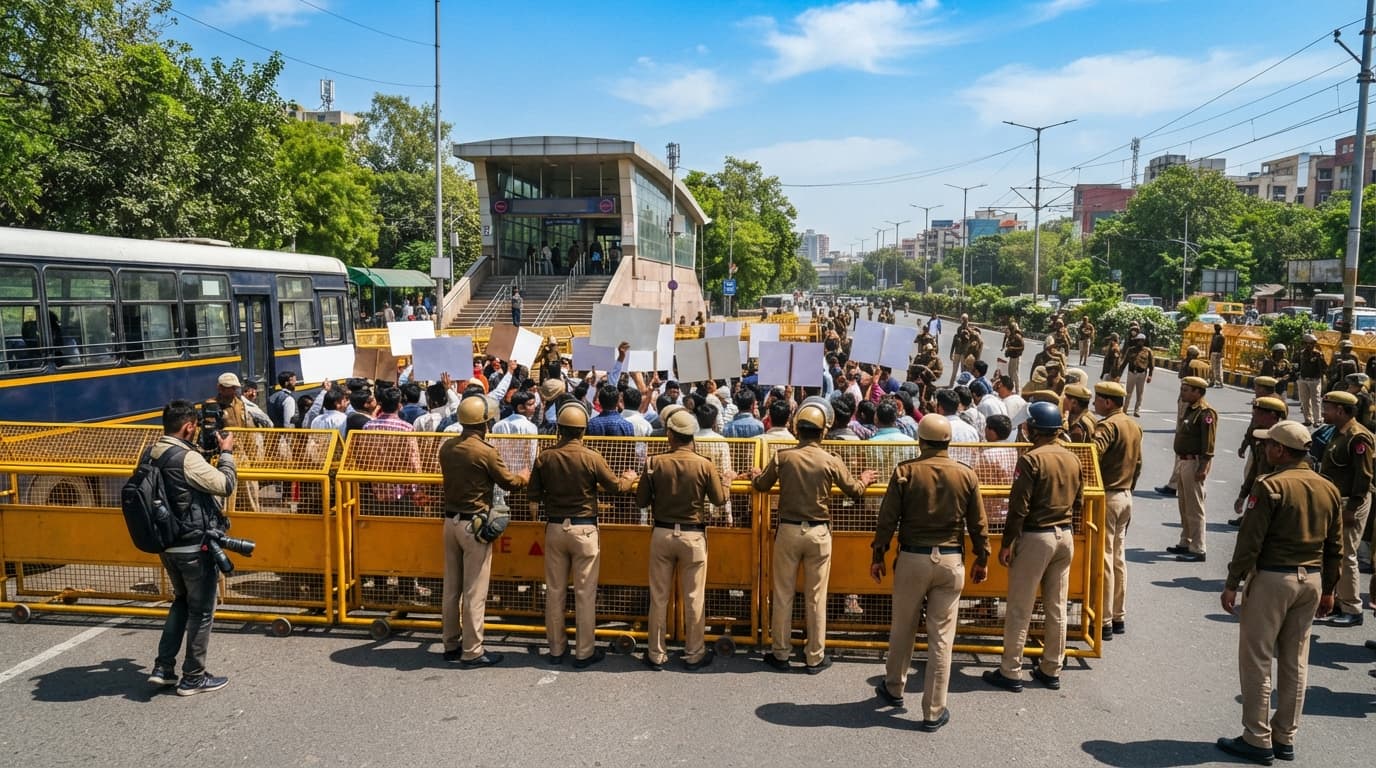
On November 3, 2026, a three-judge bench of the Supreme Court in New Delhi took up a batch of petitions alleging illegal detention by police, assault on protesters and curbs on public transport during demonstrations directed against Chief Election Commissioner Gyanesh Kumar. Chief Justice Surya Kant led the bench with Justices Joymalya Bagchi and V. Mohana. The court heard the matters together because they raise connected questions of protest, policing and free movement in the capital.
The demonstrations were held in Delhi over alleged irregularities in the functioning of the Election Commission. The petitions say protesters who sought to question the poll body and its head faced detentions said to lack legal basis, force on the street, and restrictions that blocked access to protest sites and disrupted movement across the city.
Among the petitioners are CPI(M) General Secretary M.A. Baby, Senior Advocate Menaka Guruswamy and Rajya Sabha MP A.A. Rahim. The batch also includes separate pleas by journalists who were present to cover the protests. That mix brings street-level claims by demonstrators together with reporting claims by the press, and the court listed them as one set.
The pleas do not ask the court to decide whether the allegations against the Election Commission itself are correct. They challenge the policing instead — whether detentions and force used on the ground were lawful, and whether transport and communication curbs imposed around the protests had sanction in orders passed for law and order.
On October 11, the bench had directed the authorities to ensure no illegal detentions, free movement of people, normal running of metro and train services, and no internet disruptions, subject to law and order needs. Those directions set the measure for later conduct. The petitioners now test police action after that date against them, and the contempt case flows from them.
The bench then found a prima facie case of contempt. It issued notices to the Centre, the Delhi Police and the Delhi Metro Rail Corporation, seeking affidavits and compliance reports. Such notices are not a final finding. They require each authority to place its version on record, explain steps taken after October 11, and show cause against action for non-compliance.
Each respondent covers a different piece of the enforcement chain in the capital. The Centre answers for overall law and order arrangements and deployment of forces. The Delhi Police answers for detentions, barricades, diversions and use of force ordered by its officers. The DMRC answers for station closures, regulation of entry and exit, and service cuts that decide whether protesters and other commuters can move at all.
Allegations of illegal detention by police examined
Several petitions allege protesters were picked up and held without following due procedure. Reasons were not disclosed, records were not prepared in the required manner, families and lawyers were not informed, and people were let off after several hours with no formal proceeding, the pleas say. The affidavits now called for will have to answer with station records, detention memos and orders passed by competent officers.
The Constitution protects the right to protest as part of speech and peaceful assembly, and provides that no person shall be deprived of life or personal liberty except by procedure established by law. It also provides protection from illegal arrest and detention — being told the grounds of arrest, access to legal advice, and production before a magistrate within the stipulated time. The petitioners argue preventive action claimed in the name of order must stay inside those stated limits.
Beating and rough handling during dispersal and after detention figure in the descriptions placed before the court. Police have powers to disperse unlawful assemblies and to use strictly necessary force, but statute, manuals and court directions set the bounds of that power. Video material, medical records and contemporaneous complaints from specific sites and times will be relevant in testing the rival accounts.
Public order law cuts the other way too. Freedom to assemble does not cover violence, damage to property or indefinite blockade of public roads, and police may impose conditions on time, place and manner of demonstrations. Past orders have tried to hold traffic and daily life together with space for dissent. Here the October 11 directions expressly made normal life and free movement part of compliance, unless genuine law and order needs required otherwise.
Metro, train and internet curbs under scrutiny
The petitions also challenge metro and train curtailments around the protests. Stations were closed or services cut so protesters could not reach authorised sites, and ordinary commuters suffered hardship, the pleas say. The notice to the DMRC seeks detail on who requested closures, what was put in writing, for which stations and hours, and what alternatives were provided to the public.
Daily wage workers, hospital staff, schoolchildren, litigants and passengers with reserved train tickets depend on steady metro and rail operations. The October 11 direction for normal working of metro and train services was framed as a general safeguard for all users, not only for protesters. Compliance reports must show any departure was narrowly drawn, time-bound and backed by recorded reasons linked to safety.
Free movement of people and alleged internet disruptions make up the rest of the October 11 frame. The pleas allege curbs that impeded assembly and reporting, while the direction left room for measures truly required for law and order. Courts have treated internet access as closely tied to expression, work and study, and have asked for orders by a competent authority that are proportionate and open to review. The affidavits must state whether any such measures were ordered at all in the relevant period.
Journalists allege detention during reporting
The batch includes separate pleas on detention and alleged assault of journalists during the protests. Reporters at a protest site are not demonstrators in the same sense, the pleas say, and their work to observe, record and report feeds public information on both the protest and the policing. Detention of journalists, seizure of equipment or deletion of footage needs its own specific justification.
Those complaints were listed with the main protest petitions rather than as an isolated grievance. That combined hearing lets the bench test whether field instructions distinguished protesters from accredited or identifiable press, whether press cards and equipment were respected, and whether safe passage was given for reporting work. The right to peaceful protest and freedom of the press operate together at such sites, where public understanding often turns on independent reporting.
In arguments, counsel for the petitioners are expected to say detentions, force and transport curbs together deter later demonstrations even without a formal ban. Counsel for the authorities are expected to defend the steps as preventive, temporary and grounded in inputs on congestion, safety and risk of disorder. Station diaries, control room logs, written closure orders and medical examination records will carry more weight than general submissions in such an inquiry.
On the ground in Delhi, the immediate questions are narrow. Who authorised each detention, and under what provision? Were the safeguards for arrested persons followed? Which metro stations were shut, and on whose written request? Were train schedules altered? Was any order affecting movement or communications in force? The Centre, the Delhi Police and the DMRC have been asked to answer with dates, times and documents rather than broad statements.
The November 3 hearing kept all these threads together and on compliance with the October 11 directions. With prima facie contempt notices already issued, the case now turns to scrutiny of the affidavits and compliance reports from the three authorities and to further orders on whether the directions were followed in letter and spirit and what relief or action follows.
Comments
Sign in to read the discussion and share your thoughts.
Latest from LawWorld
News
View all- Supreme Court Seeks Centre, ECI Reply On Plea Against Immunity For CEC And ECs4 Nov 2026
- Supreme Court Directs MP Speaker To Decide Bina MLA Disqualification Plea In Two Months4 Nov 2026
- Supreme Court Orders Special Cell To Monitor Child Labour Law Enforcement4 Nov 2026
- Bail Cannot Rest On Judge's Personal Notions Of Morality, Rules Supreme Court4 Nov 2026
- Supreme Court Refers Two-Child Norm Penalties To Larger Bench As Outdated4 Nov 2026