
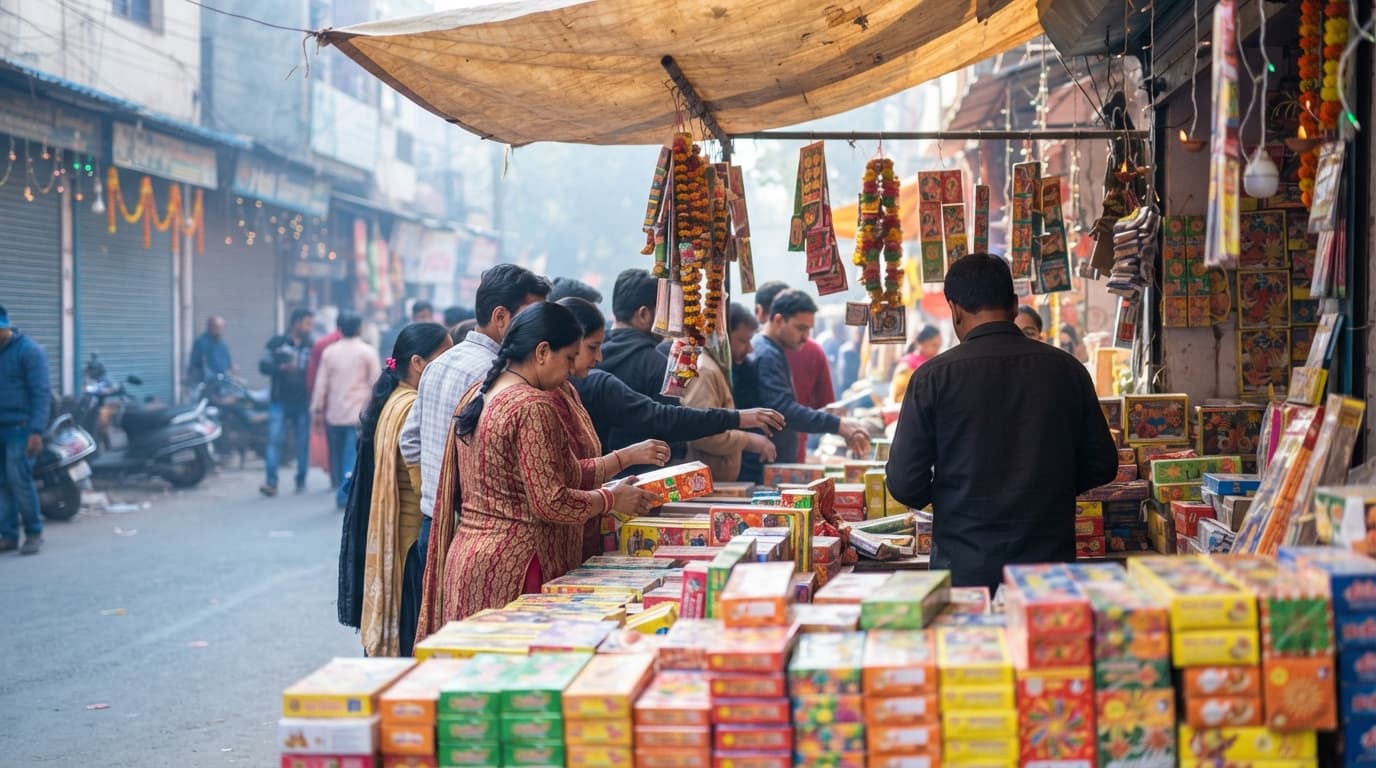
The Supreme Court on November 3 flagged open sale of firecrackers in Delhi markets despite its pre-Diwali curbs, and asked the Centre to verify the violations in the Diwali firecracker ban case. The bench of Justices M.M. Sundresh and Prasanna B. Varale acted on a report that all kinds of crackers were freely available in the capital. Additional Solicitor General Aishwarya Bhati, for the Centre, was asked to get the claim checked and place the facts before the court. The exchange came a day after the November 2 order that allowed certified green crackers in Delhi-NCR for a short window, with a full ban to return from November 9.
According to Justice Sundresh, the report pointed to markets in Delhi selling every variety of firecracker without restraint. Licensed and unlicensed stock was mentioned. So were boxes with and without QR codes. The bench said such sales, if true, would breach the conditions it had set. It recorded no final finding. It asked Bhati to have the enforcement machinery verify the position.
No shop or market area was named in open court. The bench spoke of general availability across Delhi markets. The direction was for verification, not immediate penalty. For traders and buyers, the signal was that the court was watching compliance during the short relaxation and not only bursting on festival days. For authorities, it meant showing what checks were done on the ground between the order and Diwali.
Diwali Firecracker Ban Timeline Explained
Under the November 2 order, certified green firecrackers can be sold in Delhi-NCR from November 4 to November 6. Use is allowed only on November 7 and November 8. Bursting is limited to two slots each day, 6 AM to 7 AM and 8 PM to 10 PM. Sales must take place at designated locations. A complete ban stands restored from November 9.
Only makers certified by the Council of Scientific and Industrial Research-National Environmental Engineering Research Institute and the Petroleum and Explosives Safety Organisation can manufacture green crackers. That permission runs from November 2 to November 6. Licences will be cancelled for breach. The frame is narrow: certified product, certified maker, fixed sale days, fixed bursting days and hours, and fixed sale sites.
The bench also recorded dissatisfaction with past enforcement. It said the State had failed to implement the restrictions effectively. It said the complete ban had not met its objective and had pushed sales toward illegal channels. That view formed the basis for the limited relaxation for green crackers. A regulated channel with certification and QR codes, the court reasoned, would be easier to police than a total prohibition that went underground.
Market sales under scanner
If shops are openly displaying non-green crackers, or green crackers without proper QR codes, or stock from uncertified makers, the core of the November 2 framework is broken. The court’s reference to licensed and unlicensed crackers and to packs with and without QR codes shows what officers must check. A QR code on a certified green cracker is meant to allow verification of maker and formulation. Absence of the code, or a code that does not verify, raises questions on source and compliance.
Bhati was asked to have the alleged violations looked into. In practice that will involve the Delhi Police, Petroleum and Explosives Safety Organisation officials, the district administration and the pollution control machinery. Market inspections, seizure memos where needed, and records of designated sale points will matter. The court will want specifics: where inspections were held, what was found, whether stock was seized, and whether any licence was acted upon. Till that report comes, fault has not been fixed on any trader, market body or officer.
Lawyers tracking the matter said the designated-location condition will also be tested. The November 2 order did not open sales everywhere in Delhi-NCR. Display in a regular market never notified as a sale point would itself be an issue, even if the product was claimed to be green. Stocking before November 4 or sales after November 6 would fall outside the window. Early sale and late sale both count for the report the Centre has to file.
Delhi-NCR air quality enforcement
Diwali enforcement in Delhi-NCR works within the wider air pollution law on emissions, graded responses to poor air quality, and duties of public authorities in winter. Fire and smoke from crackers sit beside dust, vehicle exhaust, stubble burning and industrial sources. In past winters the court has tied Diwali directions to close watch on air quality in the national capital region. The present orders follow that course through a short, conditional relaxation instead of open permission.
That statutory design is what lawyers mean by the air pollution prevention and control law, which lets pollution control boards, the Centre and state governments issue directions, fix standards and act against violations. Powers include inspection, seizure, closure and prosecution in fit cases. The Diwali orders do not replace those statutes. They operate as time-bound directions on top of them for the festival period, with the field machinery expected to act if conditions are broken.
Commentators on air pollution under environmental law often point to the gap between orders on paper and action in markets and neighbourhoods. The bench touched on that gap when it said the earlier complete ban had failed and fed illegal sales. Much public debate now turns on finding a durable firecracker ban solution that buyers and sellers will follow. Whether the short regulated window does better will turn on three tests: buyers able to tell a certified green cracker from an ordinary one, sellers staying within notified sites and dates, and visible checks by officers before Diwali.
Interest in earlier curbs has revived alongside this hearing. Searches have grown around the earlier firecracker ban in Delhi 2018. The wider debate on the firecracker ban in India has also resurfaced in discussion. Those references show public curiosity. They do not change the order now in force, which allows sale from November 4 to November 6 and use on November 7 and November 8 within the two daily slots, with a full ban again from November 9.
For Delhi-NCR residents, the position till any further order is as the court fixed it. No bursting is allowed outside November 7 and November 8. Even on those days, bursting is allowed only from 6 AM to 7 AM and 8 PM to 10 PM. Only certified green crackers from certified makers are allowed, bought at designated locations during the sale window. Talk of a firecracker ban Mumbai concerns curbs in another city and has no bearing here. Any other cracker, any other day, or any other time falls outside the permission, and traders in breach face cancellation of licences apart from action under the statutes.
The Centre must now check the claim of unrestricted sales and inform the bench. No separate date for that report was stated in the material before the court, but the calendar leaves little room. Sales run from November 4 to November 6 and bursting on November 7 and November 8. Any check has to happen at once to have effect. If violations are proved, the bench can order seizures, tighten conditions, or issue directions against defaulting sellers and officers before the full ban returns on November 9.
Comments
Sign in to read the discussion and share your thoughts.
Latest from LawWorld
News
View all- Supreme Court Seeks Centre, ECI Reply On Plea Against Immunity For CEC And ECs4 Nov 2026
- Supreme Court Directs MP Speaker To Decide Bina MLA Disqualification Plea In Two Months4 Nov 2026
- Supreme Court Orders Special Cell To Monitor Child Labour Law Enforcement4 Nov 2026
- Bail Cannot Rest On Judge's Personal Notions Of Morality, Rules Supreme Court4 Nov 2026
- Supreme Court Refers Two-Child Norm Penalties To Larger Bench As Outdated4 Nov 2026