
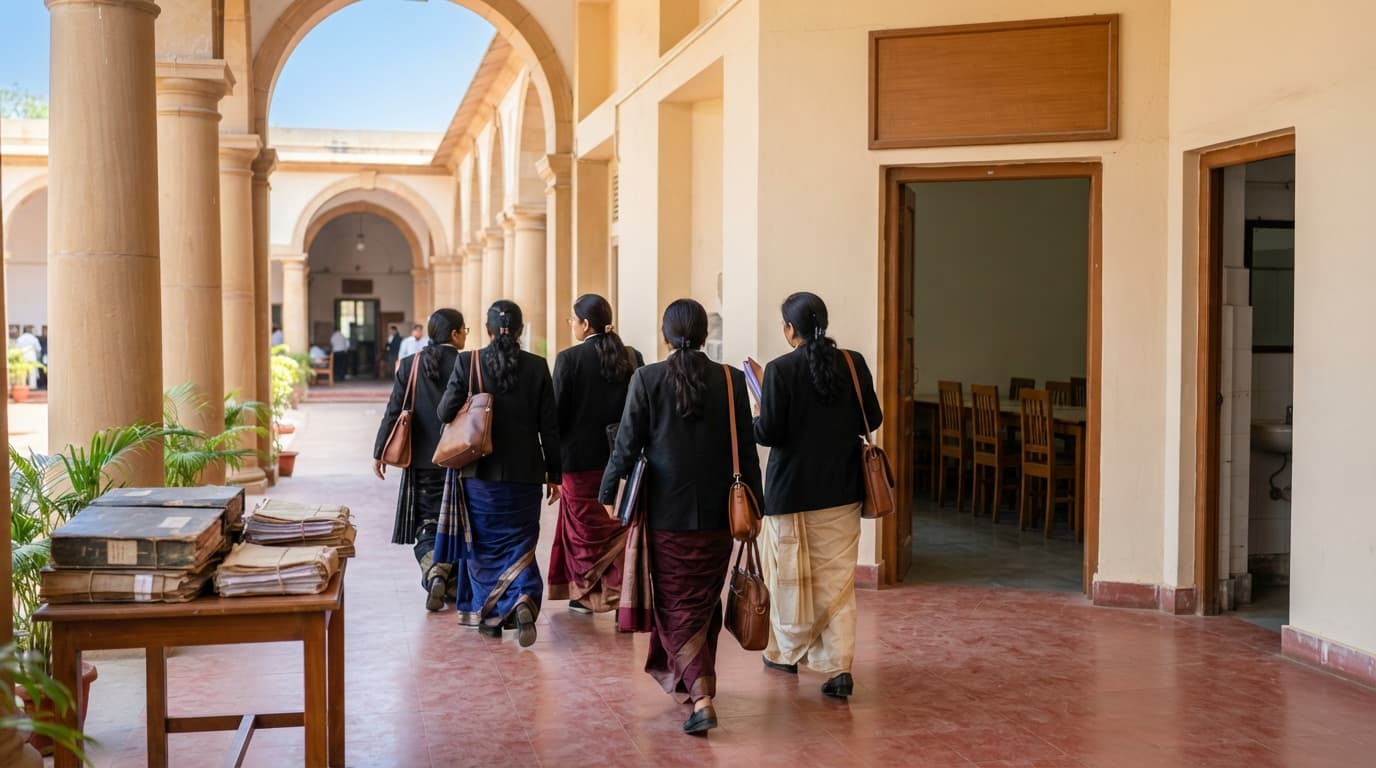
New Delhi, October 26: The Supreme Court of India on October 26, 2026 directed all States and Union Territories and all High Courts to ensure exclusive bar rooms and washrooms for women lawyers in India. The Bench of Chief Justice Surya Kant, Justice Joymalya Bagchi and Justice V. Mohana said States and Union Territories must allocate necessary funds wherever required.
Supervision will lie with the building-cum-infrastructure committees of the High Courts. The order came in a petition that flagged the lack of basic facilities for women legal professionals inside court premises. The material on the order gave no further details of the petitioner.
Across the country, the direction covers court complexes under the administrative control of the High Courts. That includes District and subordinate courts, where most daily litigation happens. The Court treated a separate bar room and toilets as a question of working conditions and access for women in the profession, not as an optional amenity.
What this means for women lawyers in India
A bar room in Indian courts is a place of work. Lawyers wait there between cases, take instructions, brief colleagues, store robes, books and files, eat lunch and get ready when their matter is called. For juniors and lawyers without chambers, it is often the only place to sit through a court day. Where no separate room exists, women have for years described working from corridors, litigant halls, cars or libraries.
Toilets present the same practical problem. In older District and taluka buildings, toilets are few, badly kept or shared without privacy. In some complexes women lawyers use common litigant facilities or staff toilets. The Court has now said washrooms for women lawyers must be exclusive and available within each High Court's jurisdiction. It prescribed no design or size.
High Court buildings in state capitals generally have ladies bar rooms, though space and upkeep vary. The gap widens further down. In District courts, sub-divisional courts and rural centres, the number of women in practice has grown while building upgrades have lagged. Lawyers on the criminal, civil, family, labour and revenue sides spend long hours in these complexes, often travelling from another town for a single hearing.
The available material named no petitioner and recorded no appearance by the All India Federation of Women Lawyers. That gap does not limit the order. The Bench placed the obligation on States, Union Territories and High Courts, and left supervision to the High Court committees that already handle construction, renovation and maintenance of judicial infrastructure.
No new statute was created and no new right under a code was declared on the basis of any particular gender equality law. The Bench issued an administrative direction to the authorities that fund, build and maintain courts, with the stated aim of improving working conditions for women in the profession.
Funds and committees to oversee implementation
Court buildings draw money from more than one source. State governments fund District judiciary infrastructure under construction, repair and upkeep heads. Central support for judicial infrastructure has also come at intervals. High Courts, through building committees and registrars, project needs, clear plans and track execution through public works departments or other agencies.
By saying funds must come wherever required, the Bench fixed financial responsibility. The words leave room for local assessment. Some complexes may need only repair or conversion of existing space. Others will need fresh construction, plumbing, water supply, lighting, ventilation and furniture. In rented or temporary premises, interim steps may be needed before permanent work is done.
High Court building-cum-infrastructure committees will now be central. They inspect sites, review estimates, set priorities across districts and receive reports from District judges and registry officers. Under this order they will take stock of existing ladies bar rooms and washrooms, list gaps court-wise, seek money where needed and track completion. Day-to-day control stays with the High Court that knows local conditions.
The first move is likely to be counting. Registries may ask District judges for the number of complexes, the state and condition of exclusive rooms and toilets for women lawyers, space that can be set apart at once, and the cost of new work. Bar associations are likely to be asked about location, access and upkeep, since they run bar rooms daily in many stations. The exercise is administrative, and not a study of any law that promotes gender equality in the abstract.
Upkeep will count as much as building. A room without locks, drinking water, fans, charging points or daily cleaning fails in use. Washrooms without running water, disposal systems, sanitary vending and disposal facilities and attendant support quickly fall out of use. Availability, in the Court's words, will in practice mean functional and maintained facilities during court hours, not rooms that exist on paper. The available material drew no comparison with a law about gender equality in the Philippines.
Bar rooms, washrooms and daily court practice
Small changes in space alter trial court work. A woman lawyer appearing in three courts in one complex needs a secure place to leave files while moving from hall to hall. A junior waiting for a remand, a local commission or a bail order in the afternoon needs a desk to sit and write. A lawyer nursing an infant, observing a fast or managing a health condition needs privacy during a long day.
Client meetings need the same privacy. In criminal and family matters, women lawyers take instructions on sensitive facts. Corridors and canteens do not allow that talk. A separate room gives a quieter place for client and co-counsel discussions, without stepping outside the building.
Location will decide use. A bar room far from court halls, in an unlit basement or in a wing that shuts early, helps little. Washrooms in isolated corners raise the same concern. The order lays down no floor plan, but committees and District administrations will have to weigh lighting, distance from halls, CCTV cover on approaches and housekeeping staff when they pick space.
Much will turn on buildings now under construction. Many District complexes are adding blocks, mediation centres, legal services offices and waiting halls. Setting apart space for women lawyers at the drawing stage costs less than breaking walls later. The same standard can be applied at once in new family court buildings, tribunal premises and judicial complexes on the drawing board.
Rented buildings, heritage structures and congested city premises will pose the hardest problem. Partition of halls, conversion of record rooms or temporary units may serve for now. The material on the order set out no uniform timeline or design. High Courts will have to fix priorities district by district, starting with stations with the largest presence of women lawyers and litigants.
Lawyers will see compliance each day. They will know if a room has been set apart, if it stays open in working hours, if it has basic furniture with toilets attached or near, and if it is cleaned. District judges, bar associations and registry officers will take the first complaints about closure or poor upkeep. The High Court committees can then seek funds or order repairs through the usual administrative channel.
The order settles no contest between parties on merits. It lays down a continuing administrative direction. Unless varied later, States and Union Territories must provide money where needed, and High Courts must see that exclusive bar rooms and washrooms for women lawyers stay available and usable across their jurisdictions.
Comments
Sign in to read the discussion and share your thoughts.
Latest from LawWorld
News
View all- Supreme Court Seeks Centre, ECI Reply On Plea Against Immunity For CEC And ECs4 Nov 2026
- Supreme Court Directs MP Speaker To Decide Bina MLA Disqualification Plea In Two Months4 Nov 2026
- Supreme Court Orders Special Cell To Monitor Child Labour Law Enforcement4 Nov 2026
- Bail Cannot Rest On Judge's Personal Notions Of Morality, Rules Supreme Court4 Nov 2026
- Supreme Court Refers Two-Child Norm Penalties To Larger Bench As Outdated4 Nov 2026