
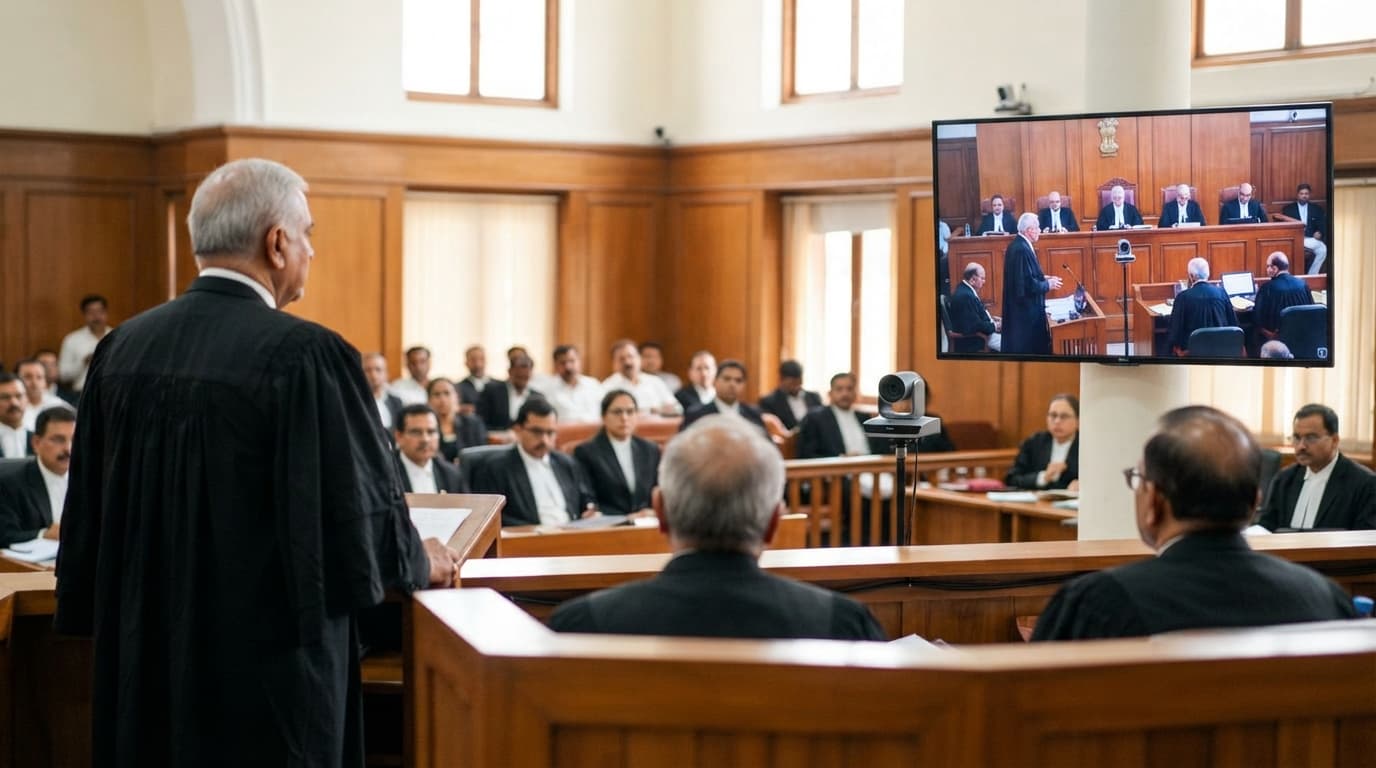
The Supreme Court on Friday directed the Centre to write penalties and enforcement action into its proposed policy on live-streamed court proceedings, saying its interim curbs on unauthorised extraction, editing and circulation of hearing videos must carry a consequence for violation, including through contempt of court proceedings. A bench of Chief Justice Surya Kant and Justices Joymalya Bagchi and V. Mohana passed the direction while hearing pleas against lifting, altering, sharing or selling video clips of hearings for commercial use without permission.
Compliance was the theme. The bench said a policy framework under preparation must not stop at listing what is allowed and what is barred. It must spell out what follows a breach. The court was dealing with the continued operation of interim directions, including an order dated October 9, 2026, which had restrained unauthorised extraction, circulation and commercial use of live-streamed proceedings. Those directions needed work on the ground, the bench said, and asked the government to place on record how breaches would be identified, acted upon and stopped from recurring.
Solicitor General Tushar Mehta, for the Centre, said suggestions received from various High Courts and other contributors had been sent to the Ministry of Electronics and Information Technology for preparation of detailed guidelines. The court recorded that submission. It did not dictate the contents of the policy at this stage. It asked instead that the draft sent to the Ministry and the framework placed before the court contain a dedicated enforcement part, with graded responses for different violations and a clear authority to start action.
Live streams are meant to widen access to open court proceedings. The petitions contend that short clips are cut from full hearings, stripped of context, captioned or dubbed, and then pushed on social media platforms and messaging groups. Some clips, it has been alleged, earn advertising revenue or are used to promote channels, pages and paid services. In earlier hearings the bench treated such practices as a risk to accurate public understanding of judicial proceedings and to the dignity of those who appear.
The October 9 curbs remain the immediate backdrop. Under them, extraction of clips from official live streams, their alteration and their circulation or commercial exploitation without authorisation were restrained pending a final policy. The court did not dilute that arrangement on Friday. It reiterated that the restraints continue and turned to what happens when they are ignored. The Solicitor General cited alleged instances of violation and pressed for directions to remove material uploaded in breach. No separate removal order was passed, but the bench asked that enforcement, including takedown and preservation of evidence, be addressed in the policy placed for review.
Suggestions sent to MeitY for guidelines
The reference to the Ministry of Electronics and Information Technology marks the next stage of rule-making. On the submission recorded by the bench, inputs from High Courts and others have gone to the Ministry for framing of detailed guidelines. The court has prescribed no format. What it has asked for is completeness. A use policy without an action plan for breach, the bench indicated, would leave courts with repeated complaints and no predictable path for redress.
In practical terms, the enforcement design will have to answer three questions. The first is identification, where clips are reposted through anonymous handles or mirrored across platforms. The second is speed. A misleading clip can travel widely within hours while a court process moves over days. The third is proportionality. A student sharing a full hearing link for study stands on a different footing from a commercial account that edits remarks to suggest an outcome the court did not reach. The call for penalty measures means these distinctions will have to be written into the framework rather than left to ad hoc orders.
Existing legal tools figured in the background discussion, though the court ruled on none of them on Friday. Wilful disobedience of a court order can attract action for contempt, and orders restraining publication or circulation draw force from the court’s authority to secure compliance. Counsel also referred to the statute governing contempt jurisdiction, cited in court exchanges by the shorthand Court of Contempt Act, alongside the information technology framework that applies to intermediaries and content removal. The bench did not decide which provision would apply to any particular breach. It directed that the policy make the route for action explicit, so litigants, platforms and the public know where a complaint goes and how it is processed.
Watermarked official clips proposed
One concrete proposal came from advocate Prashant Bhushan, who suggested official clips carry a verifiable digital signature or watermark and be made available on the Supreme Court’s website. The idea is to create an authentic reference point. If the court itself publishes short, complete and searchable excerpts with a mark of authenticity, viewers can check a viral clip against the official version. A visible watermark would travel with the video when shared, while an embedded digital signature would allow technical verification even if the visible mark is cropped.
No final ruling came on the suggestion on Friday, but the bench recorded it for the policy exercise. A system of official clips would change incentives for reuse. News organisations, educators and researchers could cite or embed the authenticated version instead of relying on third-party recordings of uneven quality. Platforms receiving a complaint about a manipulated clip could compare it quickly with the official file. Questions of selection, length and neutrality would still arise if the court publishes excerpts, since any choice of what to excerpt can be contested. Those questions were left for the compliance stage, after the Diwali vacation, when the Centre is expected to report how watermarking and official access have been considered.
Prevention, the bench kept stressing, must go with punishment. Watermarking, controlled access to high-resolution feeds, clear display of use conditions on the live-stream page, and standard notices for educational use are among the preventive tools discussed in such matters. The emphasis on Friday was that preventive design and punitive response must operate together. A notice that forbids commercial reuse needs a stated process for complaint, verification, takedown and record-keeping, and a penalty clause that can be invoked without filing a fresh substantive case each time.
Enforcement linked to contempt of court powers
The talk of action for breach brings the court’s contempt jurisdiction into view. No contempt proceeding was started on Friday and no alleged violator was named. The point was structural. Interim restraints of the Supreme Court operate with the authority of court orders. Deliberate breach can invite proceedings for contempt of court, in addition to any statutory consequence the policy may prescribe. By asking the Centre to build in measures for taking action against violations, the court signalled the coming framework should explain how such proceedings would be triggered, who would bring the breach to notice, and what material would be needed to establish it.
Platforms and uploaders got a clear warning to be cautious. Until the policy is finalised, the interim restraints on extraction, alteration, circulation and commercial use stay in force. The Solicitor General’s request for removal of material uploaded in breach indicates past uploads may also face scrutiny when the matter returns. Uploaders who have posted hearing clips with commentary, thumbnails or captions that change the sense of what happened in court face the greatest exposure. Live access, even where a hearing was streamed for public viewing, is not a licence to republish in altered form or for profit.
Viewers, researchers and students face no closing of access. The court has not suggested an end to live streaming. It has sought a regulated form of reuse that preserves accuracy. Watching a live hearing, citing an official link, or referring to a full proceeding for academic purposes stands apart from cutting a thirty-second exchange and presenting it as the court’s finding. The policy exercise is expected to draw that line with greater precision and to provide a simple method for seeking permission where reuse beyond viewing is wanted.
The matter will come up again after the Diwali vacation for a compliance review. The Centre is expected to report the progress made with the Ministry, how High Court suggestions have been incorporated, and the specific enforcement and penalty clauses proposed for inclusion. The bench will then assess whether the interim arrangement needs modification, added takedown directions, or continuation until the final framework is notified.
Comments
Sign in to read the discussion and share your thoughts.
Latest from LawWorld
News
View all- Supreme Court Seeks Centre, ECI Reply On Plea Against Immunity For CEC And ECs4 Nov 2026
- Supreme Court Directs MP Speaker To Decide Bina MLA Disqualification Plea In Two Months4 Nov 2026
- Supreme Court Orders Special Cell To Monitor Child Labour Law Enforcement4 Nov 2026
- Bail Cannot Rest On Judge's Personal Notions Of Morality, Rules Supreme Court4 Nov 2026
- Supreme Court Refers Two-Child Norm Penalties To Larger Bench As Outdated4 Nov 2026