
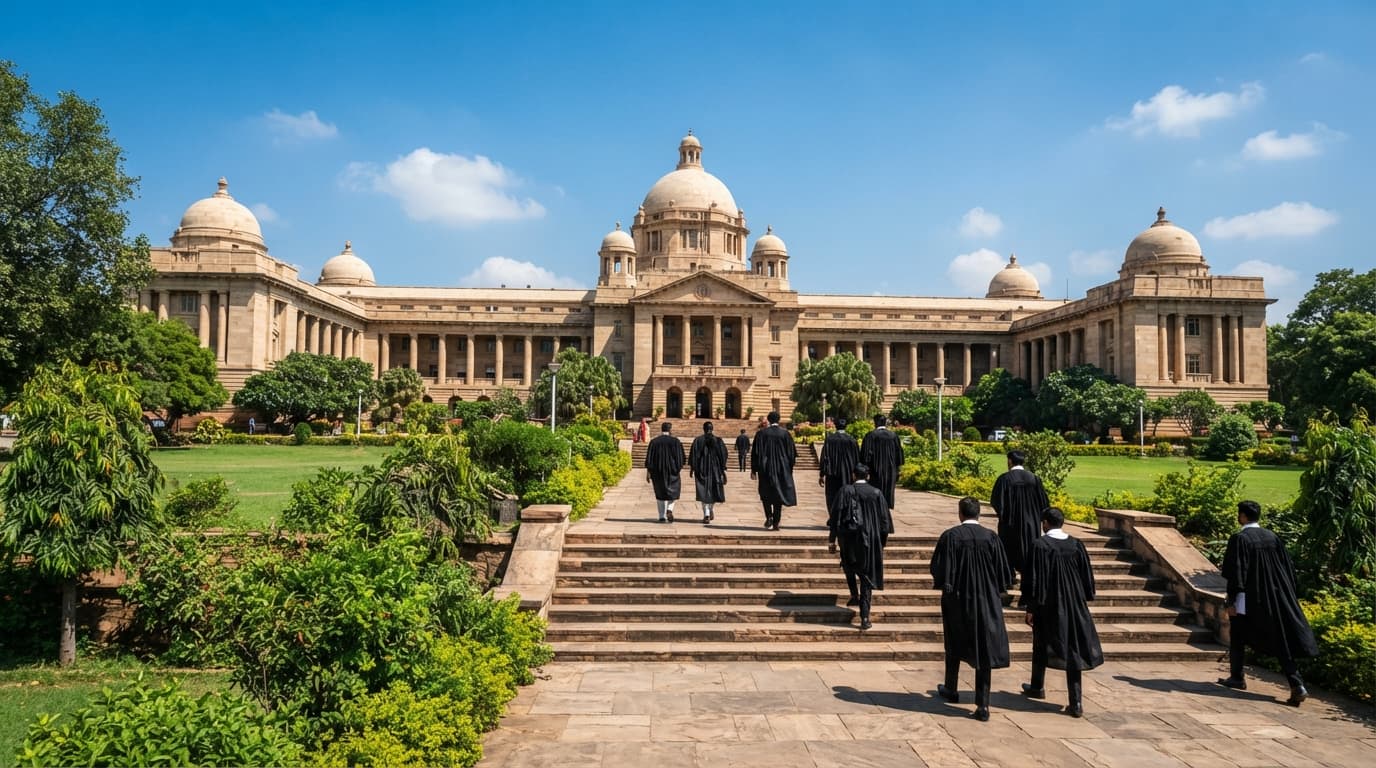
New Delhi, October 30: The Supreme Court collegium headed by Chief Justice of India Surya Kant on October 30 approved proposals for the appointment of eleven persons as judges of the Madhya Pradesh High Court and the Chhattisgarh High Court. Five judicial officers were cleared for Madhya Pradesh, including three women, while six persons — four advocates and two judicial officers — were cleared for Chhattisgarh. The decisions were conveyed through separate statements issued the same day, which listed the names approved and did not set out reasons for the choice.
The approvals relate to two High Courts in central India that handle a large volume of civil, criminal, service and land matters, apart from public interest litigation. For readers of the appointment orders, the immediate effect is limited to recommendation. A person named by the Collegium does not become a judge until the Central government processes the file and the President issues a warrant of appointment. Until then, the advocates continue in private practice and the judicial officers continue in district judiciary postings.
Five officers named for Madhya Pradesh
For the Madhya Pradesh High Court, the Collegium approved five serving judicial officers: Renuka Kanchan, Krishnamurty Mishra, Virendra Singh Rajput, Mamta Jain and Ashita Shrivastava. All five are drawn from the judicial service, which means they are presently serving as district and sessions judges or in equivalent posts under the Madhya Pradesh higher judicial service. No advocate from the Bar was included in this particular batch for Madhya Pradesh. The recommendation will, if accepted by the government, add five service judges to the Bench at Jabalpur, which also has Benches at Indore and Gwalior.
Three of the five officers — Renuka Kanchan, Mamta Jain and Ashita Shrivastava — are women. Their inclusion has been noted by court watchers because representation of women on High Court Benches remains low across the country, and service appointments are one of the routes through which women judges enter the higher judiciary. Upon appointment, their seniority among themselves will be fixed in the order shown in the warrant, in keeping with usual practice, and they will be assigned court rooms and subjects by the Chief Justice of the High Court.
Six names cleared for Chhattisgarh
For the Chhattisgarh High Court at Bilaspur, the Collegium approved six names. Four are advocates practising before the High Court: Anand Shukla, Ratna Nidhi Pusty, Shashank Thakur and Sourabh Sharma. Two are serving judicial officers: Rajnish Shrivastava and Balram Prasad Verma. The mix reflects the constitutional design for the appointment of High Court judges, under which the Bench is drawn both from the Bar and from the judicial service. Advocates recommended for elevation usually have at least ten years of practice, while judicial officers come with experience of trial court and district court adjudication.
The Chhattisgarh list brings together different streams of work that typically feed into a High Court judge appointment. Lawyers elevated from the Bar often bring experience of constitutional, civil, criminal, tax or company matters argued before the High Court, while officers elevated from the service bring first-hand experience of recording evidence, conducting trials, deciding bail and appeals, and managing heavy district court dockets. Once appointed, both streams sit together and hear the same classes of cases, with assignments rotated by the Chief Justice.
Supreme Court collegium clears names without reasons
The Supreme Court of India collegium resolutions issued on October 30 list only the names approved for the two High Courts and do not give reasons for selection or rejection. That form is in line with how such resolutions are ordinarily published. They record the decision taken at the meeting, the names cleared, and the High Court concerned, without discussing comparative merit, reports from consultative authorities, or intelligence inputs. Detailed files, including views of the High Court Collegium, the state government, and the central agencies, move separately between the court and the executive and are not placed in the public domain.
In the present round, the two statements were released on the same day as the meeting. One statement deals with the Madhya Pradesh High Court and records the approval of five judicial officers as judges. The other deals with the Chhattisgarh High Court and records the approval of four advocates and two judicial officers as judges. Neither statement fixes a date for joining, oath, or assumption of office. Those steps follow only after the executive completes its processing and warrants are signed.
How High Court selections reach Delhi
Under the Constitution, a High Court judge must be a citizen of India and must either have held a judicial office in India for at least ten years or have practised as an advocate of a High Court for at least ten years. Appointments are made by the President after consultation with the Chief Justice of India, the Governor of the state, and, in the case of transfer, other consultees. In practice, the process is governed by the Memorandum of Procedure and the judgments on the collegium system. A proposal is initiated by the Chief Justice of the High Court concerned in consultation with senior colleagues.
That proposal, with views of the state government where sought, is sent to the Union Law Ministry, which arranges background checks and places material before the Supreme Court Collegium. The Supreme Court Collegium, comprising the Chief Justice of India and senior judges, then considers suitability, reputation, ability, and inputs received. When it approves a name, as it has done for the eleven persons from Madhya Pradesh and Chhattisgarh, the file returns to the government for final action. The government may seek reconsideration once, but if the Collegium reiterates the name, the appointment is to proceed.
What happens after collegium approval
The next steps are administrative. The Law Ministry processes the eleven files, prepares notes for Presidential approval, and, upon clearance, notifies the appointments in the official gazette. New judges take oath before the Governor or an officer authorised for the purpose and assume office on the dates specified. Seniority is generally fixed with reference to the order in the notification and the date of assumption, subject to rules on service judges and Bar appointees. The High Court Chief Justice then allocates court work.
For both High Courts, the addition of new judges, once notified, will enlarge the available Bench strength for division and single benches hearing fresh admissions, bail pleas, appeals and pending trials. Litigants in Madhya Pradesh and Chhattisgarh will watch for the central notification, the oath dates, and the subsequent sitting list that shows which judges sit where. Until the warrants are issued, the Collegium statements remain recommendations and no change takes place in the composition of either High Court.
Comments
Sign in to read the discussion and share your thoughts.
Latest from LawWorld
News
View all- Supreme Court Seeks Centre, ECI Reply On Plea Against Immunity For CEC And ECs4 Nov 2026
- Supreme Court Directs MP Speaker To Decide Bina MLA Disqualification Plea In Two Months4 Nov 2026
- Supreme Court Orders Special Cell To Monitor Child Labour Law Enforcement4 Nov 2026
- Bail Cannot Rest On Judge's Personal Notions Of Morality, Rules Supreme Court4 Nov 2026
- Supreme Court Refers Two-Child Norm Penalties To Larger Bench As Outdated4 Nov 2026