
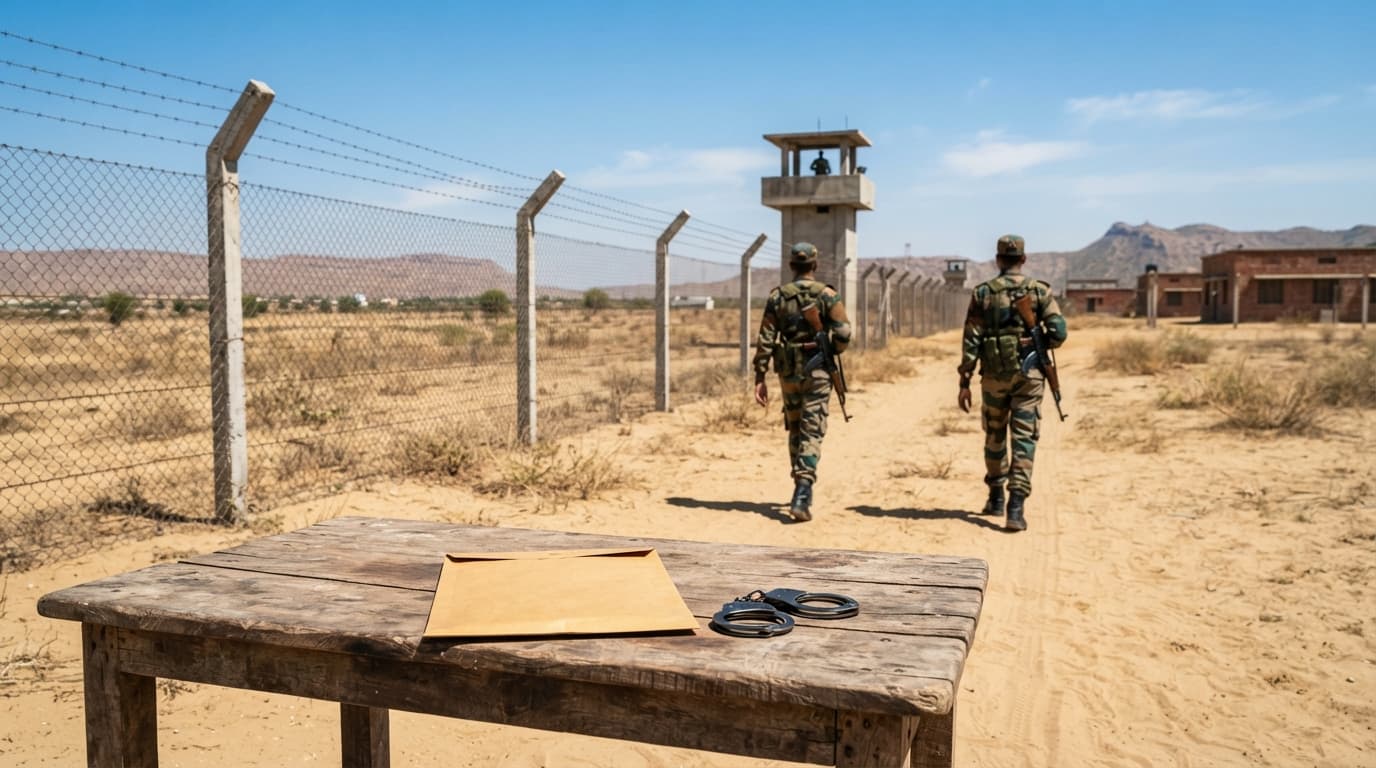
The Supreme Court has cancelled regular bail granted to an accused charged under the Official Secrets Act with passing sensitive military information to foreign handlers. A Bench of Justices M.M. Sundresh and Prasanna B. Varale allowed the State of Rajasthan's appeal in State of Rajasthan v. Jhabra Ram and set aside the Rajasthan High Court's order. A lapse in communicating the grounds of arrest, the Court said, does not by itself earn bail unless the accused shows real prejudice. On this record, the grounds had been substantially communicated.
Rajasthan had challenged the High Court order granting regular bail to the respondent. The State said the case involved grave charges concerning national security and that bail had turned largely on alleged failure to inform the accused of the grounds of arrest. Its case was that the record showed substantial compliance and no prejudice to the accused. The Bench accepted those submissions and held the accused was not entitled to remain on bail on that ground.
Under the Constitution, the right to know the grounds of arrest lets a person taken into custody understand why liberty has been curtailed, take legal advice and seek remedy before a court. The Bench did not dilute that protection. It said the safeguard must work in practice at the time of arrest. At the same time, it drew a line between a complete failure to give that information and a dispute over the exact manner of communication where the record otherwise shows the accused was made aware.
Here the Court went through the arrest papers. The arrest memo bore the accused's signature and had been witnessed. That material, the Court said, showed substantial communication of the grounds. Such contemporaneous documentation carries weight where the claim is that nothing at all was told. The alleged procedural defect was therefore no basis for continuing bail.
The backdrop was the prosecution under the Official Secrets Act, 1923 and the Bharatiya Nyaya Sanhita, 2023 for allegedly passing sensitive military information to foreign handlers, described as alleged Pakistani intelligence agents. The Court made no finding on those allegations. It decided only whether bail granted by the High Court could stand on the arrest-grounds issue. It held it could not, given the material on record and the absence of shown prejudice.
Bail cancelled in Official Secrets Act case
Bail in such cases turns on the gravity of the offence, the role attributed to the accused, the risk of tampering or influencing witnesses, the chance of flight, and the stage of investigation or trial. When the High Court grants bail, the Supreme Court in appeal checks whether discretion was exercised on relevant considerations and in line with law. Here the Bench found error in resting bail on the alleged defect in communicating the grounds, with no finding of prejudice and despite the signed arrest memo.
The order adds to the line of grounds of arrest Supreme Court judgement on how to test claims of non-communication. The Bench said the remedy must match the breach. Release on bail does not follow automatically from every irregularity in arrest. An accused who says the grounds were not properly given must show how the lapse hurt the ability to understand the reason for arrest or to seek legal remedies. A bare assertion, without more, will not do.
Questions over grounds of arrest under CrPC and its successor provisions have come up often as trial courts and High Courts deal with objections raised soon after arrest. The law has long required the arrested person to be told why the arrest is made and to be produced before a magistrate within the prescribed time. Police records, including the arrest memo, the general diary and the written grounds where required, are checked to see if that duty was met. This order follows that method, testing the claim against the contemporaneous record instead of viewing the objection alone.
Arrest memo and signed acknowledgement
Much turned on the arrest memo in this case. It recorded the time, place and circumstances of arrest and carried the accused's signature with attestation by witnesses. A signed acknowledgement does not settle every challenge. Courts still look at whether the contents are credible and whether procedure was fairly followed. But where the signature is not disputed and witnesses support the record, courts are slow to hold there was a total denial of information.
The Bench then stressed demonstrable prejudice. The test was not only perfect compliance with each procedural step, but whether any shortfall stopped the accused from understanding the arrest and acting on it. No such showing was found here. The accused had engaged counsel, moved the court for bail and raised the procedural point itself, which pointed to knowledge of the case and the basis for custody. Bail could not rest on the alleged defect alone in those circumstances.
As a grounds of arrest latest judgement on bail in a national-security prosecution, the order is likely to be cited in trial courts faced with similar pleas. It does not say defects in furnishing grounds can be ignored. It says courts must read the full record — whether grounds were substantially communicated, whether the arrest memo was duly executed, and whether the accused suffered actual disadvantage. Where substantial communication is shown, bail need not follow only because a technical lapse in the form of communication is alleged.
Custody after cancellation of bail
With the High Court order set aside, the respondent's bail stands cancelled. He will have to surrender or be taken into custody in accordance with law, subject to further orders of the trial court on custody and remand. The prosecution under the Official Secrets Act and the Bharatiya Nyaya Sanhita will proceed before the competent court, where charge, disclosure and admissibility of sensitive material will be dealt with under regular procedure. The Supreme Court expressed no view on guilt or innocence.
Comments
Sign in to read the discussion and share your thoughts.
Latest from LawWorld
News
View all- Supreme Court Seeks Centre, ECI Reply On Plea Against Immunity For CEC And ECs4 Nov 2026
- Supreme Court Directs MP Speaker To Decide Bina MLA Disqualification Plea In Two Months4 Nov 2026
- Supreme Court Orders Special Cell To Monitor Child Labour Law Enforcement4 Nov 2026
- Bail Cannot Rest On Judge's Personal Notions Of Morality, Rules Supreme Court4 Nov 2026
- Supreme Court Refers Two-Child Norm Penalties To Larger Bench As Outdated4 Nov 2026