
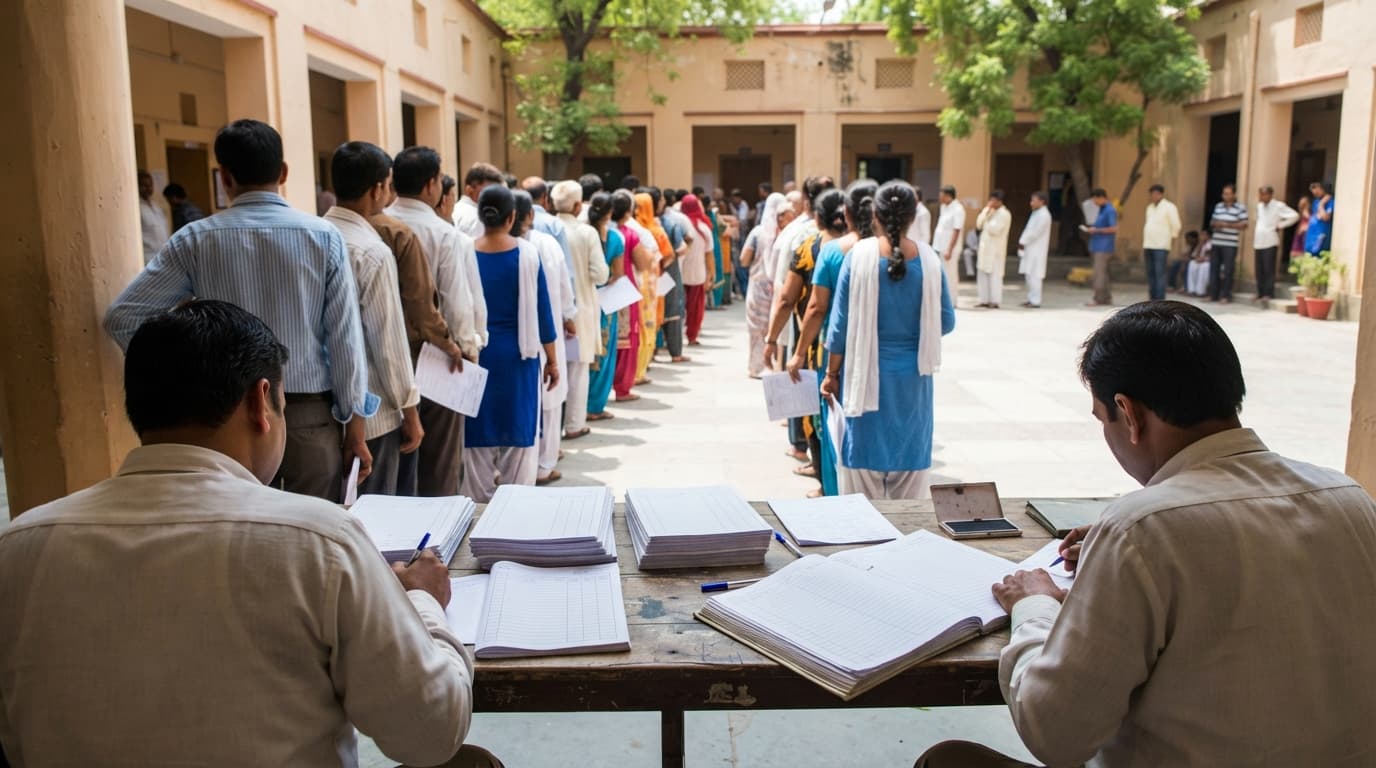
The Supreme Court of India on October 28 asked the Election Commission of India to consider accepting enumeration forms in Delhi after the August 17 cut-off and extending the October 30 deadline for claims and objections. The protection, the Bench said, was meant to stop electors already on the rolls from losing the vote for good because they did not return a paper in time.
Chief Justice Surya Kant headed the three-judge Bench with Justices Joymalya Bagchi and V. Mohana. It was hearing petitions against large-scale deletions under the Special Intensive Revision in Delhi. Counsel for the Election Commission said orally the request for late filing and more time for claims and objections would be examined.
The draft rolls at issue were published after house-to-house verification and collection of enumeration forms. Names missing from the draft must now come through claims and objections, for which Delhi's last date is October 30. Petitioners said many genuine voters, including people who had voted from the same address before, found their names dropped and had little time to arrange papers and file the prescribed forms.
The judges clarified that the earlier judgment upholding the Special Intensive Revision in Bihar did not decide whether logical discrepancy can be a ground for deletion. Bihar could not be cited as binding on that point, the Bench said, because the Commission had not used logical discrepancy as a category there at the initial stage. Its legality remains open.
In the Delhi and West Bengal proceedings, logical discrepancy has been described as a category thrown up during automated checking of roll data, where entries are flagged for mismatch across fields. For West Bengal the Court has allowed its use as an interim arrangement without deciding the legal question. The Delhi petitions raise the same tool on a different set of facts.
Bench questions deletion of existing voters
Much of the argument turned on the voter already on the roll whose name was then deleted for not returning the enumeration form. The Bench asked whether such lapse in paperwork could cost the franchise permanently. It put to the Election Commission whether failure to file the form could be answered with loss of the right to vote for all time.
Under the Registration of Electors Rules, 1960, Form 6 is for inclusion as a new elector, Form 7 is for objection to inclusion or for deletion, and Form 8 is for correction, shifting or other changes to an existing entry. The Bench said the Commission was in error in telling deleted electors to apply afresh as new voters, since that route did not fit the scheme of the Rules.
Justice Bagchi intervened to say Form 6, Form 7 and Form 8 are cast in stone and cannot be altered in substance. The point goes to the petitioners' case that the 1960 Rules require strict procedure before a name is struck off, with notice and a chance to be heard, and do not permit short cuts through automated flags or fresh Form 6 applications.
Activists Anjali Bhardwaj and Amrita Johri are among the petitioners. Their counsel argued that an old voter sent through Form 6 is forced into a false declaration, because the form asks the applicant to state the name is not already included elsewhere and treats the case as a first-time inclusion. That misstates the record of a person who has voted for years and can attract penal consequences, counsel said.
Senior advocate Dama Seshadri Naidu, for the Election Commission, said the revision was meant to clean the rolls of dead, shifted and duplicate entries and no genuine voter would be shut out without an opportunity. He assured the Court the Commission would explore delayed filing of enumeration forms in Delhi and consider extension of the claims period. The Court recorded the assurance and asked for its response.
Supreme Court of India narrows Bihar precedent
The word on the Bihar judgment shaped the day's hearing. The Bench said in plain terms that logical discrepancy was not used as a category in Bihar at the relevant stage, so the earlier ruling did not decide its constitutionality. Counsel cannot cite Bihar as the final answer for Delhi or for other states where the flag has been applied to large numbers.
That distinction matters in Delhi because several deletions under challenge rest on the discrepancy flag rather than death, permanent shifting or proved duplication after field inquiry. Petitioners contended a computer-generated mismatch cannot by itself prove a person is dead, has shifted, or holds two entries, and at best calls for verification. The Commission has maintained the flags only start checks and final deletion follows the statutory process.
The Court has accepted neither version as final. By keeping the Bihar precedent narrow and retaining the logical discrepancy issue, the Bench left open the legal basis, the method of verification, the quality of notice to the elector, and the proof needed before a name is struck off. The interim position in West Bengal, where the flag was allowed to continue for now, settles none of those questions.
For Delhi the immediate need, the Bench said, was practical even while the law waits to be settled. Electors who missed August 17 need a workable route back before final publication. The suggestion covers two windows: late enumeration forms from persons who say they were already voters, and more time beyond October 30 for Forms 6, 7 and 8 for inclusion, objection and correction, with inquiry and decision.
Claims window and field verification in Delhi
The timetable laid down distribution and collection of forms during door-to-door verification, publication of the draft roll, and then claims and objections. Booth level officers are to hold inquiries, issue notices where deletion is proposed, and pass reasoned orders open to appeal. Petitioners said that in dense settlements, tenanted premises and resettlement colonies, forms never reached many homes and deletions followed without effective service.
The Election Commission answered that booth level agents of political parties were involved, public notices went out, and no final deletion happens except under the Rules. The Bench gave no final finding on those disputed facts on October 28. It pressed instead for safeguards, including clear word that existing voters need not apply as new voters, proper receipts for late forms, and time-bound disposal of claims with written orders.
Counsel for the petitioners also pointed to scale, referring to about 13 crore voters affected across the country by the revision. The Court did not adopt that figure as its own. It treated the number as part of the argument for caution and for a procedure that leans toward inclusion while automated tools are still under scrutiny.
A deleted voter seeking restoration is not in the same place as an 18-year-old applying for the first time, the Bench indicated. Forms 6, 7 and 8 must be used for the purpose assigned to each under the 1960 Rules, and the Commission must fix the correct track so electors are not pushed into declarations that hide their history on the roll.
The matter will return after the Commission reports on late enumeration forms and on extending the October 30 date for claims and objections in Delhi. Till further directions, electors missing from the draft were advised by counsel to keep proof of residence, identity and prior voting, take receipts for every form filed, and watch for notices and hearing dates from the electoral registration officer of the constituency.
Comments
Sign in to read the discussion and share your thoughts.
Latest from LawWorld
News
View all- Supreme Court Seeks Centre, ECI Reply On Plea Against Immunity For CEC And ECs4 Nov 2026
- Supreme Court Directs MP Speaker To Decide Bina MLA Disqualification Plea In Two Months4 Nov 2026
- Supreme Court Orders Special Cell To Monitor Child Labour Law Enforcement4 Nov 2026
- Bail Cannot Rest On Judge's Personal Notions Of Morality, Rules Supreme Court4 Nov 2026
- Supreme Court Refers Two-Child Norm Penalties To Larger Bench As Outdated4 Nov 2026