
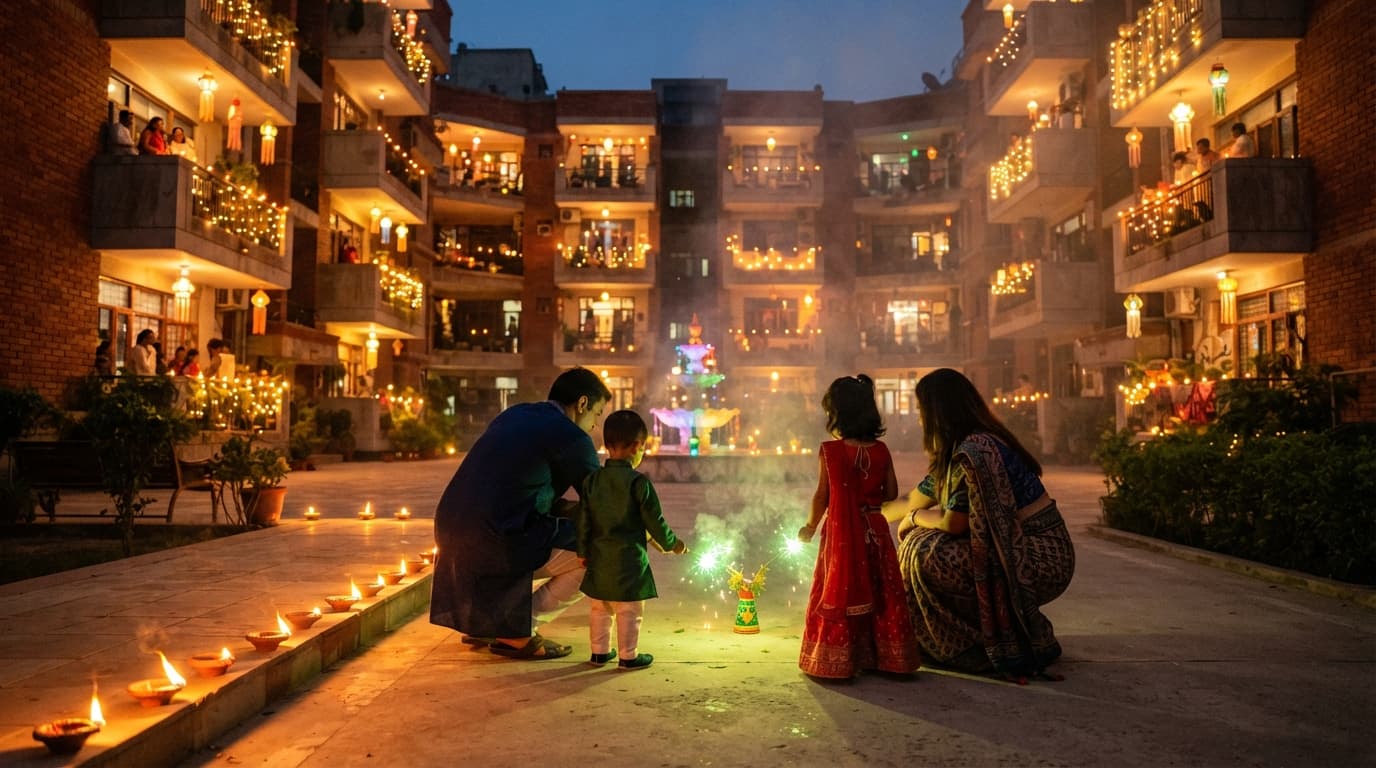
The Supreme Court of India on Monday permitted the sale and bursting of certified green firecrackers in Delhi and the National Capital Region on November 7 and 8, 2026, for limited hours, while ordering a complete ban again from November 9. The permission covers two short windows each day, between 6 AM and 7 AM in the morning and between 8 PM and 10 PM at night. The order applies only to firecrackers certified as green and sold through lawful channels. The bench said the relaxation seeks to balance festival practice with air quality concerns in the capital region.
A complete ban on firecrackers will stand reinstated from November 9 across Delhi-NCR. Sale or bursting after the two-day window will invite confiscation and prosecution under the order. Authorities have been directed to seize illegal stock and proceed against violators. Pollution control bodies have been tasked to collect environmental data during the period to assess the effect of the limited permission. The data collection will run alongside enforcement on the ground.
The directions were issued by a bench of Justices M M Sundresh and P B Varale. The bench made clear that the permission is time-bound and product-specific. It does not open general sale or use of conventional firecrackers in the region. Only certified green firecrackers fall within the relaxation. All other types remain prohibited.
Two-day window with fixed hours
Residents in Delhi, Noida, Ghaziabad, Gurugram, Faridabad and other NCR towns may burst only certified green firecrackers on November 7 and 8, and only during the hours fixed by the court. Morning bursting is allowed between 6 AM and 7 AM. Evening bursting is allowed between 8 PM and 10 PM. No bursting is allowed outside those hours, even on the two permitted days. Sellers may sell only during the period covered by the order and only stock that meets certification norms.
For households, the message is narrow. Buying a box marked green is not enough unless the product carries approval from CSIR-NEERI and the manufacturer holds a valid licence linked to Petroleum and Explosives Safety Organisation standards. Retailers will be expected to show certification for the stock on their shelves. Buyers who burst crackers beyond the fixed hours, even if the product is certified, will be in breach of the order. Police and local administration have been empowered to act on the spot.
No-cracker zones around sensitive places
No firecracker, including certified green stock, may be burst within a 300-metre radius of hospitals, nursing homes, primary and district health centres, old-age homes, educational institutions and notified silence zones. The court described these areas as No-Cracker Zones. The restriction applies on both permitted days and during permitted hours. A resident living near such a facility must move outside the 300-metre radius to burst even a permitted product, or refrain altogether.
Enforcement of the zones will fall on district administration, police and municipal bodies in Delhi and the neighbouring NCR districts. Hospitals and schools are not required to fence the radius themselves, but their locations will guide patrolling and complaints. Silence zones already notified under noise control norms remain covered. Where a housing colony adjoins a hospital or school, residents will need clear information on the boundary. The order leaves no exception for small or low-emission products inside those zones.
Why Supreme Court of India limited permission
The court framed the two-day relaxation as a middle path between festival custom and public health. Delhi-NCR faces severe air quality stress in late October and November, when smoke, dust, low wind and stubble-related load combine with local emissions. Past orders had imposed a full ban on sale and use of firecrackers in the region to curb spikes in particulate matter. Calls for a limited allowance for green crackers were raised before the bench this season. The bench accepted a short, controlled opening rather than a general lifting of the ban.
Green firecrackers, as approved by CSIR-NEERI, are designed to emit less particulate matter and gaseous pollutants than conventional products and to reduce noise within prescribed limits. The court did not treat them as pollution-free. That is why the permission ties use to certification, time slots and place restrictions, and pairs it with monitoring. Pollution control bodies will gather air and noise data before, during and after the two days. The figures will give the court and the administration a record of what a limited window means in practice.
Only certified makers, no laris
On the supply side, the order allows only manufacturers holding valid certifications from CSIR-NEERI and PESO to produce approved green crackers between November 2 and 6. The production window is short. Units without current certification cannot use the interval to make or pass off stock as green. Traders sourcing from uncertified units will carry the same risk as sellers of conventional crackers. The court directed confiscation of illegal firecrackers and prosecution of violators.
Two categories are barred outright. The court prohibited the manufacture and sale of laris, which are firecrackers joined in series, and of crackers containing barium or lacking CSIR-NEERI approval. Laris prolong bursting and multiply smoke and noise, which runs against the purpose of a time-bound allowance. Barium-based compositions raise toxicity concerns and have been the subject of earlier restrictions. Shopkeepers must therefore check both the certification mark and the product type. A green label alone will not protect a lari string or a barium-containing item.
Police, district magistrates and explosives and pollution control authorities will need to coordinate checks at manufacturing units, wholesale mandis, retail shops and entry points where non-compliant stock may be brought into NCR. The order expects swift seizure where stock is unapproved, mislabelled or of a prohibited type. Prosecution will follow under applicable law. For consumers, the practical advice is simple. Keep purchase bills, burst only what is permitted, and keep within the fixed morning and evening hours on November 7 and 8.
From November 9 the position returns to a complete ban, with the same No-Cracker Zones and enforcement machinery in place. Any leftover green stock from the two days cannot be burst after the window closes. Manufacturers must stop the approved production run on November 6. Pollution data collected by the monitoring agencies will show whether the limited opening can be repeated with tighter controls or needs review.
Comments
Sign in to read the discussion and share your thoughts.
Latest from LawWorld
News
View all- Supreme Court Seeks Centre, ECI Reply On Plea Against Immunity For CEC And ECs4 Nov 2026
- Supreme Court Directs MP Speaker To Decide Bina MLA Disqualification Plea In Two Months4 Nov 2026
- Supreme Court Orders Special Cell To Monitor Child Labour Law Enforcement4 Nov 2026
- Bail Cannot Rest On Judge's Personal Notions Of Morality, Rules Supreme Court4 Nov 2026
- Supreme Court Refers Two-Child Norm Penalties To Larger Bench As Outdated4 Nov 2026