
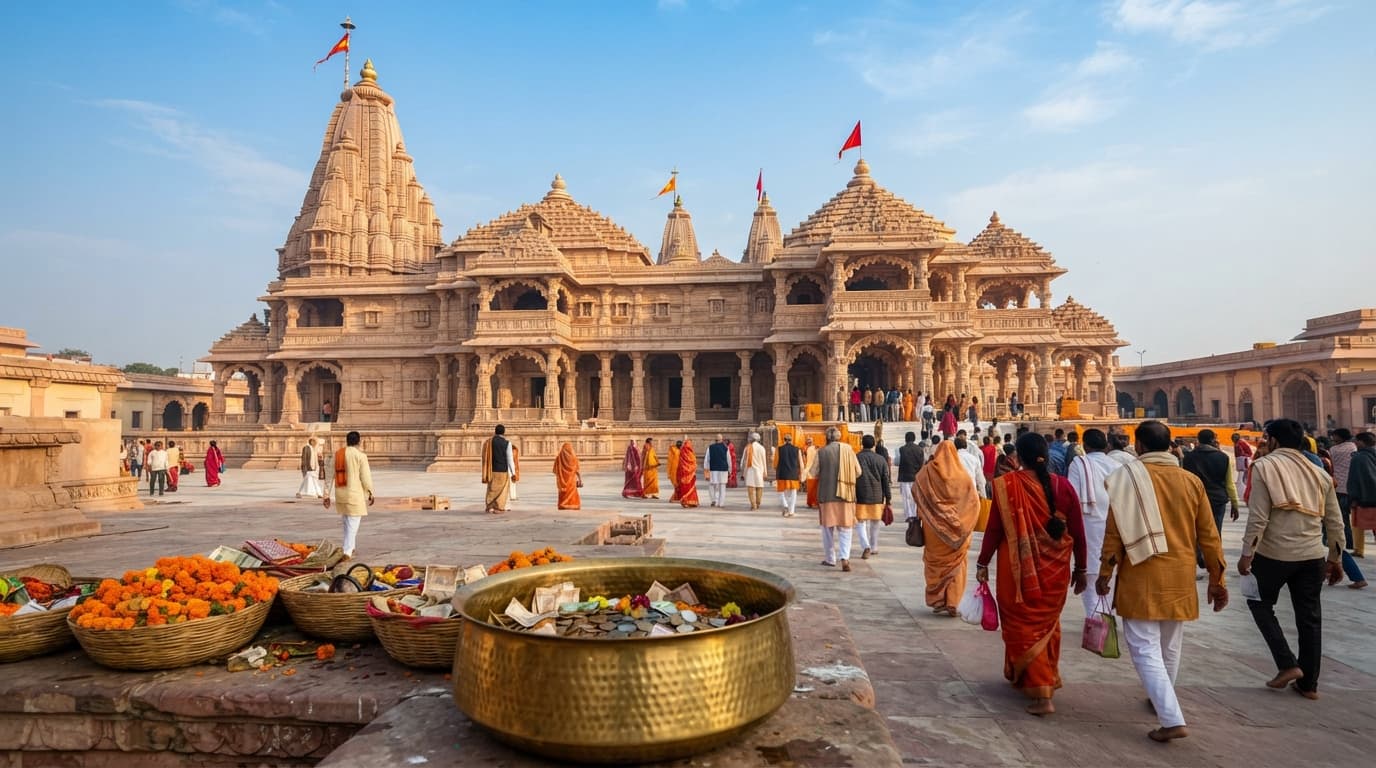
A fresh plea in the Ram Janmabhoomi case Supreme Court asks for an independent technical check of the Ayodhya Ram temple site and a full audit of donations and accounts. Filed by the Shri Ram Janmbhoomi Case Trust, it is listed for hearing on November 2, 2026, before Chief Justice Surya Kant with Justices Joymalya Bagchi and V. Mohana. The filing returns to the land decided in the 2019 Constitution Bench decision and to how public offerings for the temple are handled.
The petition makes two requests. It wants an independent commission of technical experts to verify whether the temple stands on the exact land adjudicated in 2019. It also wants the Comptroller and Auditor General of India to audit donations and accounts, with daily digitisation and display of offerings to stop misappropriation. The petitioner says it is distinct from the Shri Ram Janmbhoomi Teerth Kshetra Trust, which is in charge of construction and management.
Temple site verification sought
At the centre of the first prayer is location. The plea asks the court to get experts to confirm on the ground that the built temple matches the parcel dealt with in the 2019 decision. No survey number mismatch or encroachment is alleged on the material available. What is sought is a verification exercise so compliance can be placed on record. For readers tracking the Ram Janmabhoomi case judgement, the question is one of implementation, whether the paper decree matches the structure on the site.
If admitted, such a task would turn on revenue maps, settlement records, and the decree and site plans from the earlier adjudication. In land disputes courts often call for survey officials, engineers and demarcation reports when identity of the plot is contested. Here the petitioner wants that job given to an independent commission, not the temple management. The court will have to decide if any doubt has been shown, what the scope should be, and who will give the experts access to records and the site and pay for the exercise.
Donations take several forms at a shrine of this size, cash in hundis, online transfers, cheques and drafts, and offerings in kind such as gold and silver. The plea seeks a CAG audit of the collections and accounts alongside daily entry and public display of figures. In practice that would mean counting procedures, receipts, bank credits, stock registers for valuables, and publication at short intervals so devotees can see what came in.
What Ram Janmabhoomi case Supreme Court plea seeks
The audit prayer raises a separate legal question on the reach of public audit over religious endowments. The Comptroller and Auditor General audits government receipts and spending and the accounts of authorities and bodies under statute or specific directions. A direction for such an audit here would depend on the legal character of the trust, the source of its land and funds, and whether public law duties attach to its work. The bench will likely examine maintainability and the exact legal basis for the relief against a body that is not a government department.
Daily digitisation and display would be an administrative direction, not an audit finding. Courts in temple administration matters have ordered display boards, electronic receipts and periodic statements where facts called for it. The plea asks for a similar regime, with entries made and shown each day. The court will consider if that is needed, whether it can work day to day given the volume of offerings, and how it fits with the existing management scheme. Any order would also have to fix responsibility for data handling, reconciliation with bank statements, and correction of errors or delays.
Among Ram Janmabhoomi case lawyers who practise in land and trust matters, the choice of petitioner has drawn attention. The name on the petition, Shri Ram Janmbhoomi Case Trust, closely resembles the Ram Janmabhoomi case name from the long title litigation. The material states it is separate from the Teerth Kshetra Trust that builds and manages the temple. That separation will matter. The court will look at who the petitioner is, what link it has to the land or the donations, and whether it has standing to seek relief that concerns another trust, the deity and devotees.
Two trusts, separate roles
On the information available, construction and management rest with the Teerth Kshetra Trust. The petitioner approaches as an outsider seeking oversight. In public interest and representative actions, courts test standing, delay and alternative remedies before passing orders that affect daily management. Counsel may be asked to explain the source of its knowledge on location and accounts, the documents relied on, and why the relief was not sought first from the authorities directly concerned with administration or audit. The answers will shape whether notice is issued or the matter ends at admission.
For court watchers who follow Ram Janmabhoomi case judges over the years, the present formation is familiar. The matter sits before the Chief Justice with two companion judges, the usual bench for fresh public law petitions at admission. No view on merits can be read into a listing. Those who recall the Ram Janmabhoomi case verdict will remember the 2019 adjudication was by a five-judge Constitution Bench, while further directions on implementation can come before smaller benches under the roster.
Court to consider maintainability first
Procedure at this stage is narrow. The Ram Janmabhoomi case hearing on November 2, 2026 will start with maintainability. The court will assess whether the petition discloses a breach of fundamental rights or a public law wrong, whether the prayers seek a roving inquiry without foundation, and whether the respondents arrayed are the proper parties. If it finds an arguable case it may call for responses from the management and any public authority holding records. If not, it may decline interference with brief reasons. Interim orders for survey or audit before replies are filed are rare and would need a strong case of urgency and risk of irreparable harm.
The verification prayer in particular will be tested against finality. The Ram Janmabhoomi case judgement settled title and gave directions for handover and management, and construction has since proceeded on that basis. A plea that reopens identity of the land must show why revenue and court records are not enough and why a fresh commission is needed after the decree. The court may also consider whether civil and revenue forums, which routinely handle demarcation with site inspection and survey, are better placed to examine any specific discrepancy backed by documents.
The petition will be called on November 2, and the order that day will decide whether it is dismissed, whether notices go to the respondents, or whether records are called for first.
Comments
Sign in to read the discussion and share your thoughts.
Latest from LawWorld
News
View all- Supreme Court Seeks Centre, ECI Reply On Plea Against Immunity For CEC And ECs4 Nov 2026
- Supreme Court Directs MP Speaker To Decide Bina MLA Disqualification Plea In Two Months4 Nov 2026
- Supreme Court Orders Special Cell To Monitor Child Labour Law Enforcement4 Nov 2026
- Bail Cannot Rest On Judge's Personal Notions Of Morality, Rules Supreme Court4 Nov 2026
- Supreme Court Refers Two-Child Norm Penalties To Larger Bench As Outdated4 Nov 2026