
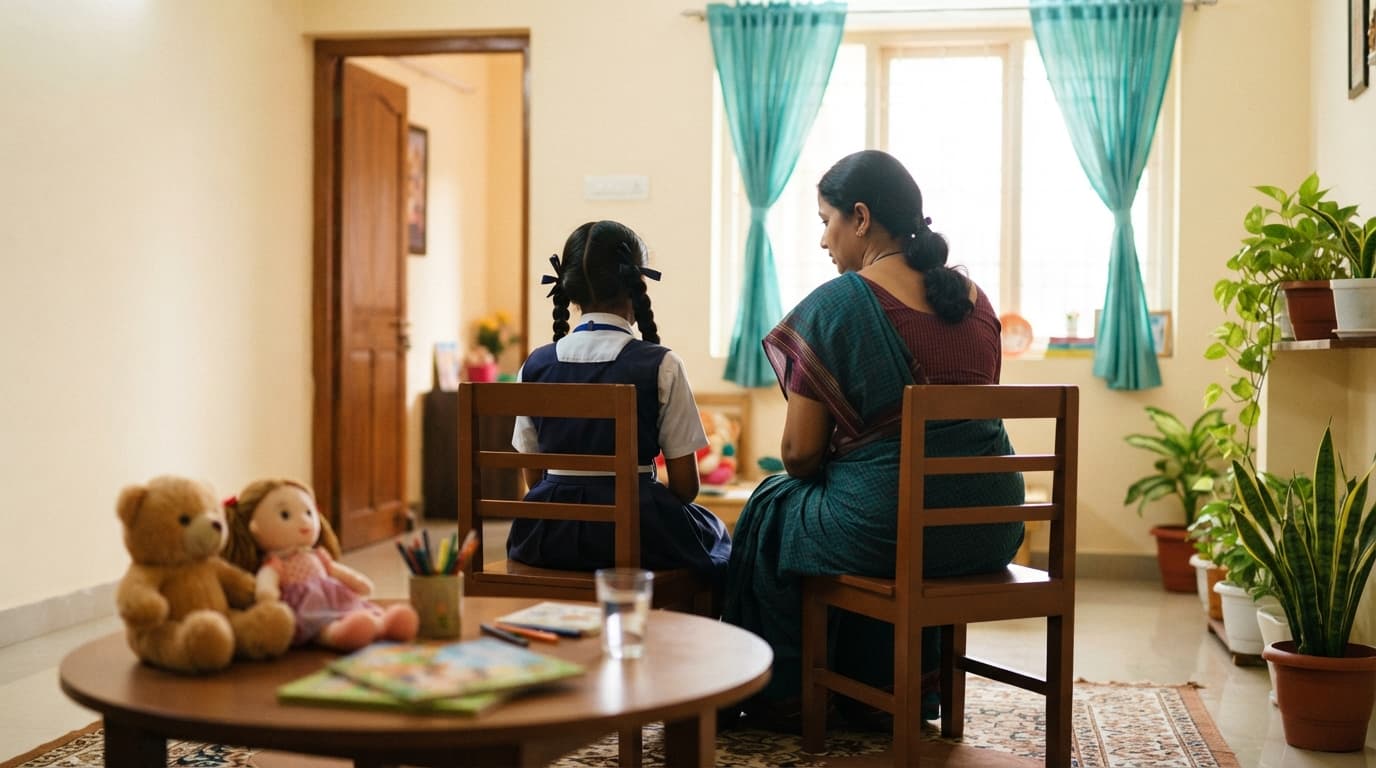
The Karnataka High Court has quashed a trial court order that allowed an accused in a Protection of Children from Sexual Offences Act case to recall the minor survivor for further cross-examination. The Court set aside the recall direction. The child will not face another round of questioning on that plea, and the trial will proceed on the evidence already recorded.
Pleas to recall a child witness stand on a different footing from ordinary recall applications. The Court said a judge must weigh the right of the accused to a fair trial against the statutory demand to shield the child from repeated adversarial exposure. Recounting abuse in a courtroom takes a toll, and it cannot be ordered again without strong and specific justification.
No names have been disclosed beyond the recall question. The identity of the survivor, the details of the allegations and the exact stage of trial are not set out. That restraint follows the bar on disclosure of a child survivor's identity under POCSO and allied laws. The issue before the Court was narrow: whether further cross-examination was permissible after the child had already been examined and cross-examined.
Trial Court Allowed Fresh Cross-Examination
The accused had moved the trial court to call the child witness back for further cross-examination. A trial court can summon, recall or re-examine a witness at any stage before judgment if the step is necessary for a just decision. Here, the trial court used that power and granted the defence another round with the survivor. That order did not record a finding on guilt. It was challenged before the High Court.
Before the High Court, counsel for the petitioner called the recall unnecessary and harsh. The argument invoked the child-protection scheme of the POCSO Act, which requires proceedings to be conducted in a child-friendly manner. Once testimony and cross-examination were complete, counsel said, permission for yet another round amounted to harassment rather than a fair-trial measure.
The defence argued the other way. Further questioning was needed, it said, to test the testimony and to secure a full opportunity to defend a serious charge. The trial court had accepted that submission at first instance. The High Court drew the line differently where the witness is a child survivor of alleged sexual assault.
High Court Rejects Routine Recall Pleas
The High Court said the criminal process must not itself add to the trauma of a vulnerable victim. A minor who has deposed and faced cross-examination and is then put through repeated questioning in open proceedings can turn fearful, ashamed and unwilling to speak. The Court observed that repetition has little forensic value when the defence has already had a full chance to challenge the earlier statement, unless exceptional reasons appear on record.
Routine recall cannot be used as a litigation tactic. An application that seeks to bring the child back without showing what new fact, contradiction or subsequent event makes further questioning strictly necessary must fail. A general wish to ask more questions, to rephrase old questions or to probe the same answers from another angle does not meet that test. Trial courts must ask what remains untested with precision, and why it was not put during the earlier cross-examination.
Orders on recall are discretionary and must give reasons. When the witness is a child, those reasons must show that POCSO safeguards were applied and not merely the convenience of counsel. A brief, mechanical order that grants recall without weighing the effect on the child and without identifying the specific need for it will be vulnerable in revision or writ proceedings.
POCSO Bars Aggressive, Repeated Questioning
The POCSO Act provides a separate, protective framework for offences against children. Parliament built in measures to reduce intimidation inside courtrooms, including in-camera proceedings, screens to avoid direct confrontation, breaks during testimony and the presence of support persons. Questioning of a child is to be conducted with sensitivity, without aggression or repetition. The statute also limits how often a child can be called to depose.
Judges in POCSO trials are expected to control the tone and length of cross-examination. They may disallow questions that are irrelevant, insulting or needlessly repetitive. They must also ensure the child understands the questions and is not overwhelmed. Prosecutors, legal-aid lawyers and support persons are to alert the court when questioning turns oppressive. The ruling treats repeated recall as an extension of that protection.
The right to cross-examine remains. It was exercised here during the first round. What the Court has curbed is a second or later opportunity sought without adequate cause. Defence counsel must therefore finish effective cross-examination at the first opportunity, prepare on the charge sheet and prior statements, and place any special reason for recall on affidavit with supporting material. Vague claims of prejudice will not suffice where the witness is a minor survivor.
Prosecutors and child welfare bodies are likely to cite the order to oppose similar pleas in other POCSO trials in the state. Trial judges will have to demand specifics rather than general submissions when recall of a child is sought. Commissions for Protection of Child Rights and District Legal Services Authorities that monitor POCSO courts can use the reasoning to train panel lawyers and to support child witnesses who fear being called again.
With the recall order set aside, the record will stand as it was before recall was granted. The trial court will move the case toward arguments and judgment on the evidence already recorded, without putting the child through further cross-examination on that application. Any fresh plea for recall will have to clear a higher threshold.
Comments
Sign in to read the discussion and share your thoughts.
Latest from LawWorld
News
View all- Supreme Court Seeks Centre, ECI Reply On Plea Against Immunity For CEC And ECs4 Nov 2026
- Supreme Court Directs MP Speaker To Decide Bina MLA Disqualification Plea In Two Months4 Nov 2026
- Supreme Court Orders Special Cell To Monitor Child Labour Law Enforcement4 Nov 2026
- Bail Cannot Rest On Judge's Personal Notions Of Morality, Rules Supreme Court4 Nov 2026
- Supreme Court Refers Two-Child Norm Penalties To Larger Bench As Outdated4 Nov 2026