
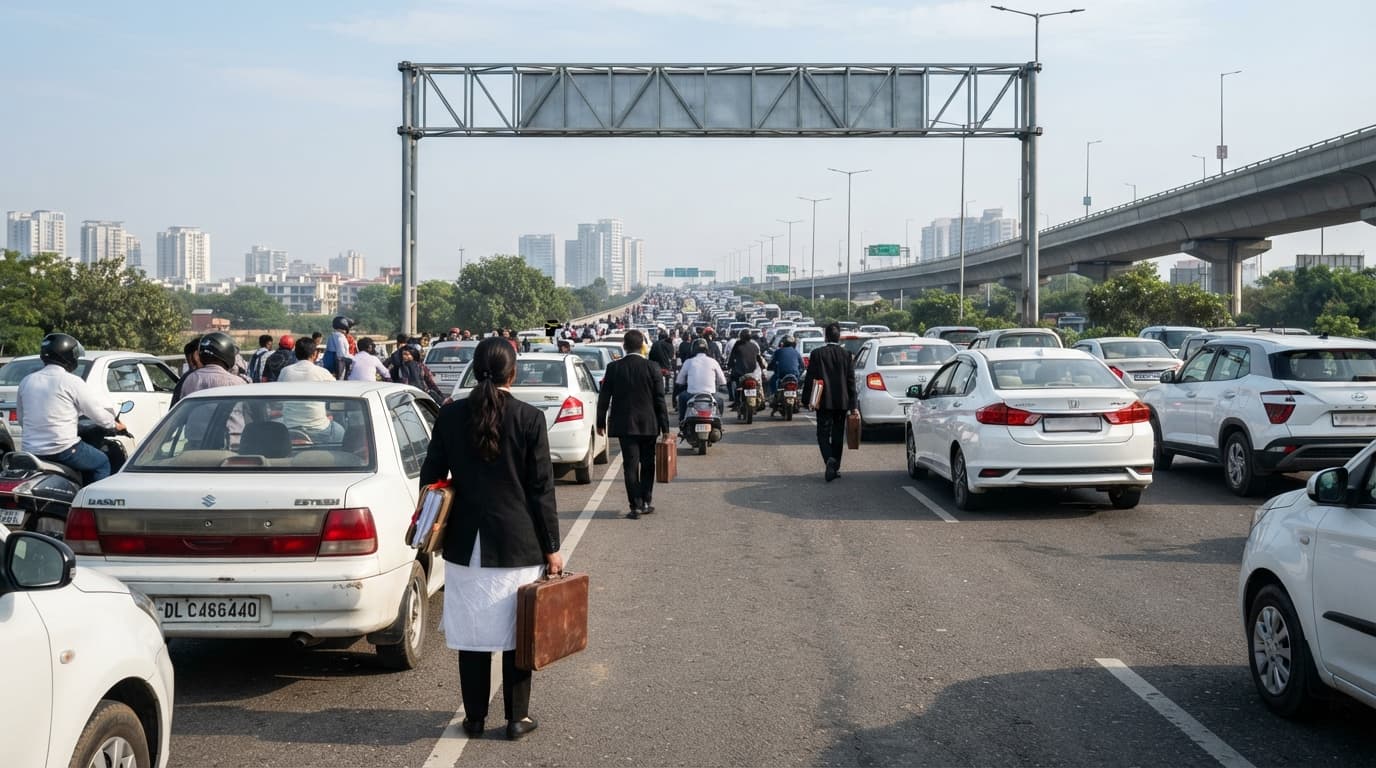
New Delhi, Oct 31: The Supreme Court Bar Association has asked the Supreme Court administration to intervene over restrictions on vehicles that do not meet Bharat Stage-VI standards in Delhi with effect from November 1, 2026, saying daily travel for a large number of advocates from the National Capital Region could be hit and the smooth administration of justice could suffer.
Addressed to the Secretary General of the Supreme Court, the representation said members practising before the apex court commute every working day from Noida, Ghaziabad, Gurugram and Faridabad. Many still use vehicles bought before the current emission regime began. If those vehicles are stopped at the Delhi border or inside the capital, the Association said, lawyers may not reach court on time.
Counsel are essential to the functioning of courts, the Association said. A curb that keeps counsel from appearing affects hearings. It touches litigants, instructing counsel and the courts that depend on their presence. The plea seeks an administrative resolution before the restriction starts.
According to the Association, the Supreme Court had through earlier orders permitted the use of vehicles meeting previous emission standards under prescribed conditions. Those orders, it said, did not contemplate a complete bar in all circumstances. Regulated use was allowed where conditions fixed by the court were met. The representation did not seek adjudication of pollution policy itself. It asked the court administration to take up the hardship with the authorities concerned.
Restriction date nears for NCR commuters
The request is tied to the November 1 date. With the restriction set to operate from the start of the month, the Association said members had little room to arrange alternative transport or replace vehicles at short notice. The hardship described is immediate and practical. It involves getting to chamber, to the court complex, to client conferences, and back to offices in the satellite towns in the evening.
For lawyers based outside Delhi, the commute is part of the working day. Counsel living in Noida or Ghaziabad often travel through east Delhi to reach the Supreme Court complex. Those in Gurugram or Faridabad travel across the southern corridor. Public transport covers parts of these routes, the Association indicated, but it does not fully replace a personal vehicle for a professional who carries case files, books and robes and must move between the Supreme Court, the High Court, tribunals and offices within tight gaps.
Court work runs on strict time. Matters are called item by item. Passovers are limited. A lawyer who misses the call may lose the hearing for that day. Adjournments cost litigants time and money. The Association said that was why it had approached the administration now, rather than waiting for instances of difficulty after enforcement begins.
Working patterns at the Bar add to the problem. Juniors travel with seniors. Clerks carry records. An advocate-on-record based in Delhi may depend on a colleague coming in from Ghaziabad to argue a matter. A chamber in Noida may brief counsel who must appear in Delhi at 10.30 a.m. A single missed connection, the representation suggested, can affect a chain of briefs.
Fear of disruption to administration of justice
The central ground raised by the Association is continuity in the administration of justice. In court practice, the expression covers the day-to-day ability of courts to hear and decide cases without avoidable dislocation. It includes the presence of judges, staff, counsel and parties, the availability of records, and the orderly listing of matters. Restrictions on movement, even for a public purpose, need to account for this requirement, the Association said.
Advocates have a defined role in that system. They assist the court as officers, hold instructions from litigants, and remain responsible for compliance with directions, filing of documents and adherence to timelines. The Association said advocates are central to the administration of justice, and any restriction that affects their commute would directly affect their ability to perform professional duties before the court.
That argument extends beyond civil and constitutional matters. The Supreme Court and the courts in Delhi take up bail pleas, appeals against conviction, suspension of sentence, quashing petitions and transfer petitions every day. Delay in such cases bears directly on personal liberty. On that basis, the Association linked its request to the wider administration of criminal justice, where the presence of defence counsel and the prosecutor on the fixed date is often determinative.
The Association has not questioned the objective behind emission controls. Its case, as stated, concerns method and transition. It seeks intervention by the court administration to ensure that lawyers who must enter Delhi for judicial proceedings are not placed in a position where compliance with a traffic or pollution direction makes it difficult to comply with a court date.
What the earlier court orders allowed
Much of the representation turns on what the Association described as earlier orders permitting vehicles meeting previous emission standards under prescribed conditions. The material communicated did not identify a specific case number or set out the full text of those conditions. The Association relied on them to contend that the court had earlier favoured regulated use rather than an absolute prohibition in certain contexts.
For readers unfamiliar with the background, the question of what are BS VI norms is central to the present restriction. The Bharat Stage standards prescribe permissible limits for pollutants from vehicle tailpipes, including particulate matter, nitrogen oxides, hydrocarbons and carbon monoxide. Each successive stage tightens those limits and requires changes in fuel quality and engine technology.
In general terms, BS VI emission norms set stricter ceilings than the standards that preceded them and apply to private cars, taxis, goods vehicles and other categories on public roads. The BS VI pollution norms are enforced through fuel specifications, type approval for new models, registration rules and, in cities with severe air quality stress, curbs on older vehicles.
The history of BS-VI norms in India is one of successive tightening, with each stage leaving less room for older engine and fuel combinations. The Association's reference to previous standards must be read in that context. Its point is that vehicles bought lawfully under an earlier regime, and which remain validly registered and insured, were allowed to operate subject to conditions laid down in the past.
Lawyers following the issue have also raised related questions about scope. One concerns BS VI norms for two-wheelers, which involve separate technical thresholds but form part of the same shift to cleaner combustion and after-treatment systems. Another concerns BS VI Stage II norms, a further phase that tightens testing and on-road performance requirements, including real-driving measurements and stricter control under actual use. The Association has not linked its request to any particular sub-stage, but the queries show why motorists find the framework difficult to follow at the point of enforcement.
Balance between pollution control and court functioning
Delhi's winter months bring a familiar conflict between emergency pollution measures and the need to keep essential services running. Curbs on vehicle entry and use are among the tools available when air quality deteriorates. Courts have in the past accepted that such measures may be needed, while also allowing regulated exceptions where public interest required continued movement.
By this plea, the Association has invited the court administration to consider whether lawyers fall within that practical category during working hours on court days. It does not ask for exemption from emission law as such. It asks for engagement with the enforcing agencies so the transition does not disrupt listed matters.
Such engagement could take several forms. The administration could seek clarification on whether vehicles with valid pollution-under-control certificates and registration will be stopped, whether any pass system for court work is contemplated, and how staff at border points will verify compliance. It could also ask whether a time-bound arrangement is possible while longer-term questions of fleet renewal are addressed.
Emphasis has been placed on four commuter belts. Noida and Ghaziabad in Uttar Pradesh and Gurugram and Faridabad in Haryana together account for a large share of the Bar's residential base outside Delhi. Many advocates settled in these towns as housing costs in the capital rose and metro and expressway links improved. That residential pattern, built over years, cannot be altered before a November 1 enforcement date.
From the court's side, the practical concern is listing. The Supreme Court lists a heavy board each day, including fresh matters, after-notice matters and regular hearing matters. The Delhi High Court, district courts and tribunals function on parallel tracks. If even a small proportion of counsel face entry problems on the same morning, the effect could spread across courtrooms in requests for passover, adjournment or proxy appearance.
The Association said that outcome would hit litigants most directly. A client who has travelled from another state expects counsel to be present. An adjournment means fresh travel, fresh expense and extended uncertainty. For legal aid matters and clients with limited means, the cost of a lost date is relatively higher.
No judicial order on the representation had been communicated in the material available at the time of reporting. The Association has approached the administration, not filed a substantive writ petition on the issue. Any response would come as an administrative decision or a communication with the enforcement authorities. Until then, members have been left to plan travel on the assumption that the restriction will operate as announced.
For now, the immediate question is whether any clarification or facilitative arrangement will issue before November 1. Advocates commuting from the four towns named in the representation will watch for guidance on which vehicles may enter and ply in Delhi, what proof will be checked on the road, and whether court-related travel will receive regulated consideration consistent with the earlier orders cited. The answer will decide how many lawyers reach the court complex on Monday morning and how the week's boards proceed.
Comments
Sign in to read the discussion and share your thoughts.
Latest from LawWorld
News
View all- Supreme Court Seeks Centre, ECI Reply On Plea Against Immunity For CEC And ECs4 Nov 2026
- Supreme Court Directs MP Speaker To Decide Bina MLA Disqualification Plea In Two Months4 Nov 2026
- Supreme Court Orders Special Cell To Monitor Child Labour Law Enforcement4 Nov 2026
- Bail Cannot Rest On Judge's Personal Notions Of Morality, Rules Supreme Court4 Nov 2026
- Supreme Court Refers Two-Child Norm Penalties To Larger Bench As Outdated4 Nov 2026