
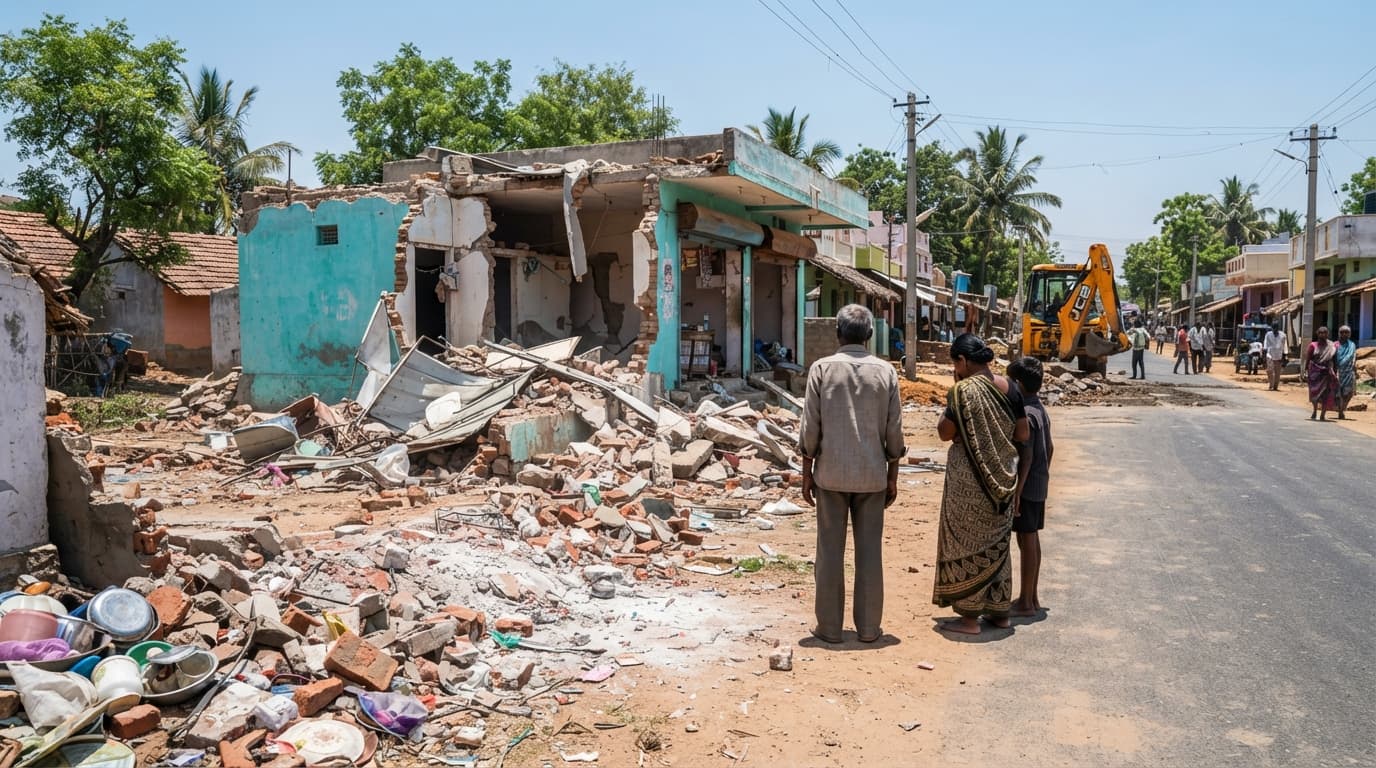
The Karnataka High Court has dismissed a writ appeal filed by the Panchayat Development Officer of Mangalore Grama Panchayat in Koppal district and upheld an order directing the officer to pay Rs 50,000 from personal resources to petitioner Dharmaveer for the illegal demolition of his residential-cum-commercial structure. A Division Bench of Justice M. Nagaprasanna and Justice Hema Kulkarni held that demolition done in the name of road-widening, without formal land acquisition proceedings and without compensation, violated Article 300A of the Constitution of India.
It refused to interfere with the single judge's order imposing the personal cost. The amount must reach Dharmaveer within four weeks of receipt of the judgment. The panchayat was told to stop any further unauthorised action against the property and to follow the procedure prescribed by law if the land is needed for a public purpose. The financial liability stays on the officer concerned, not on panchayat funds.
Dharmaveer's property was acted against on the ground that it encroached on road land. The case record showed the panchayat issued a notice on October 22, 2023, seeking removal of the alleged encroachment. Demolition followed. Dharmaveer moved the High Court, contending the structure was lawful, there was no encroachment, and the authorities had pulled down a residential-cum-commercial building without acquiring the land and without paying compensation.
October Notice, Survey And Demolition
The Bench traced the sequence from the October 2023 notice to the demolition. Two questions framed the inquiry. Had the panchayat proved encroachment before it acted, and did it have power to take private property for road-widening without acquisition. The Court answered both in the negative. It found the demolition was carried out despite prior High Court directions for a survey to verify the allegation.
A claim of encroachment does not by itself allow removal of a building. The authority must demarcate the road and the private holding, give the owner a fair chance to reply, complete the survey with reference to revenue records and then, if private land is still needed, acquire it under the applicable law on payment of compensation. That course was not followed here, the Court said.
The omission weighed heavier because a court-ordered joint survey had been directed to settle the factual dispute. Conducted under the Court's directions, that survey found no encroachment. Once that finding came on record, the factual basis for the demolition fell away. The Bench treated the survey result as conclusive and rejected the defence that the action was taken in good faith for maintenance of public roads.
Court files often describe one set of complaints as illegal building demolition. Another set, involving deviations from sanctioned plans, is entered as illegal construction demolition. The labels cover different fact patterns. In one category, the owner says a lawful building was removed without survey or compensation. In the other, the authority says it carried out a lawful demolition of illegal structures after notice and hearing. This case fell in the first category. The joint survey showed the building was not on road land, and no acquisition notification or award was produced to support taking private land for widening.
How illegal demolition Charge Was Proved
Single judge had relied on the joint survey to hold that the demolition had no factual foundation. The Division Bench agreed. Where a court-ordered measurement based on revenue records shows absence of encroachment, the authority cannot defend the demolition as a routine anti-encroachment drive, it said. The record pointed to road-widening being used as a reason to take private property without following the law.
That distinction answered the officer's reliance on other types of disputes. A plea of illegal house demolition usually turns on title, sanctioned plan and whether the house stands on the owner's land or on public land. A dispute over illegal temple demolition can raise added questions of religious use, public trust and eviction procedure. In each, the court calls for measurement, title papers, sanction, notice and hearing. Here the measurement supported the owner, and the process for taking private land had not begun.
The Bench held the action violated the right to property article in the Constitution. Article 300A provides that no person shall be deprived of property save by authority of law. Courts have read the provision to require clear legal power, fair procedure and compensation where the law provides it before private property is taken for a public purpose. The right to own property does not block acquisition for roads and other public needs, but it bars taking by executive order. A panchayat that needs private land for widening must acquire it and pay for it.
Panchayat Development Officers hold statutory powers for sanitation, roads and removal of obstructions. Those powers do not include a general power to pull down a residential-cum-commercial structure on private land on the assumption that the land will be needed for the road, the judgment said. Where the building is lawful and stands on private land, the only lawful route is acquisition. Demolition without acquisition and without compensation amounts to deprivation of property without authority of law.
Court Insists On Acquisition And Compensation
Part of the order directs the panchayat to cease further unauthorised action and to proceed by formal acquisition. That stops repeated coercion on the same property while leaving the lawful option open. If the panchayat still needs part of Dharmaveer's land, it must issue the requisite notification, hear objections where the statute provides, determine compensation and take possession in accordance with law. The owner will then have the remedies under the acquisition law to contest need, measurement and compensation.
The Court did not bar the State or the panchayat from acquiring land for a public purpose in future. It barred action outside the law. The difference matters for both sides. Owners cannot block a lawful acquisition by citing rights alone, but authorities cannot bypass acquisition by calling demolition a removal of encroachment. Revenue maps, survey numbers and joint measurement decide the first question. The acquisition statute decides the second.
Short-notice procedure also drew comment. The notice dated October 22, 2023 sought removal of alleged encroachment, yet demolition followed even as measurement and the need for a survey were before the Court. Once the Court directs a joint survey, the authority is expected to wait for the result and act only on that basis. Action taken before or contrary to the survey finding invites invalidation and exposes the officer to personal costs, the Bench said.
Personal Costs And Officer Accountability
Rs 50,000 as personal costs, payable to Dharmaveer within four weeks, drew attention among local body officers. The Bench made clear the sum must come from the officer's personal resources and not from panchayat funds. Personal costs in writ proceedings are not routine. They are imposed where the action caused direct and avoidable loss to a citizen and the defence lacks factual support.
Mistake of fact was hard to plead because of the joint survey finding. Compliance with law was hard to plead because no acquisition proceedings existed. Together, the two findings supported the conclusion that the demolition lacked factual and legal basis. In that setting, the Division Bench found no reason to set aside the costs imposed by the single judge and dismissed the writ appeal.
For petitioners, such costs give limited monetary relief. Rs 50,000 will not rebuild a demolished structure. Dharmaveer remains free to pursue other remedies under law for restoration, damages or compensation for the demolished portion, subject to proof and applicable procedure. The High Court's order does not quantify the full loss. It provides immediate payment for the violation and records a finding that the demolition was unlawful, which may carry weight in any later claim.
Road-widening files must now carry survey reports, encroachment mahazars prepared with revenue officials, notices with adequate time to reply and, where private land is needed, acquisition proposals with compensation. Oral instructions, general resolutions to widen roads and presumptions from visual inspection are not a substitute for measurement and acquisition. The four-week clock for payment will run from receipt of the judgment, and proof of deposit or transfer to Dharmaveer must be placed on record. Default can lead to further enforcement proceedings, while the panchayat cannot demolish or dispossess again except under lawful acquisition with compensation.
Comments
Sign in to read the discussion and share your thoughts.
Latest from LawWorld
News
View all- Supreme Court Seeks Centre, ECI Reply On Plea Against Immunity For CEC And ECs4 Nov 2026
- Supreme Court Directs MP Speaker To Decide Bina MLA Disqualification Plea In Two Months4 Nov 2026
- Supreme Court Orders Special Cell To Monitor Child Labour Law Enforcement4 Nov 2026
- Bail Cannot Rest On Judge's Personal Notions Of Morality, Rules Supreme Court4 Nov 2026
- Supreme Court Refers Two-Child Norm Penalties To Larger Bench As Outdated4 Nov 2026