
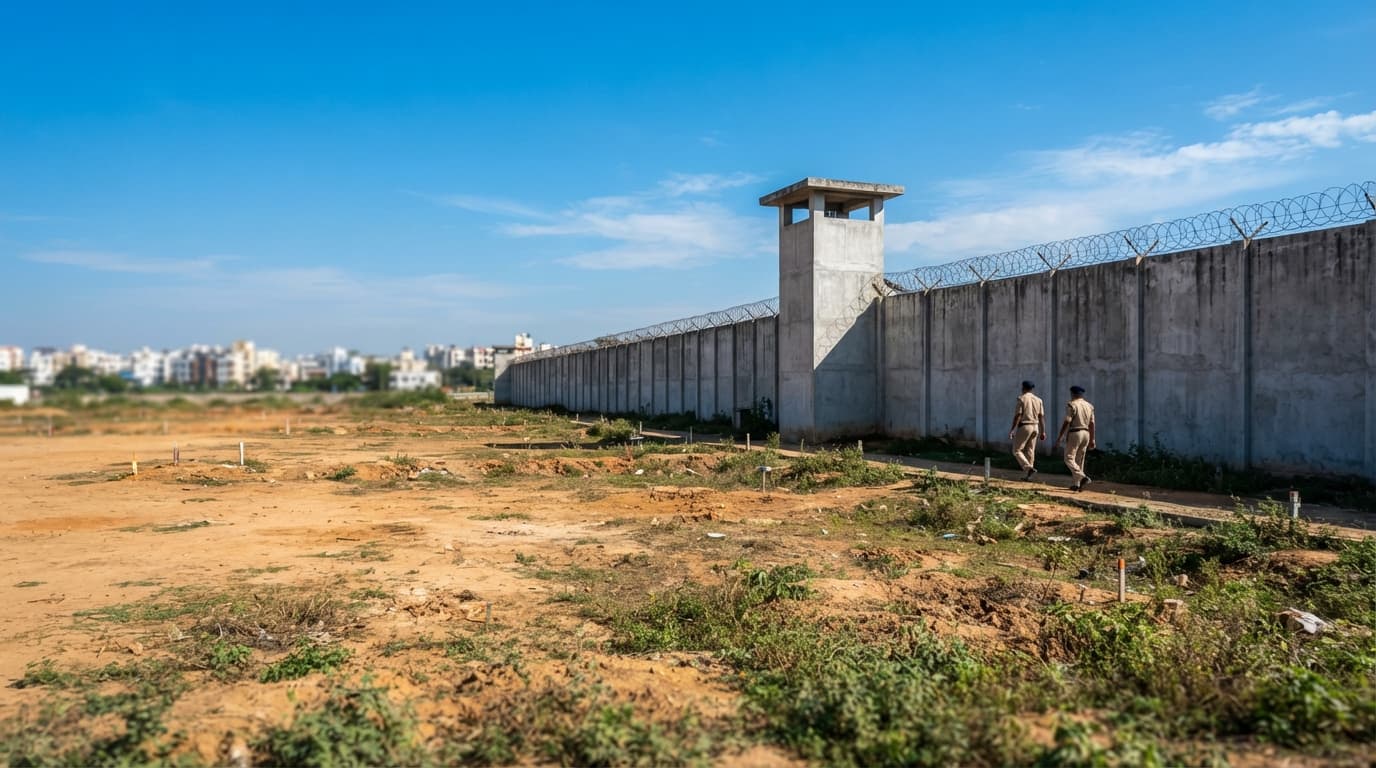
Bengaluru, October 29: A Division Bench of Justices D.K. Singh and H. Shanthi Bhushan has revived the State government's 2013 final notification for acquisition of about 20 acres at Naganathapura village for expansion of Bengaluru Central Prison at Parappana Agrahara, setting aside a single judge's May 2, 2025 order that had quashed the notification. The order was passed on October 28 and decides the challenge under the old acquisition law, at a time when many pending acquisitions are tested against principles now codified in the Land Acquisition Act, 2013.
The acquisition is for a bona fide public purpose and cannot fail on hyper-technical grounds, the Bench said. Decongestion of the overcrowded prison, a buffer zone for security around a high-security institution, and staff quarters with allied facilities made the need clear. Those are legitimate demands of prison administration and public safety, the order said. Against that need, individual objections carry less weight where the statutory procedure has been followed.
Around the Central Prison at Parappana Agrahara on the south-eastern edge of Bengaluru lie the disputed lands. The State had issued the final notification under Section 6(1) of the Land Acquisition Act, 1894 in 2013 for about 20 acres at Naganathapura village. Litigation stalled the proposal for more than a decade after landowners challenged it. The single judge quashed the final notification on May 2, 2025. On the State's appeal, the Division Bench has now restored it.
Landowners argued the Special Land Acquisition Officer had not applied his mind to their claims. Parts of the notified area held RCC buildings, plotted residential layouts, engineering workshops and other developed sites that should have been left out, they said. They also disputed the extent notified and the manner in which the State approved the acquisition.
Prison expansion held public purpose
The Special Land Acquisition Officer's report had considered objections filed under Section 4 of Land Acquisition Act and during the inquiry that followed, the Division Bench found. The officer examined the claims village-wise and plot-wise before sending the record to the government with his opinion, it said. Such recommendations do not bind the government, which must take its own decision on whether to proceed with the acquisition in whole or in part.
Expansion of an existing central prison to ease overcrowding, provide a secure buffer around the walls, and house staff on or near the campus is a classic public purpose, the order said. A prison is not an ordinary government building. Security, segregation of inmates, space for reformation work, and distance from dense habitation all demand land around the core complex. Minor slips in paperwork cannot defeat the acquisition where the substance of the procedure has been met, the court said.
Property rights did not alter that result. Article 300A protects persons from being deprived of property save by authority of law, but it does not allow resistance to every lawful acquisition, the Bench said. Where land is needed for a genuine public need and compensation is paid under the statute, the owner must give way. Only failure to follow mandatory procedure, fraud, colourable exercise of power or absence of public purpose can justify interference, the court said.
Questions under Land Acquisition Act, 2013
Much of the argument turned on which statute applies. The final notification came in 2013 under the 1894 law. Parliament has since replaced that law with the Land Acquisition Rehabilitation and Resettlement Act, which provides higher compensation, consent thresholds for certain projects, and rehabilitation duties. Pending proceedings saved under the repeal provisions are still judged for procedural validity under the repealed law, the Bench made clear, even as compensation and rehabilitation benefits may be worked out under the new framework to the extent the statute allows.
For fresh acquisitions, the Land Acquisition Act, 2013 now governs, with its requirements of social impact assessment in many cases, publication of declarations, and time-bound awards. Acquisitions started under Section 4 of Land Acquisition Act before the repeal are not automatically void because the law changed. Courts examine whether the preliminary notification, inquiry into objections, and declaration under Section 6(1) were done as that Act required, and whether the State applied its mind after receiving the inquiry record. That is the test the Division Bench applied here.
RCC buildings to be addressed lawfully
Built-up plots did not escape notice. The order records RCC buildings, residential layouts, engineering workshops and developed sites within the notified lands. The government must deal with those structures and layouts in accordance with law at the stage of taking possession, assessing compensation, and granting rehabilitation where due, the Bench directed. In practice, authorities will have to verify on the ground which survey numbers are built up, whether construction came before or after the preliminary notification, and what compensation or other relief follows for genuine occupants under the applicable provisions.
Lawyers following the case called the direction a middle path. It preserves the State's plan for a compact prison campus while leaving owners of built-up plots to seek higher compensation for structures, solatium, and shifting allowances as admissible, or to claim exclusion if a particular plot no longer needs to be taken. None of those claims can hold up the acquisition as a whole where public purpose is made out, the Bench indicated. They must be settled plot by plot under the statute, not by quashing the entire notification.
With the Division Bench order, the decade-old proposal goes back to the executive. The Home and Revenue departments are expected to complete measurement, hear remaining claims on structures, pass awards and take possession in stages. Until awards are passed and possession is taken under due process, owners retain their remedies on compensation and procedural compliance before the appropriate forum.
Comments
Sign in to read the discussion and share your thoughts.
Latest from LawWorld
News
View all- Supreme Court Seeks Centre, ECI Reply On Plea Against Immunity For CEC And ECs4 Nov 2026
- Supreme Court Directs MP Speaker To Decide Bina MLA Disqualification Plea In Two Months4 Nov 2026
- Supreme Court Orders Special Cell To Monitor Child Labour Law Enforcement4 Nov 2026
- Bail Cannot Rest On Judge's Personal Notions Of Morality, Rules Supreme Court4 Nov 2026
- Supreme Court Refers Two-Child Norm Penalties To Larger Bench As Outdated4 Nov 2026