
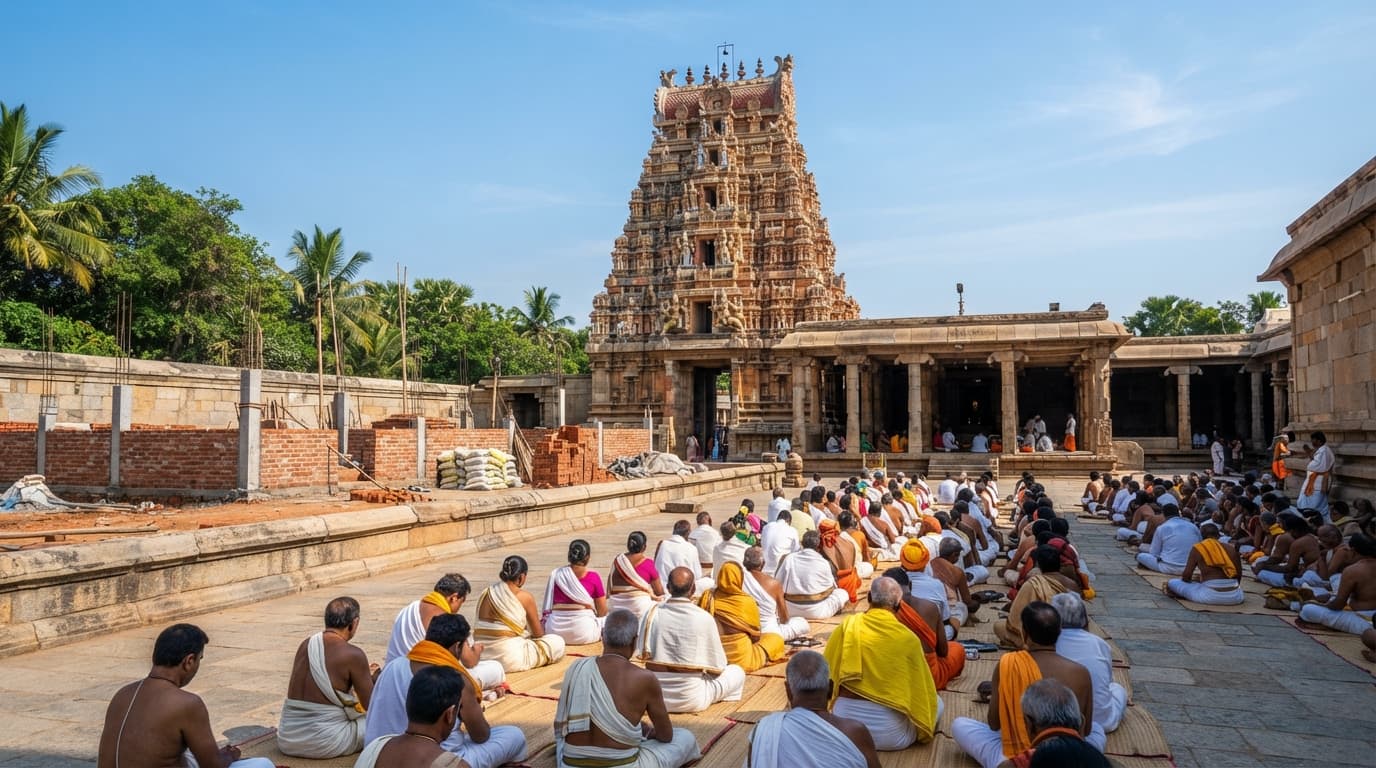
The Karnataka High Court has quashed criminal proceedings against a Bharatiya Janata Party candidate who attended a religious programme during the 2023 Assembly elections and promised a building near a temple after polling, holding that questions around Section 171E of IPC punishment did not arise on these facts. A single judge set aside the charge under the Religious Institutions (Prevention of Misuse) Act. Little remained after that. Mere presence at the gathering and such a promise, the court said, is not bribery.
Police had booked the leader while the model code of conduct was in force. His speech at the event, according to the prosecution, included an assurance that a structure would come up near the temple once elections were over. Investigators treated the attendance and the assurance as misuse of a religious institution for election purposes and as an attempt to influence voters.
He moved the High Court seeking quashing of the first information report and all further steps taken on it. The bench took up the Religious Institutions Act charge first. On the facts alleged, the court found no material to sustain it and set it aside. That left only the charge under Section 171E of the Indian Penal Code, which deals with bribery at elections.
What Section 171E of IPC Punishment Covers
Section 171E punishes bribery in connection with elections. It covers a person who gives or offers gratification to induce a voter to exercise an electoral right in a particular manner, or to refrain from doing so, and the corresponding acceptance of such gratification as a motive or reward. Conviction can lead to imprisonment up to one year, or fine, or both. The core of the offence is gratification given or offered as a motive or reward tied to the vote.
On that test, the allegations fell short, the bench said. Going to a religious event during the code period and saying a building would be raised near a temple after the polls did not show gratification offered to any voter for voting in a certain way. There was no allegation of money, gift, personal benefit to electors, or other inducement linked to the exercise of electoral rights. A general speech about future construction was not bribery within the meaning of the section.
A statement that development work will be taken up after the election, even from a religious venue, stands on a different footing from a personal inducement. It may raise questions under election law or the code of conduct. Without gratification offered to voters as a motive or reward, it does not meet the legal definition of bribery. The court held that element was missing here.
Why Procedure Under Section 155 Failed
The court then turned to procedure. Section 171E is non-cognizable. Police cannot investigate such an offence without an order from a magistrate under Section 155 of the Code of Criminal Procedure. Here the first information report had cited cognizable charges under the Religious Institutions Act, so police began investigation without seeking that permission. Once that part went, only the non-cognizable charge survived.
Section 155 is not a formality. Police must inform the magistrate when information relates to a non-cognizable offence and take direction before inquiry or investigation. The safeguard stops routine police action in less serious cases without judicial oversight. Where police start on the strength of a cognizable offence that later drops out, they cannot use that initial authority to carry on with what is left. The bench applied that rule and held the investigation had no lawful authority.
Two questions decide such cases, the order said. First, do the facts disclose the offence as defined in law. Second, did police follow the correct path to investigate it. Failure on either ground can lead to quashing. Here the surviving charge failed on both counts: the promise did not amount to gratification under Section 171E, and the inquiry went ahead without the order the Code demands.
Code Curbs On Religious Venues
The facts also touched the model code of conduct and campaigning from religious places. The code restricts appeals to religion and the use of places of worship for election propaganda, and election authorities can issue notices, directions or complaints under election law for breaches. The Religious Institutions (Prevention of Misuse) Act separately bars use of temples, mosques, churches and other religious institutions for political activity beyond what the statute permits. The bench found the conduct described in this first information report did not meet that test.
Complaints built only on attendance or speech face difficulty, lawyers in election cases say. Without details of who was offered what, and in return for which electoral act, a bribery charge will struggle. Investigating officers have to check whether any gratification was directed at voters and linked to voting. General assurances of future public work, even before devotees or supporters, are treated differently from gifts, payments or personal benefits for votes.
This ruling gives no finding on the political propriety of speaking at a religious event during the code period. Election authorities remain free to act under their own powers if they find a breach of the code or election law. What the judgment holds is narrower. Criminal prosecution for bribery needs proof of gratification, and prosecution for misuse of a religious institution needs the ingredients of that Act. Both were absent.
With the proceedings quashed, the candidate will not face trial on this first information report. Police records will show the case against him as closed unless the State files a review or appeal within the time allowed by law.
Comments
Sign in to read the discussion and share your thoughts.
Latest from LawWorld
News
View all- Supreme Court Seeks Centre, ECI Reply On Plea Against Immunity For CEC And ECs4 Nov 2026
- Supreme Court Directs MP Speaker To Decide Bina MLA Disqualification Plea In Two Months4 Nov 2026
- Supreme Court Orders Special Cell To Monitor Child Labour Law Enforcement4 Nov 2026
- Bail Cannot Rest On Judge's Personal Notions Of Morality, Rules Supreme Court4 Nov 2026
- Supreme Court Refers Two-Child Norm Penalties To Larger Bench As Outdated4 Nov 2026