
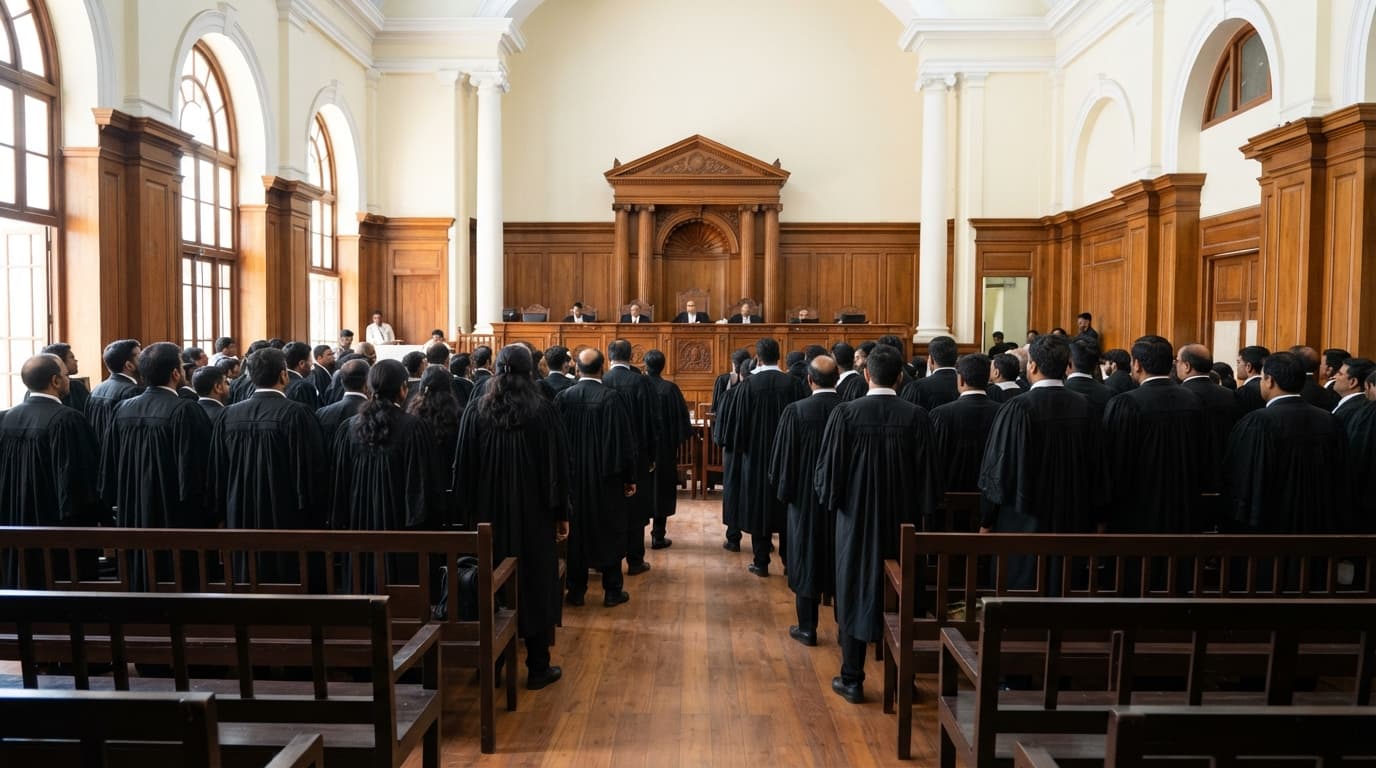
The Karnataka High Court on November 3, 2026 started suo motu contempt proceedings over alleged disruption in the Chief Justice's court hall during a lawyers' protest. A Division Bench of Chief Justice Vibhu Bakhru and Justice K.S. Hemalekha took cognisance on its own motion and said the conduct appeared prima facie to amount to contempt of court and unbecoming of members of the Bar.
It registered the matter as In Re: Suo Motu Contempt Proceedings over Court Hall Disruption. The registry must examine CCTV footage from the hall to identify those involved and place the material before the Court. Notice will go to the Advocates Association of Bengaluru. The case will come up again before the same Bench on November 19, 2026.
Disruption during lawyers' protest
Behind the incident was a protest call by the Advocates Association of Bengaluru and the Karnataka State Bar Council. They are pressing for stronger protection and effective enforcement of the Prohibition of Violence Against Advocates Act, 2023. The demand follows complaints of attacks on lawyers and a call for firm legal and enforcement action to ensure their safety while they discharge professional duties.
Material placed before the Bench suggested that persons present in the Chief Justice's court hall raised slogans and stalled the hearing while the protest was on. The Court distinguished that kind of conduct from peaceful abstention from work or a representation made through proper channels. Shouting during a hearing, entering in numbers that make business impossible, or preventing a Bench from proceeding have been treated by courts in past cases as possible interference with the administration of justice, when proved on facts.
No final finding has been recorded on who took part. The order at this stage reflects only a preliminary view. It means the allegations, if established after inquiry, could attract the contempt jurisdiction and therefore call for a formal probe. Identification of individuals, verification of their roles, and an opportunity to explain their conduct will follow under the procedure laid down for such cases.
Lawyers present in the High Court complex described the mood that day as tense over the larger agitation on safety of advocates. The Bench separated the cause behind the protest from the method used inside the courtroom. Protection of Bar members raises one set of issues. Maintenance of order in a hall where hearings are in progress and litigants wait for their matters raises another.
How contempt of court law works
The High Court acts here as a court of record with power to punish for contempt of itself. Authority for that flows from the Constitution and the Contempt of Courts Act, 1971. In everyday talk some lawyers refer to the statute as the Court of Contempt Act, though the official title remains the Contempt of Courts Act, 1971. That law sets out the definitions of civil and criminal contempt, the procedure for taking cognisance, and the punishments that may follow after a full hearing.
Criminal contempt covers acts that scandalise the court, prejudice or interfere with the due course of judicial proceedings, or obstruct the administration of justice. A disturbance inside a courtroom during a live hearing can fall for examination under that third category, depending on the facts proved. Civil contempt concerns wilful disobedience of a judgment, decree, direction or undertaking given to a court. The Bench has described the present allegation as misbehaviour in court, which for now points to interference and obstruction rather than disobedience of a specific order.
A suo motu start means the Court has acted on its own, without a petition by a private party or a reference by the State. The Bench records the reasons that call for inquiry, registers a case title, and issues directions to collect relevant material. In court-hall incidents that material often includes the court diary for the day, reports from court staff and security, minutes of proceedings, and electronic records such as CCTV footage. The registry has been asked to complete that exercise here.
Once individuals are identified from the video and other records, the Court may issue show-cause notices to them in addition to the notice already issued to the association. Those who receive notice will be required to file replies or affidavits setting out their version of events. They will have the right to be heard, to be represented by counsel, and to place facts showing absence of intent, mistaken identity, or mitigating circumstances. The Court may also consider whether any apology offered is bona fide and whether it meets the legal test for acceptance.
Punishment follows only after the charge is proved to the satisfaction of the Court and after hearing on sentence. The statute provides for simple imprisonment, fine, or both, within defined limits. Courts have said the power exists not to shield judges from criticism but to protect the functioning of the institution so cases can be decided without fear, pressure or disorder. That distinction will weigh in the further hearings in this matter.
Demand for advocates protection law
The protest that formed the context for the incident centred on the Prohibition of Violence Against Advocates Act, 2023. The Advocates Association of Bengaluru and the Karnataka State Bar Council have sought strengthening of that law and its effective implementation on the ground. Their demand reflects concern over physical attacks, threats and intimidation faced by advocates in and around courts, police stations, and other places of work.
Bar members argue that attacks on lawyers affect more than the individual victims. When counsel are threatened for appearing in a matter or for advising a client, the argument goes, the access of the client to representation suffers and the trial process itself comes under strain. Bar bodies have therefore pressed for clear definitions of prohibited acts, prompt registration of complaints, time-bound investigation, deterrent punishment, compensation for injury and loss, and institutional responsibility for security in court precincts.
The State Bar Council is the statutory body for advocates in Karnataka. The Advocates Association of Bengaluru is the principal association for practitioners in the city. Both have played visible roles in taking up issues of welfare and safety through abstention calls, memoranda to authorities, and peaceful demonstrations outside court buildings. The Court has not questioned the right of lawyers to make representations or to seek legislative and administrative change through lawful means.
What is under scrutiny in the present proceedings is narrower. The order focuses on what happened inside the Chief Justice's hall while the protest was on, and whether that conduct crossed the boundary from legitimate expression of grievance to obstruction of a live hearing. Support for stronger protection for advocates can coexist with enforcement of discipline inside courtrooms, and the prima facie remarks of the Bench point in that direction.
The early notice to the Advocates Association of Bengaluru follows that logic. When a protest is called by a Bar body, the Court often seeks the stand of that body on record at the threshold. The association will have an opportunity to state whether it authorised or had knowledge of the conduct in the hall, what instructions were given to members about maintaining decorum, and what steps it proposes to prevent recurrence. The reply filed by the association will therefore carry weight in shaping the next orders.
Notice to association, hearing on November 19
For now the directions are administrative as well as judicial. Examination of CCTV footage is intended to create an objective record of entry, movement, utterances and behaviour inside the hall. The registry will be expected to correlate time stamps with the cause list and the order sheet for the day, so the Court can see which matters were interrupted and for how long. Staff reports and any contemporaneous notes by court officials may supplement the video record.
The notice to the Advocates Association of Bengaluru brings a representative voice into the proceedings. The association can assist the Court by identifying office-bearers present on the day, producing communications issued to members about the protest, and clarifying whether any individual action departed from the association's decision. If the association disowns the disruption, it may still be asked about measures to uphold decorum during future agitations. If it seeks to explain the conduct, the Court will test that explanation against the record.
Individual lawyers face a direct message from the order. Presence in a court hall during a hearing carries obligations that apply even during a period of collective protest. Counsel are expected to seek leave before speaking, avoid collective shouting, and take grievances about listing, adjournments or policy to the Chief Justice through a deputation or written representation rather than through interruption of a sitting Bench. Junior members and interns who may have followed others into the hall will need to consider their own position carefully once notices are issued.
Litigants pay the price when a Bench hearing stalls. Cases fixed for admission, interim orders or final hearing lose time that is difficult to restore. The High Court in Karnataka handles a heavy board every day, and even a short stoppage in the Chief Justice's court can have a ripple effect on mentioning, allocation, and administrative directions. The contempt jurisdiction in that sense protects the interest of the litigant in an orderly hearing as much as the dignity of the Bench.
The Bench will review the registry report and the response of the association on November 19, 2026. It will then decide whether to issue notices to individuals, call for further reports, or pass other directions to carry the inquiry forward.
Comments
Sign in to read the discussion and share your thoughts.
Latest from LawWorld
News
View all- Supreme Court Seeks Centre, ECI Reply On Plea Against Immunity For CEC And ECs4 Nov 2026
- Supreme Court Directs MP Speaker To Decide Bina MLA Disqualification Plea In Two Months4 Nov 2026
- Supreme Court Orders Special Cell To Monitor Child Labour Law Enforcement4 Nov 2026
- Bail Cannot Rest On Judge's Personal Notions Of Morality, Rules Supreme Court4 Nov 2026
- Supreme Court Refers Two-Child Norm Penalties To Larger Bench As Outdated4 Nov 2026