
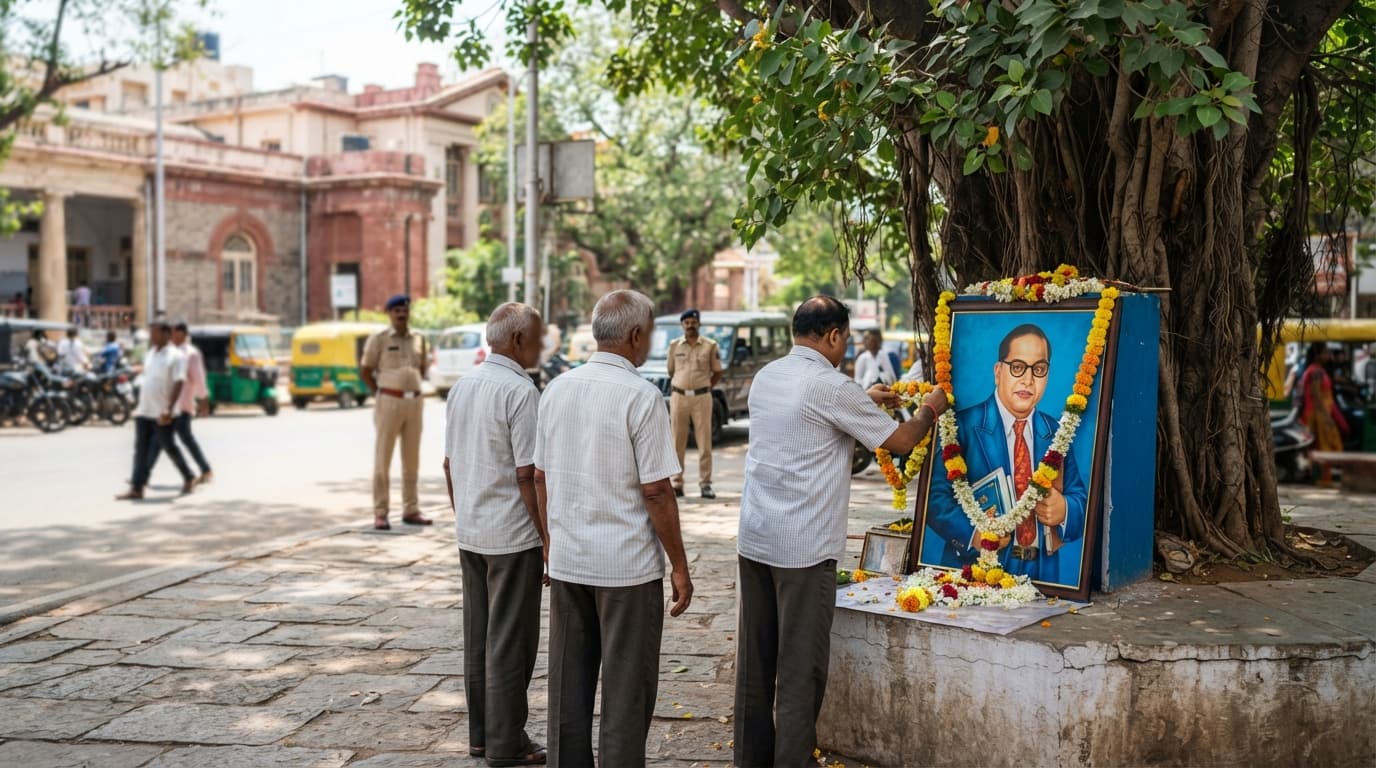
The Karnataka High Court has granted regular bail to a 38-year-old man accused of tying footwear to photographs of Dr B R Ambedkar and Babu Jagjivan Ram in March 2026. Justice Rajeshwari N Hegde, sitting singly, set aside the Sessions Court order dated June 19, 2026, which had refused bail. Investigation is complete and the charge sheet has been filed, the Court said. The accused has spent six months in judicial custody. He has no criminal antecedents. He will be released on a personal bond of Rs 1 lakh with one surety for the like sum, subject to conditions.
He had first sought release after arrest and remand. The Sessions Court refused relief in June. The High Court has now taken a different view on the need for further custody. It did not go into the merits of the allegation. The only question was whether the man should stay in jail during trial. The Court said he need not.
The prosecution case, as placed before the Court, is that footwear was tied to photographs of the two leaders in March this year. Dr Ambedkar, architect of the Constitution, and Babu Jagjivan Ram, freedom fighter and former Deputy Prime Minister, command wide public respect. The act, the prosecution said, was meant to insult their memory and provoke communal disturbance. The defence did not seek a finding on guilt at the bail hearing. Arguments centred on custody, the status of investigation and criminal history.
Six months in judicial custody was admitted on both sides. The period covers the initial remand after arrest, extensions while police collected material, and the time after the charge sheet was placed before the competent court. When the High Court heard the plea, no request for police custody was pending. No further recovery was claimed from the accused. In that setting, the bench observed that keeping him inside would serve no investigative purpose.
Sessions Court Rejection Set Aside
Trial courts refuse bail for varied reasons. They look at the gravity of the allegation, the stage of investigation and the risk of interference. Here the Sessions Court had, on June 19, found those considerations weighed against release. The High Court, exercising concurrent power to grant bail, reassessed the same record at a later stage. The change was material. Investigation had closed. The charge sheet was on record. The accused had already spent half a year in jail. A superior court in such circumstances can take a fresh view without commenting in detail on the earlier reasoning.
Lawyers who practise in bail matters say the sequence is common. An accused first moves the Sessions Court after remand. If relief is refused, he moves the High Court. The second court does not act as an appeal in the strict sense. It applies its own mind to custody. Filing of the charge sheet often alters the balance. Once police have collected oral and documentary material and placed it before the trial court, the claim that release would hamper collection loses force. Courts then focus on securing attendance at trial.
Regular Bail After Charge Sheet Filed
Justice Hegde rested the decision on four linked grounds. First, investigation is over. Second, the final report is filed, so the trial court now has the papers on which the prosecution will rely. Third, the petitioner has been in judicial custody for about six months, a period the bench treated as substantial where the probe no longer requires detention. Fourth, no criminal antecedents were shown against him. Together, these pointed to release on conditions. The Court made clear that bail at this stage expresses no view on conviction or acquittal.
Absence of antecedents carries weight in such orders. Courts ask whether the accused has earlier convictions or pending cases suggesting repetition or flight. A clean record alone does not ensure bail. But with completed investigation and prolonged custody, it reduces the stated risks. The prosecution placed no material to show prior convictions or a history of disobeying court process. The bench proceeded on that basis. It also recorded that no case for custodial interrogation survived the charge sheet.
The terms of release are financial and behavioural. The accused must execute a personal bond for Rs 1 lakh with one surety for the like sum. A personal bond is an undertaking by the accused himself to pay the amount if he fails to attend or breaks conditions. A surety is a solvent person who guarantees that undertaking and can be called on to produce the accused. The amounts are not fines. They operate as security to compel presence. Furnishing surety before the trial court often involves identification, address proof and solvency verification.
Conditions to Secure Fair Trial
Conditions on bail are meant to keep the trial on track. Though the full list will appear in the written order, such conditions in cases of this type generally require the accused to attend hearings regularly, not to tamper with witnesses or evidence, not to leave the jurisdiction without permission, and to appear when summoned. Breach can lead to cancellation and return to custody. The trial court will enforce compliance as the case proceeds. The High Court order does not dilute the prosecution right to seek cancellation on fresh material showing misuse.
With bail granted, the focus shifts to trial. The Sessions Court will now take steps for committal or framing of charges, examine witnesses and decide the case on evidence. The accused will remain on bond until the verdict unless the bond is cancelled for lawful reasons. The prosecution will rely on the charge sheet already filed.
Comments
Sign in to read the discussion and share your thoughts.
Latest from LawWorld
News
View all- Supreme Court Seeks Centre, ECI Reply On Plea Against Immunity For CEC And ECs4 Nov 2026
- Supreme Court Directs MP Speaker To Decide Bina MLA Disqualification Plea In Two Months4 Nov 2026
- Supreme Court Orders Special Cell To Monitor Child Labour Law Enforcement4 Nov 2026
- Bail Cannot Rest On Judge's Personal Notions Of Morality, Rules Supreme Court4 Nov 2026
- Supreme Court Refers Two-Child Norm Penalties To Larger Bench As Outdated4 Nov 2026