
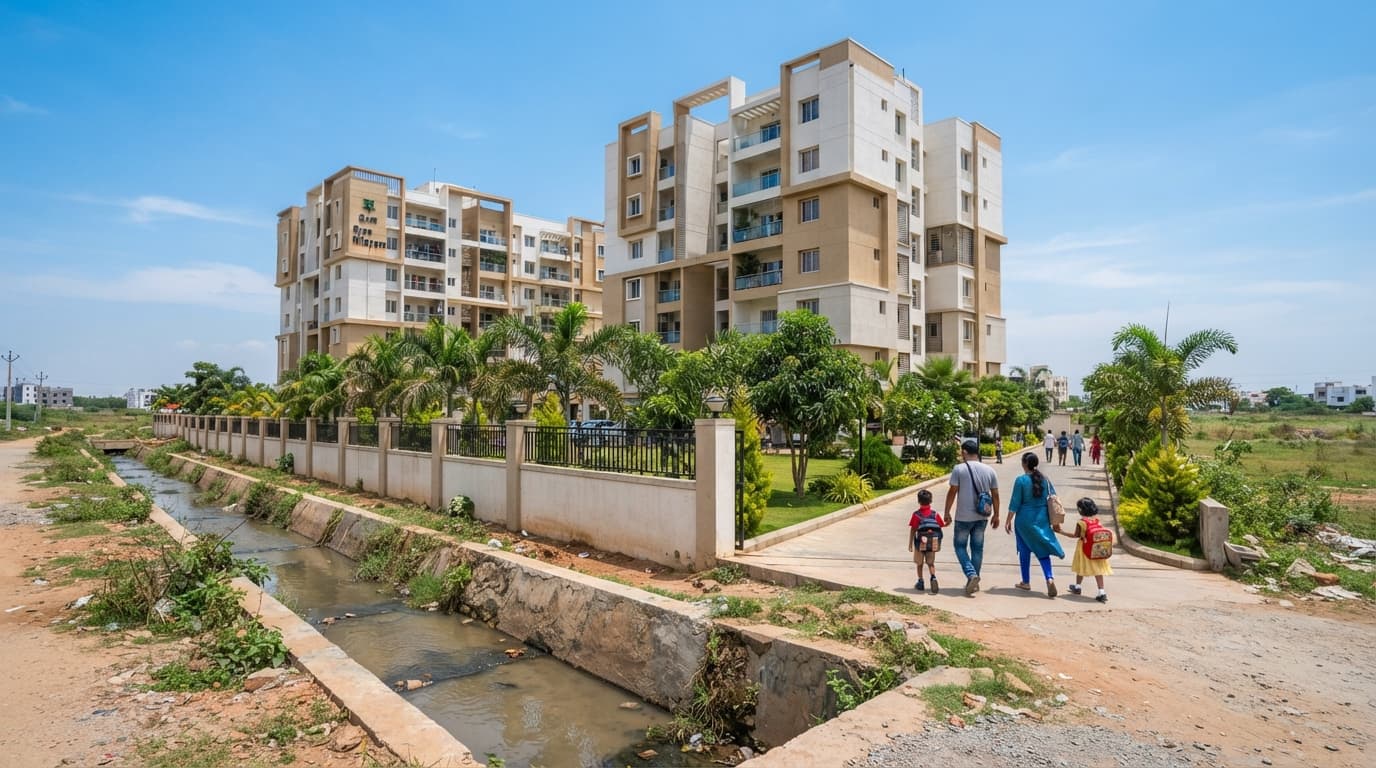
The Karnataka High Court on October 15, 2026 restrained authorities from taking coercive steps against the Infrany Petals and Hollyhock apartment complexes on Survey No. 56 at Kammasandra in Anekal taluk over an alleged encroachment of a storm water drain. No demolition or other coercive measure can be taken without a specific notice and an opportunity of hearing to the petitioner-Association, Justice E.S. Indiresh said in Writ Petition No. 32428 of 2026. The Court did not decide whether any encroachment exists.
The protection operates against the respondent authorities in respect of the two named residential complexes. It covers coercive action in any form linked to the allegation that a nala or kaluve runs through or along the property. Such action, the Bench said, including demolition of built-up portions or compound structures, must follow due process of law. The direction was issued at the consideration stage without any finding on title, survey boundaries or revenue records.
For residents of the two complexes, the immediate effect is a pause. No portion of the buildings can be pulled down or sealed on the ground of drain encroachment until the Association is first told in writing what exactly is alleged and is given a chance to reply. The question of encroachment is left open. Neither the residents nor the authorities can therefore treat the order as a declaration that the land is free from a drain or, conversely, that it is encroached.
Alleged storm water drain encroachment
At Kammasandra village in Anekal taluk, the dispute centres on Survey No. 56, where the Infrany Petals and Hollyhock apartments stand. The allegation before the authorities was that a nala or kaluve, the local term for a storm water drain or channel that carries rainwater and connects to a larger valley system, had been encroached upon. In Bengaluru and its outskirts, such drains figure in village maps, survey sketches and drain master plans held by revenue and municipal bodies, and claims of narrowing, diversion or construction over them often lead to enforcement drives.
Those who move the High Court in such matters usually say they are bona fide purchasers or a registered association of apartment owners, that the buildings came up under sanctioned plans, and that they were never shown how their plot overlaps a public drain. Authorities, on the other hand, generally rely on survey records, spot inspections and complaints about flooding or blockage. The October 15 order does not record which set of records applies to Survey No. 56. It confines itself to procedure and says enforcement cannot begin or continue without telling the affected party what case it has to meet.
That distinction matters in practice. A finding on encroachment would call for verification of the survey number, the cadastral map, the drain alignment, the history of sub-division and conversion, and any sanctioned layout or building plan. A direction on procedure requires only that, whatever the records may show, the person likely to be affected must be heard. Justice Indiresh took the second course. The approach follows the rules of natural justice that govern administrative action affecting civil rights, particularly where homes are at stake.
In the Bengaluru context, property lawyers understand the difference between a general warning and a specific notice. A public notice that encroachments on drains will be removed, or a survey intimation issued to a village at large, does not tell an individual owner which pillar, wall or block is said to sit on a kaluve, what measurement or map the allegation rests on, and what time is given to produce documents. The Court here insisted on a specific notice. That means a communication addressed to the petitioner-Association, identifying the property, the nature of the alleged encroachment and the action proposed.
Notice first, demolition later
Demolition is treated in law as an irreversible step. Courts have repeatedly said it cannot be ordered or executed without strict compliance with the statute that authorises it and with the hearing requirement under the principle natural justice doctrine that no one should be condemned unheard. The October 15 direction applies that logic to drain-related enforcement. Even where an authority has power to remove an obstruction over a public drain, it must first put the allegation in writing, disclose the material relied upon, and allow the occupant to explain or to seek time to remove or regularise what is removable under law.
Apartment complexes add a layer of complexity, lawyers appearing in such cases often point out. A single survey number may have been split into dozens or hundreds of undivided shares, with individual flats sold to separate families. A demolition notice pasted on a gate or addressed vaguely to an owner or developer may never reach the association that maintains the common areas or the flat owners who will lose their homes. By directing that the opportunity be given to the petitioner-Association, the Court ensured the collective body representing the residents is heard before any part of the common structure is touched.
Nor does the order bar verification. Authorities can still check records, conduct a survey in accordance with law, or issue a notice calling for documents. What is barred is coercive enforcement until that process is complete. Officials can do the paperwork, measure the drain, compare the ground position with the village map, and ask the Association for its sale deeds, sanctioned plans, khata extracts and other permissions. In the meantime, they cannot bring in machinery or disconnect essential arrangements on the ground of the same allegation.
Hearing must address maps, records
A hearing in this setting is not a formality. Under the principles of natural justice, it includes adequate notice of the charge, disclosure of adverse material, time to file a reply with documents, and consideration of that reply by a competent officer before a reasoned order is passed. The Association would be entitled to know the survey number and extent said to be encroached, the width and alignment of the nala or kaluve as per records, the date and method of inspection, and whether any prior notices went to the original landowner, developer or local body.
Its own material can then go on record. That could include the sale deeds tracing title to Survey No. 56, the conversion order if agricultural land was converted for non-agricultural use, the layout sanction, the building plan approval, the occupancy certificate, and any prior survey or no-objection concerning the drain. Where flat buyers purchased after approvals, they often say they had no means to verify a decades-old drain alignment and relied on sanctions granted by public bodies. Whether that argument helps in a particular case depends on facts, but the Court has kept that chance alive.
Monsoon flooding in low-lying pockets has increased pressure on civic bodies to clear drains quickly, as past drives around Bengaluru show. Residents, in turn, fear a mistake in reading an old hand-drawn map could cost them their homes without a chance to point out the error. A prior hearing allows both concerns to be addressed. The authority gets a clear record to defend its action, and the resident gets a chance to show, for example, that the drain lies elsewhere, that the construction leaves the required buffer, or that only a compound wall and not a residential tower is involved.
No finding on encroachment
On the merits, the Court kept its hands off. The order does not say the nala or kaluve does not exist on Survey No. 56, nor does it say the two apartment complexes have encroached upon it. It does not approve or cancel any sanctioned plan. It does not direct regularisation. It simply says that if the authorities wish to act, they must act after notice and hearing. That restraint is common at the interim stage of writ proceedings under Article 226 of the Constitution, where the High Court tests whether the procedure followed is lawful and leaves disputed questions of fact for determination after hearing both sides.
The limited scope has practical consequences for both sides. The Association cannot claim the order settles title in its favour or prevents all future proceedings. It can claim only that no surprise demolition will take place. The authorities, for their part, are not prevented from proceeding in accordance with law. They can issue a fresh, specific show-cause notice, grant reasonable time, hear the Association, pass a speaking order, and then take such further steps as the law permits. Any person aggrieved by that final order would retain the usual remedies in law.
Lawyers generally advise apartment associations to use the breathing time to put papers in order. A complete set of title and approval papers should be kept in one place, the survey number history tracked, and every notice answered in writing within time rather than waiting for a hearing date. Where a notice arrives, the reply should meet the specific allegation survey point by survey point and annex the relevant maps and permissions. Oral assurances from field staff, they say, are no substitute for a written reply filed on record.
On the ground at Kammasandra, the position remains as it was before the coercive threat. The Infrany Petals and Hollyhock complexes continue in occupation under the cover of the Court's restraint. If the authorities believe action is still warranted, the next step must be a specific notice to the petitioner-Association followed by an opportunity of hearing, and any demolition or other coercive measure can only follow a decision taken after that process.
Comments
Sign in to read the discussion and share your thoughts.
Latest from LawWorld
News
View all- Supreme Court Seeks Centre, ECI Reply On Plea Against Immunity For CEC And ECs4 Nov 2026
- Supreme Court Directs MP Speaker To Decide Bina MLA Disqualification Plea In Two Months4 Nov 2026
- Supreme Court Orders Special Cell To Monitor Child Labour Law Enforcement4 Nov 2026
- Bail Cannot Rest On Judge's Personal Notions Of Morality, Rules Supreme Court4 Nov 2026
- Supreme Court Refers Two-Child Norm Penalties To Larger Bench As Outdated4 Nov 2026