
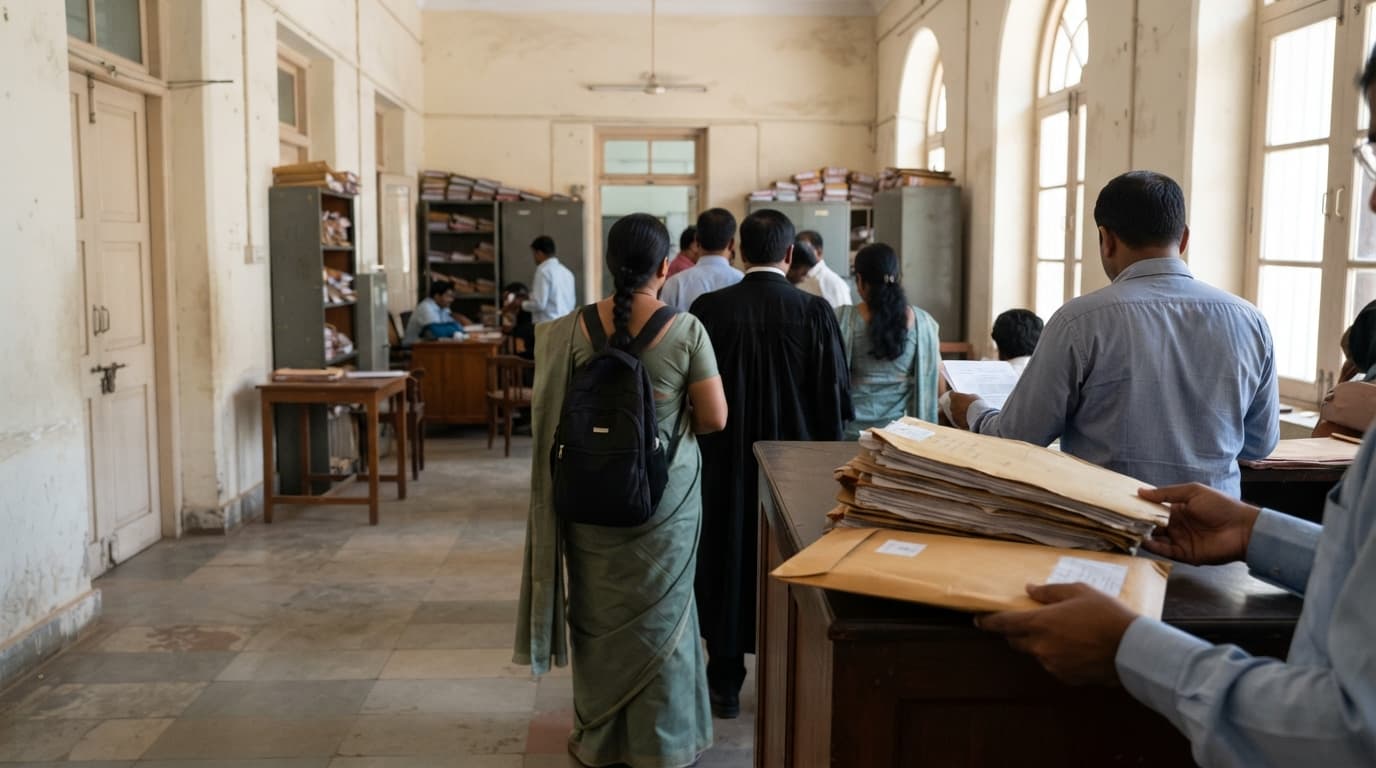
Bengaluru: The Karnataka High Court has held that litigants before the Karnataka administrative tribunal are entitled to file applications and pleadings in Kannada and that such filings cannot be rejected only because they are not in English. A Division Bench comprising Justice Ashok S. Kinagi and Justice Subramanya Rangarao set aside an order of the Tribunal which had refused to take on record an application filed by a petitioner in Kannada. The Court held after reading the relevant rules together that the filing in Kannada was entirely in accordance with law and had to be considered on its merits.
The Bench examined the regulatory framework governing filings before the Tribunal. It considered Rule 3 of the Karnataka Administrative Tribunal (Procedure) Rules, 1986, together with Rule 9(iii) of the Karnataka Administrative Tribunal Rules of Practice, 1990. On that reading, the Court said the word proceedings in Rule 3 must be understood to include the filing of originating applications. That interpretation meant an originating application presented in Kannada falls within proceedings duly instituted before the Tribunal and cannot be treated as defective for that reason alone.
The Court also pointed to the language used in the Rules of Practice. According to the order, clause (iii) of Rule 9 of the 1990 Rules expressly states that documents, affidavits and pleadings before the Tribunal may be submitted in either English or Kannada. The Bench said that provision leaves no room for a complete bar on Kannada filings. Since the petitioner had used one of the two permitted languages, the Court concluded that there was no procedural defect in the presentation of the application.
What Karnataka administrative tribunal rules say
Rule 3 of the 1986 Procedure Rules deals with the manner in which proceedings are instituted and conducted before the Tribunal. Rule 9 of the 1990 Rules of Practice deals with the preparation and presentation of pleadings, affidavits and accompanying documents. The High Court read the two provisions as part of a single scheme. Proceedings, in that scheme, were not limited to the hearing stage or to orders passed after admission. They begin with the filing of the originating application itself, and the language permission in Rule 9(iii) travels with the case from that first step.
That approach follows the ordinary method of reading subordinate legislation. A general provision on proceedings is read with the specific practice rule that tells litigants how to prepare their papers. Where the specific rule allows two languages, the general rule cannot be used to impose English alone. The Bench therefore rejected the view that an application in Kannada was not maintainable. It held that English and Kannada stand on the same footing for the purpose of filing before the Tribunal, subject to any other requirement about form, copies, verification or fees.
The order sets aside the Tribunal rejection and restores the application to the file. In practical terms, the Tribunal will now have to deal with the Kannada application in the normal course. It will have to examine whether the application meets the other procedural conditions, hear the parties where necessary, and decide the issues raised in accordance with law. The High Court did not decide the merits of the underlying service dispute. It decided only the question of language and maintainability, leaving the substantive questions open for the Tribunal.
Kannada Filings Clear Procedural Hurdle
For litigants, the order removes uncertainty that had affected Kannada filings. State government employees, teachers, police personnel, municipal staff and other applicants who seek relief before the Tribunal often work in Kannada and keep their service records, correspondence and departmental orders in Kannada. Many of them are more comfortable setting out facts, dates of appointments, promotions, transfers, seniority claims, pay fixation and disciplinary proceedings in Kannada. The ruling confirms that they may do so without facing rejection at the filing counter.
Lawyers practicing before the Tribunal also receive clear guidance. An application, written statement, rejoinder, additional affidavit or set of documents in Kannada does not require translation into English as a condition for filing. The Tribunal registry cannot insist on English as the sole filing language. At the same time, parties will still need to comply with the usual rules on legibility, paper size, margins, pagination, indexing, number of copies, service on the other side, affidavit verification and court fee. The language finding does not excuse any other defect, and the Tribunal retains the power to call for clarification or better particulars where the pleadings are vague.
The framework applies across the Tribunal system in the State, whether a matter is filed at the principal seat or at a regional location such as the Karnataka state administrative tribunal belagavi bench at belagavi. The High Court reading of Rule 3 with Rule 9(iii) does not turn on the place of filing. It turns on the text of the rules, which operate uniformly. Litigants appearing in person at different registries, and counsel filing from different districts, can therefore rely on the same position that Kannada and English are both permitted for originating applications and subsequent pleadings.
Questions about translation during hearing were not decided in the order. Tribunals in Karnataka routinely handle Kannada documents, and judges and members are familiar with both languages. Where a department files its reply in English and the applicant files in Kannada, or vice versa, the Tribunal can proceed on the basis of the record as filed. If a party or a witness needs assistance in understanding a particular annexure, the Tribunal can use the established practice of seeking a translated copy for convenience without treating the original Kannada filing as invalid. The High Court order does not direct automatic translation in every case.
English Rule in Higher Courts
The position before the Tribunal is different from the position on the official language of high courts in India. Under the Constitution, English continues to be the language for proceedings in the High Courts unless Parliament provides otherwise, and records, judgments and orders are in English. A litigant who moves from the Tribunal to the High Court in a writ proceeding will therefore enter a forum where English remains the working language of pleadings and orders. That distinction explains why the Tribunal rules needed specific consideration. The Tribunal is a statutory body governed by its own procedure rules, and those rules make express provision for Kannada.
Kannada is the official language of the State of Karnataka, and its use in administration, subordinate courts and tribunals has been encouraged through legislation and practice rules over several decades. Service litigation in particular involves orders passed by district offices, taluk offices, schools, hospitals, police units and local bodies, many of which are written in Kannada. Allowing the originating application itself to be in Kannada avoids a situation where an applicant must attach Kannada annexures but plead the case only in English. It also reduces cost and delay for applicants who would otherwise have to get their entire case translated before approaching the Tribunal.
The High Court reasoning also clarifies the limits of registry discretion. A registry can check compliance with rules on limitation, jurisdiction, parties, verification and fees. It cannot add a language condition that the rules do not contain. Where Rule 9(iii) permits pleadings in English or Kannada, refusal to register a Kannada application amounts to an error in the application of the rules. The Division Bench corrected that error by setting aside the rejection order. Future objections on language will have to be tested against the same text, and any insistence on English alone will need a rule to support it.
No further directions on costs or time limits were stated in the material on the order. The immediate effect is that the petitioner application stands restored and must be processed under the 1986 Procedure Rules and the 1990 Rules of Practice. The Tribunal will issue notice where it has not already been issued, call for the response of the concerned department, and fix the matter for hearing in its regular roster. Parties will be able to file additional pleadings in Kannada or English as permitted by Rule 9, and the Tribunal will decide the case after hearing both sides.
Comments
Sign in to read the discussion and share your thoughts.
Latest from LawWorld
News
View all- Supreme Court Seeks Centre, ECI Reply On Plea Against Immunity For CEC And ECs4 Nov 2026
- Supreme Court Directs MP Speaker To Decide Bina MLA Disqualification Plea In Two Months4 Nov 2026
- Supreme Court Orders Special Cell To Monitor Child Labour Law Enforcement4 Nov 2026
- Bail Cannot Rest On Judge's Personal Notions Of Morality, Rules Supreme Court4 Nov 2026
- Supreme Court Refers Two-Child Norm Penalties To Larger Bench As Outdated4 Nov 2026