
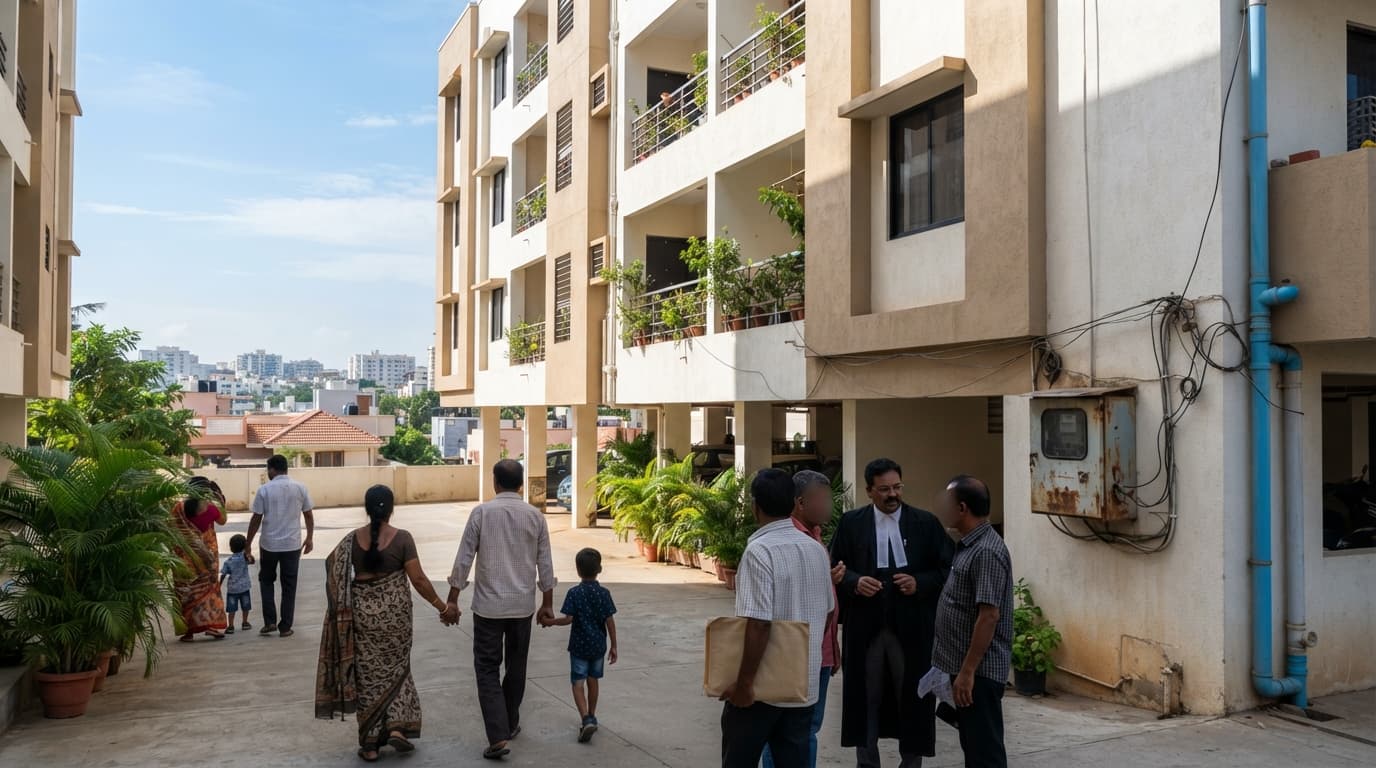
The Karnataka High Court on October 5, 2026 quashed notices to BESCOM and BWSSB to cut power and water supply to the Jeya Pride residential complex in Kagadasapura. The Court held that a demolition notice and the orders that follow it under the Greater Bengaluru Governance Act, 2024 must be served on every occupant, with a chance to be heard.
Justice B M Shyam Prasad partly allowed Writ Petition No. 31128 of 2026 filed by the flat owners. He read down the demolition confirmation order passed under Section 243 of the Greater Bengaluru Governance Act, 2024. He directed that copies of the provisional order be served on every occupant of the complex, with personal hearing under Section 243(3)(d) and eight weeks to respond.
Power and water stay on for now. The Court did not decide whether the building or any part of it is unauthorised. It laid down how the authority must proceed before it can confirm demolition and before it can ask utility agencies to cut supply. Service on the builder or on a single representative will not meet that test.
For the families in Jeya Pride, the effect is immediate. The disconnection threat from BESCOM and BWSSB is gone. The confirmation order as it stood cannot be used as a final direction to demolish. Residents will get the papers, a hearing before the authority, and a fixed period of eight weeks to place objections, title papers, approvals and occupancy records on file.
Court Sets Aside Utility Disconnection
The directions to BESCOM and BWSSB were at the centre of the petition. Such disconnection is often ordered alongside demolition action on the ground that supply should not continue to a structure facing coercive steps. The flat owners had challenged those directions along with the confirmation order under Section 243.
The Court accepted that part of the challenge and quashed the disconnection notices. The reason was procedural. If the confirmation could not stand without hearing every occupant, consequential directions to cut power and water could not stand either. The supply agencies need not act on those notices.
That distinction hits hard in apartment cases. Disconnection affects all households at once, including buyers who hold registered sale deeds, pay taxes and utility bills, and have lived in the building for years without personal notice of any violation. The Court treated them as persons affected in their own right, not as persons represented through a developer or association. Until each is served and heard, utilities cannot be used to empty the building by another route.
The relief is partial. The Court did not close the proceeding. It read down the confirmation order instead of barring all action. The file goes back to the provisional order stage, with directions on service, hearing and time.
Demolition Notice Must Reach Every Occupant
Section 243 of the Greater Bengaluru Governance Act, 2024 deals with action against unauthorised development in the Greater Bengaluru area. It provides for a provisional order, consideration of objections, and then a confirmation order. Section 243(3)(d) provides for personal hearing. The dispute was who must be served and heard when the building houses dozens of families.
The Court said every occupant must be served. Each must get a copy of the provisional order. Each must get personal hearing under Section 243(3)(d). The eight-week period is for that response — time to receive the order, take advice, collect papers and appear before the authority.
That closes a common gap in demolition files. Often the show cause or provisional order goes to the landowner or developer, at an address no longer in use. Construction is over and flats are sold. Occupants learn of the case only when officials arrive or supply is threatened. The Court said that course is not permitted under Section 243. The authority must reach the people who will lose homes if demolition is confirmed.
The issue is familiar in other cities. People facing action in Mumbai often ask can BMC demolition without notice be legal, and the Bengaluru statute as read in this order gives the same answer. No demolition confirmation and no linked utility cut survives without prior notice and hearing to the affected occupant.
For lawyers, the service direction will need close attention. Delivery to every occupant in a large complex means a verified list of flats, names of owners and residents, proof of delivery, and a hearing schedule that gives each person a real chance and not a formality. Failure on those steps could expose a fresh confirmation to challenge on the same ground.
Eight Weeks Granted For Personal Hearing
The eight weeks run from service of the provisional order. That order will set out what the authority alleges — the nature of deviation, the floors or portions affected, and the provisions invoked. Replies may need to meet those allegations flat by flat, because deviations can differ across units, floors and common areas.
Owners are likely to file sale deeds, khata records, tax receipts, sanctioned plans as made available to them, completion and occupancy papers, utility connection and payment history, and correspondence with the developer. Some will not have the original sanction file. They can ask the authority to produce the records relied on for the provisional findings and to allow inspection. They can also state if they are bona fide purchasers with no role in construction.
The personal hearing under Section 243(3)(d) is not only a written reply. The occupant or an authorised representative can appear, explain facts and answer queries. An association may coordinate on shared issues such as sanction for the whole building, while individual replies deal with unit-specific facts. The Court framed the right as individual.
After the hearings, the authority must pass a fresh decision on confirmation. It must consider objections filed in time and submissions made at hearing, and give reasons on the material on record. If it still finds unauthorised construction calling for demolition, it will need a speaking order that can be tested further. If objections succeed in whole or part, it will have to drop or modify the action. Any fresh request to BESCOM and BWSSB for disconnection must wait for that outcome and rest on orders passed after due hearing.
Comments
Sign in to read the discussion and share your thoughts.
Latest from LawWorld
News
View all- Supreme Court Seeks Centre, ECI Reply On Plea Against Immunity For CEC And ECs4 Nov 2026
- Supreme Court Directs MP Speaker To Decide Bina MLA Disqualification Plea In Two Months4 Nov 2026
- Supreme Court Orders Special Cell To Monitor Child Labour Law Enforcement4 Nov 2026
- Bail Cannot Rest On Judge's Personal Notions Of Morality, Rules Supreme Court4 Nov 2026
- Supreme Court Refers Two-Child Norm Penalties To Larger Bench As Outdated4 Nov 2026