
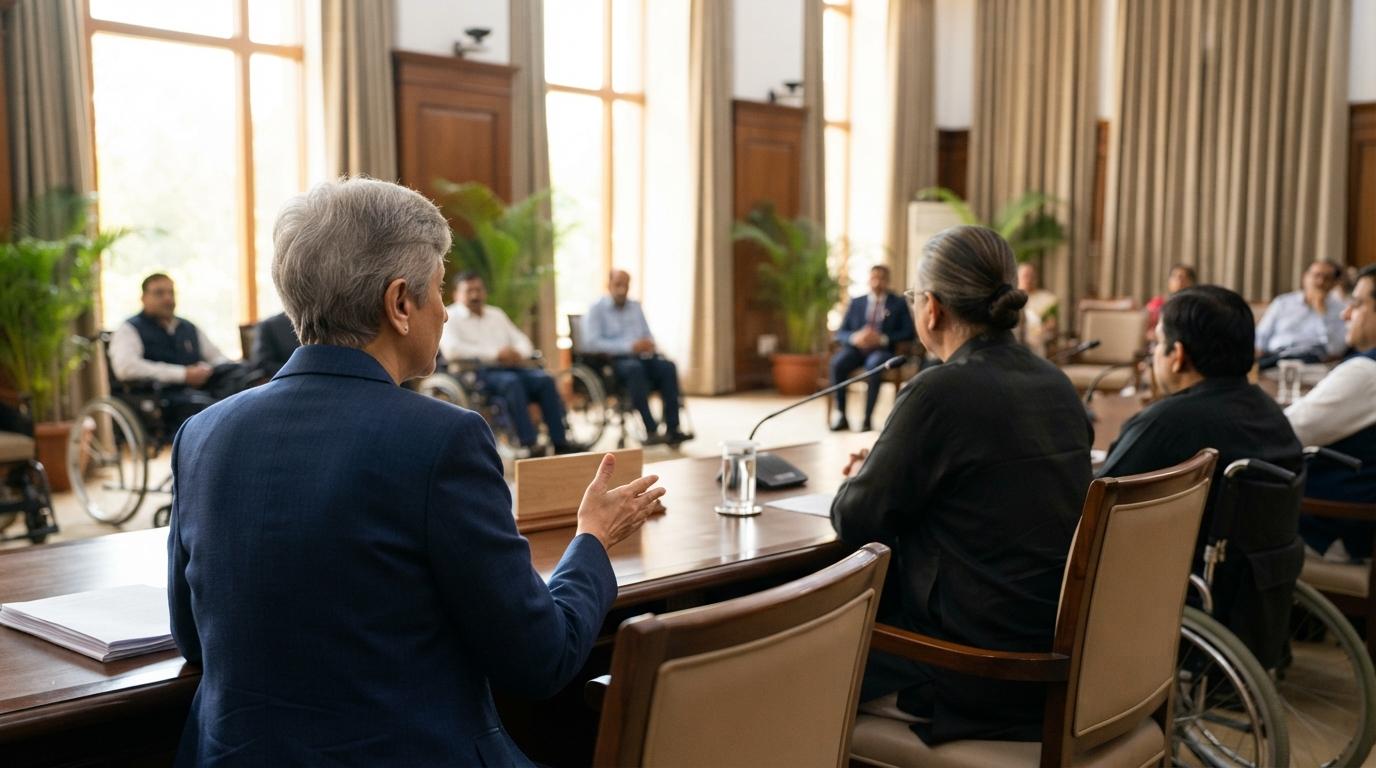
UN Special Rapporteur on the Rights of Persons with Disabilities Heba Hagrass called on Chief Justice of India Surya Kant at the Supreme Court of India on 18 November 2026. Lawyers with disabilities took part, along with civil society representatives. The Chief Justice said the Court would set up a Permanent Committee on the Rights of Persons with Disabilities. He also directed the Supreme Court Legal Services Committee to form panels of young lawyers and sign language interpreters to assist advocates with disabilities in court proceedings.
Officials from the Office of the UN High Commissioner for Human Rights and the Office of the UN Resident Coordinator in India attended. Saksham Trust, iProbono, Vidhi Centre for Legal Policy, the Politics and Disability Forum and Mission Accessibility were represented. Indian Sign Language interpreters and support persons made the meeting accessible to all participants.
The Chief Justice acknowledged the work of the judiciary and civil society in advancing disability rights. He thanked young lawyers with disabilities for bringing disability rights questions before the courts. That litigation, he said, had drawn wider attention. He added that the judiciary and State Governments must work together, given the heavy workload of courts.
Equality, he said, is a fundamental principle of the Constitution. Giving effect to the rights of persons with disabilities is a constitutional obligation. Gaps in implementation must be identified so persons with disabilities can exercise these rights in practice. He referred to the Rights of Persons with Disabilities Act, 2016, and the steps taken by the Government and judiciary over the past decade.
Continuing mandamus for delayed benefits
Where administrative delay blocks benefits under laws and schemes, he said, courts can issue writs of continuing mandamus. Such writs direct public authorities to discharge their statutory duties, with the court monitoring compliance until they do. Public interest litigation, he said, has helped persons with disabilities enforce their rights. He asked the Special Rapporteur and UN officials to share India’s experience with other countries.
He referred to Article 142 of the Constitution, which empowers the Supreme Court to do complete justice in any cause or matter pending before it. He cited reservation for persons with disabilities in the judicial and higher judicial services, with relaxation of qualifying marks for eligible candidates. He encouraged courts across jurisdictions to share effective practices.
The Permanent Committee will deal with the rights of persons with disabilities. The Supreme Court Legal Services Committee panels will comprise young lawyers and sign language interpreters to assist advocates with disabilities appearing before the Court.
Comments
Sign in to read the discussion and share your thoughts.
Latest from LawWorld
News
View all- Supreme Court Protects Birbhum Stone Quarry Accused From Coercive Action Till December 521 Nov 2026
- Supreme Court Orders Medical Examination Of 70-Year-Old Convict In 1981 Dumka Double Murder21 Nov 2026
- Supreme Court Caps Arbitral Award To Monetary Limit Of Referred Dispute21 Nov 2026
- Karnataka High Court Quashes Summoning Order Against Head Constable, Orders Fresh Process21 Nov 2026
- Karnataka High Court Upholds IGST Export Refund After Omission of Rule 96(10)21 Nov 2026