
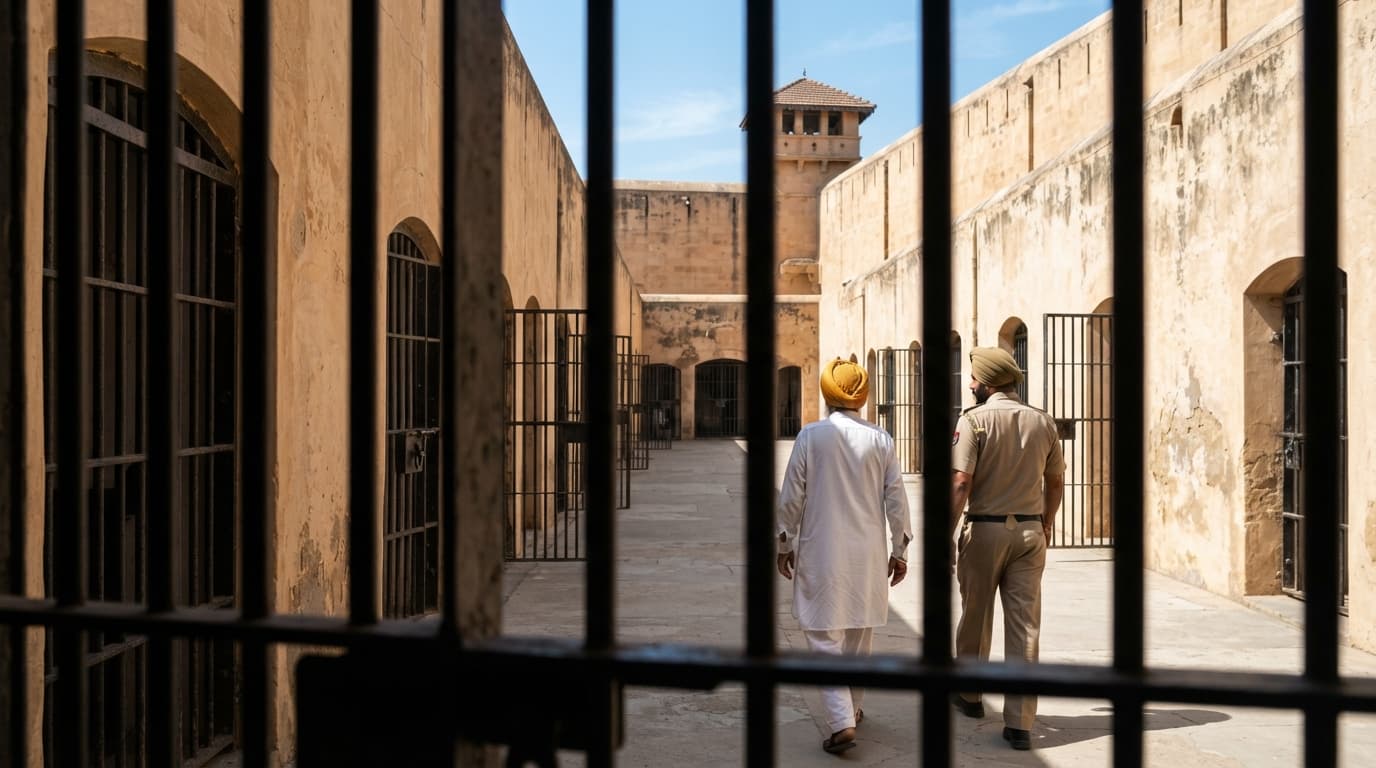
The Centre has opposed death-row convict Balwant Singh Rajoana's plea to commute his death sentence to life imprisonment, in the latest hearing on the death penalty in India before the Supreme Court. Additional Solicitor General K M Nataraj told a Bench of Justices Vikram Nath, Sandeep Mehta and Aparesh Kumar Singh that the plea should not be allowed. Senior advocate Mukul Rohatgi, for Rajoana, said his client has spent over 29 years in custody, including more than 15 years on death row, while a mercy petition filed in March 2012 remains undecided. The Bench posted the matter for further hearing on November 18.
Rajoana was sentenced to death in July 2007 for his role in the 1995 assassination of then Punjab Chief Minister Beant Singh. The sentence has remained unexecuted since. His plea does not challenge the conviction. It seeks life imprisonment on the ground of prolonged custody and the long pendency of the mercy process.
Nataraj conveyed the Union's opposition in open court. The Centre's position, as placed before the Bench, is that commutation is not warranted in this case. No detailed order on the rival contentions was passed. The Bench fixed the next date for full submissions on delay, executive jurisdiction over mercy and the scope of judicial review in death sentence matters.
For the defence, Rohatgi said the mercy petition was filed by the Shiromani Gurdwara Parbandhak Committee in March 2012 and is still pending. He linked that pendency to the time already spent in prison — over 29 years in custody, including more than 15 years under sentence of death. Such delay, coupled with the conditions of death-row custody, justifies commutation to life imprisonment, he said.
Centre resists commutation plea
The hearing was a straight contest. Nataraj opposed any relief. Rohatgi pressed for commutation on humanitarian and procedural grounds. The three-judge Bench did not indicate any view on the merits and chose to hear the matter further rather than dispose of it on first contest.
The November 18 date is practical. It gives the Union time to place its full reply on record and to explain the status of the mercy petition. It gives the petitioner time to file additional material on custody and prison record that the court may consider relevant to commutation. It also gives the Bench time to frame questions of maintainability and remedy where a mercy petition has remained pending for more than a decade.
Delay of this kind is not treated as an automatic ground for relief. Courts examine when the petition was filed, what happened after filing, who was responsible for the lapse of time and whether the prisoner faced prolonged uncertainty while under sentence of death. Those tests will form the core of arguments when the case returns next month.
How delay shapes death penalty in India
Discussion around the case often returns to basic questions from lay readers, including is death penalty legal in India and in what categories it can still be imposed. Under current law, capital punishment remains on the statute book for certain grave offences, including murder and acts of terrorism that attract the death sentence under specific laws. Courts impose it in narrow circumstances and provide for confirmation, appeal and mercy as successive safeguards. The Rajoana matter concerns the last of those stages, where the sentence has attained finality and the focus has shifted to executive clemency and the effect of delay.
A related question is does India have the death penalty as an operative punishment or only as a formal provision. Prisons continue to hold prisoners under sentence of death, and executions, though infrequent, are carried out after remedies are exhausted, clemency is declined and courts decline to intervene. At the same time, courts have commuted death sentences to life imprisonment in individual cases where delay or supervening circumstances were found to justify that course. The outcome turns on the facts of each case and on what the executive and the prisoner place before the court.
Any mercy petition in India follows a defined administrative route. A petition may be submitted on behalf of the convict by family members or by an institution, as was done here by the Shiromani Gurdwara Parbandhak Committee. It is processed through the concerned governments and placed for decision before the competent constitutional authority. The time taken in that process is often the central fact in commutation litigation, with petitioners pointing to years of waiting under sentence of death.
Mercy petition pending since 2012
The March 2012 petition in Rajoana's case has now been pending for well over thirteen years. That calendar fact forms the backbone of the plea for commutation. Rohatgi drew the Bench's attention to that pendency and to the total period of incarceration. The Centre has signalled that pendency alone should not lead to commutation here. The reasons for that opposition and the justification for the time taken are expected to be spelt out in detail at the next hearing.
Observers of recent death penalty cases in India will recall that outcomes have varied. Some prisoners have obtained commutation after courts found the delay to be excessive and unexplained. Others have not, after courts found that the gravity of the offence or the process followed by the executive did not warrant interference. The present Bench will have to locate Rajoana's case within that record without reopening the conviction itself.
Part of the legal backdrop is the distinction between a rejection, a pendency and a case where a mercy petition accepted by President of India has resulted in commutation or pardon. A grant of clemency ends the controversy in favour of the prisoner. A rejection can still be examined by courts on narrow grounds such as non-application of mind. Pendency occupies a middle space, where courts are asked whether continued detention under sentence of death during years of indecision itself warrants substituting life imprisonment.
No interim commutation has been ordered so far, and no timeline for disposal of the mercy petition has been fixed in the proceedings reported to date. Counsel on both sides will return on November 18 to address delay, mercy jurisdiction and the limits of death-penalty review. For Rajoana, in custody for over 29 years since the 1995 killing, that hearing will decide whether the death sentence imposed in July 2007 is commuted or the executive process is left to take its course.
Comments
Sign in to read the discussion and share your thoughts.
Latest from LawWorld
News
View all- Supreme Court Seeks Centre, ECI Reply On Plea Against Immunity For CEC And ECs4 Nov 2026
- Supreme Court Directs MP Speaker To Decide Bina MLA Disqualification Plea In Two Months4 Nov 2026
- Supreme Court Orders Special Cell To Monitor Child Labour Law Enforcement4 Nov 2026
- Bail Cannot Rest On Judge's Personal Notions Of Morality, Rules Supreme Court4 Nov 2026
- Supreme Court Refers Two-Child Norm Penalties To Larger Bench As Outdated4 Nov 2026