
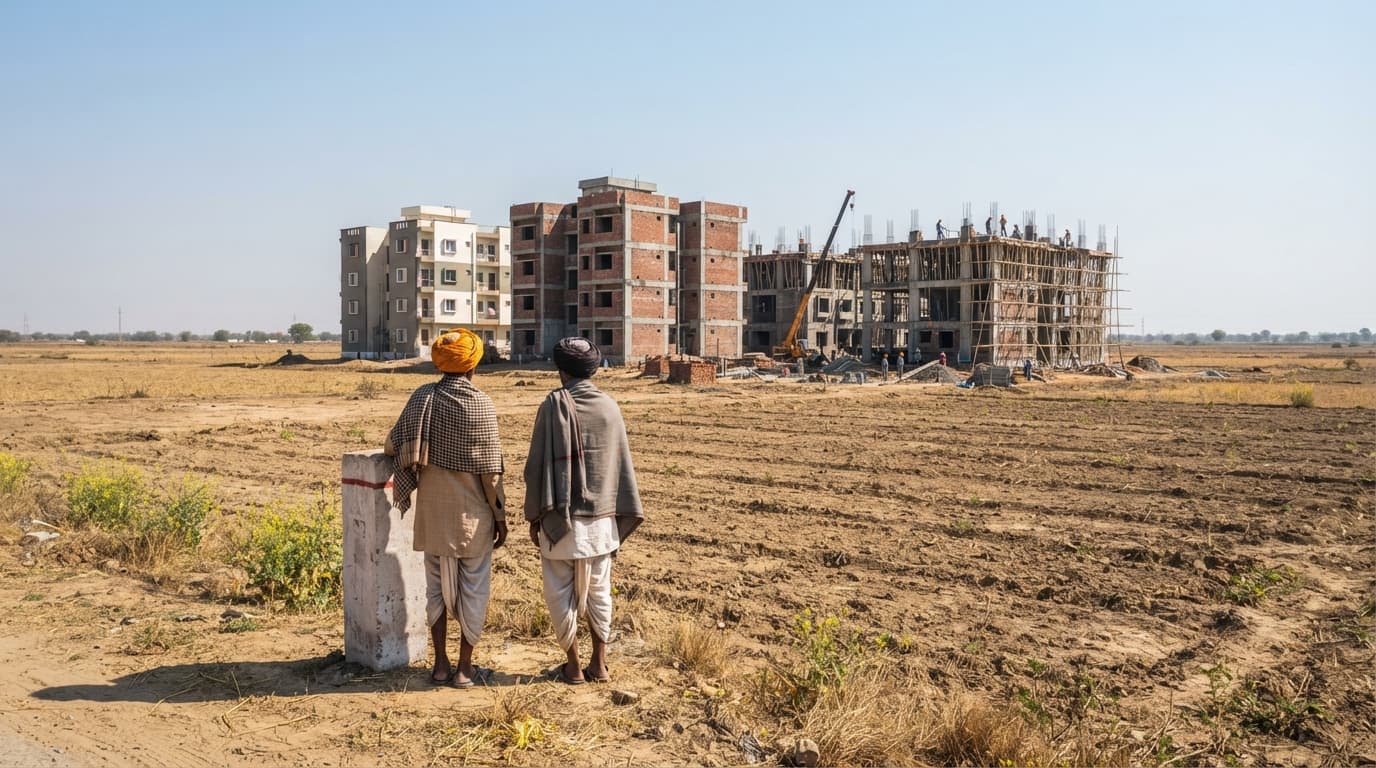
The Supreme Court has held that the 120-day outer limit for appeals against the Authority's compensation award under Section 74 of the Land Acquisition Act 2013 cannot be stretched by a single day. A Bench of Justices Dipankar Datta and Sheel Nagu laid down the law on October 16, 2026 in Rajasthan Housing Board v. M/s Hariyali Rural Ventures Ltd. and Others (2026 INSC 1168). The Board's appeal was dismissed as time-barred. The statute gives 60 days to appeal and 60 days more only on sufficient cause. Article 142 cannot rescue delay beyond that.
The Board had acquired land for housing and had to meet the award made by the Authority set up under the 2013 law to decide compensation, rehabilitation and resettlement claims. It challenged the award before the High Court after the time fixed by Section 74 had run out. The High Court stage turned on whether that delay could be excused. By the time the matter reached the Supreme Court, only one question survived: whether any court could excuse delay beyond 120 days in total. The Bench said no. The award had become final against the Board.
Section 74 lays down a two-part timeline. An appeal must be filed within 60 days from the date of the Authority's award. The appellate court may allow a further period up to 60 days if it is satisfied the appellant had sufficient cause for not filing earlier. The Bench read this as a complete code. The first 60 days is the normal period. The next 60 days is not discretion at large. It depends on proof of sufficient cause. Once 120 days expire, the provision gives no power to entertain the appeal. Where Parliament fixes an outer limit in clear terms, the Court said, it must be enforced as written.
Appeals Under Land Acquisition Act 2013
The Right to Fair Compensation and Transparency in Land Acquisition, Rehabilitation and Resettlement Act, 2013 replaced a framework that had governed compulsory acquisition for more than a century. Under the Land Acquisition Act 1894, acquisition started with a preliminary notification and moved through enquiry, declaration and award, with references against awards governed by a different set of limitation rules built around the Code of Civil Procedure and special provisions. Parliament enacted the Land Acquisition Rehabilitation and Resettlement Act to create a dedicated Authority for compensation and rehabilitation disputes and to give a fast, time-bound appeal to the High Court. Section 74 is part of that design. It balances the right to challenge an award with the need for closure, so landowners get paid and acquiring bodies know their liability without years of uncertainty.
That history is why the early stage and the late challenge are treated differently. The preliminary stage under Section 4 of Land Acquisition Act jurisprudence, whether under the old law or the comparable notification under Section 11 of the 2013 law, deals with the proposal to acquire and invites objections. The appeal under Section 74 comes at the end, after enquiry, award and adjudication by the Authority. By then title has been taken, possession has been settled in principle, and what remains is mainly the correctness of compensation and rehabilitation. The Bench reasoned that open-ended challenges at that point would keep titles and housing projects in doubt and force landowners to defend awards long after they should have been paid.
The core of the Board's case was condonation of delay beyond the second window of 60 days. In many civil matters courts can excuse late filing on sufficient cause, either under Section 5 of the Limitation Act, 1963 or under a special provision that uses that test. Section 74 uses that test, but only for the second stretch of 60 days. The Bench said the test cannot create a third stretch. That would rewrite the statute. Other statutes use similar wording where Parliament has barred the Limitation Act or fixed an absolute ceiling, and courts have enforced the ceiling. Section 74 falls in that class. Delay of even one day beyond 120 days means dismissal at the threshold, without going into merits.
Why Article 142 Cannot Save Delay
The Board had asked the Supreme Court to use its extraordinary power under Article 142 to do complete justice and hear the appeal despite the lapse of time. The Bench refused. Article 142, it said, cannot override a clear statutory bar on limitation or grant a fresh period Parliament has denied. That would contradict the law, not supplement it. If delay beyond 120 days could be cured by Article 142, every time-barred appellant would seek the same relief and the outer limit would lose all meaning.
Much of the hearing turned on consistency with S.V. Global Mill Limited, also decided in 2026, which had taken a different view on whether the 120-day ceiling could be relaxed. The Bench in the Housing Board case said it did not agree with that reading. It did not refer the conflict to a larger Bench. In the usual practice, when two Benches of equal strength disagree, the later Bench refers the question for an authoritative answer. Here the Bench decided the case on its own reading of Section 74 and recorded its disagreement. High Courts will now follow the stricter reading in this case, but litigants may still cite the earlier view until a larger Bench settles the difference.
For landowners, an Authority award will attain finality if no timely challenge is filed within the appeal window. Housing boards and acquiring authorities must count the first 60 days and treat the next 60 days as a last chance backed by documented reasons, not routine. The Board's appeal stands dismissed, and it must now satisfy the award as upheld.
Comments
Sign in to read the discussion and share your thoughts.
Latest from LawWorld
News
View all- Supreme Court Seeks Centre, ECI Reply On Plea Against Immunity For CEC And ECs4 Nov 2026
- Supreme Court Directs MP Speaker To Decide Bina MLA Disqualification Plea In Two Months4 Nov 2026
- Supreme Court Orders Special Cell To Monitor Child Labour Law Enforcement4 Nov 2026
- Bail Cannot Rest On Judge's Personal Notions Of Morality, Rules Supreme Court4 Nov 2026
- Supreme Court Refers Two-Child Norm Penalties To Larger Bench As Outdated4 Nov 2026