
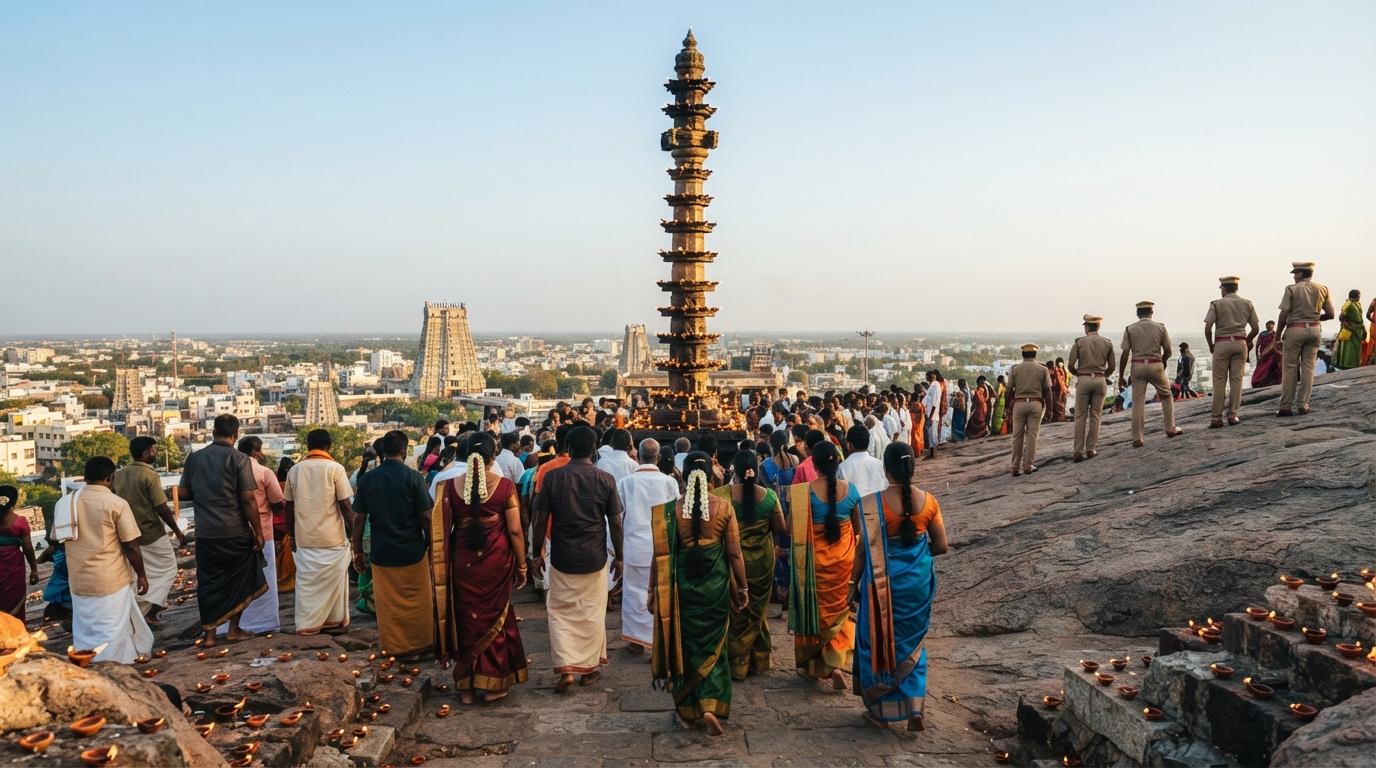
The Supreme Court in India on Friday, November 20, permitted lighting of the Karthigai Deepam at the Deepathoon on Thiruparankundram Hill in Madurai on November 24, 2026. The bench of Justices Aravind Kumar and Vipul M. Pancholi said it was a one-time interim arrangement, with safeguards, in appeals against the Madras High Court's January 6, 2026 judgment.
At issue is the annual lighting at the Deepathoon, an ancient stone pillar on the hill near the Sikandar Badhusha Dargah. Authorities had refused permission for the ritual at the hilltop in November 2025, citing proximity to the dargah and possible law-and-order concerns.
In December 2025, a single judge of the Madras High Court directed temple authorities to light the lamp at the Deepathoon. The judge noted the pillar stood more than 50 metres from the dargah. A Division Bench upheld that direction, but required the temple administration to act in consultation with the Archaeological Survey of India and the police given the site's heritage status. The Tamil Nadu government then moved the Supreme Court, which issued notice on the state's plea in August 2026.
According to the bench, the batch raises substantial questions on competing religious claims, the scope of religious freedom under Articles 25 and 26 of the Constitution, and the extent of judicial review in matters of religious practice. It said questions on the effect of earlier judicial pronouncements would also need examination. The one-time permission was granted only because the larger dispute remains pending, it said, leaving all questions open.
That interim arrangement, the bench repeatedly clarified, should not be read as endorsement of the High Court's judgment or its findings. Their validity will be examined independently when the matter is heard in the second week of January 2027.
Collector to fix team, route and timing
A restricted team organised by the temple administration will perform the ritual. The Madurai District Collector will decide its size and composition in consultation with the temple Executive Officer, the Archaeological Survey of India and the Madurai Police Commissioner, and will supervise the arrangements. The district administration will fix the timing, route and duration. Police will provide security, with assistance from the Central Reserve Police Force if required and feasible.
Safeguards for conservation of the site will be prescribed by the Archaeological Survey of India. Excavation, construction and structural alterations are prohibited. The court said the permission would not create any additional right of entry, occupation or control over the hill. Neither the permission nor the ceremony can be relied on as proof of an established custom or to claim the ritual in later years. Customary worship at existing sites and lawful access to the dargah and mosque must continue without obstruction.
The court issued notice to the remaining respondents. Counter-affidavits are to be filed within six weeks and rejoinders, if any, within three weeks thereafter. The District Collector, as nodal officer, will submit a compliance report within three days of the festival identifying any legal, physical or security-related impediment that cannot be met through the prescribed safeguards.
Comments
Sign in to read the discussion and share your thoughts.
Latest from LawWorld
News
View all- Supreme Court Protects Birbhum Stone Quarry Accused From Coercive Action Till December 521 Nov 2026
- Supreme Court Orders Medical Examination Of 70-Year-Old Convict In 1981 Dumka Double Murder21 Nov 2026
- Supreme Court Caps Arbitral Award To Monetary Limit Of Referred Dispute21 Nov 2026
- Karnataka High Court Quashes Summoning Order Against Head Constable, Orders Fresh Process21 Nov 2026
- Karnataka High Court Upholds IGST Export Refund After Omission of Rule 96(10)21 Nov 2026