
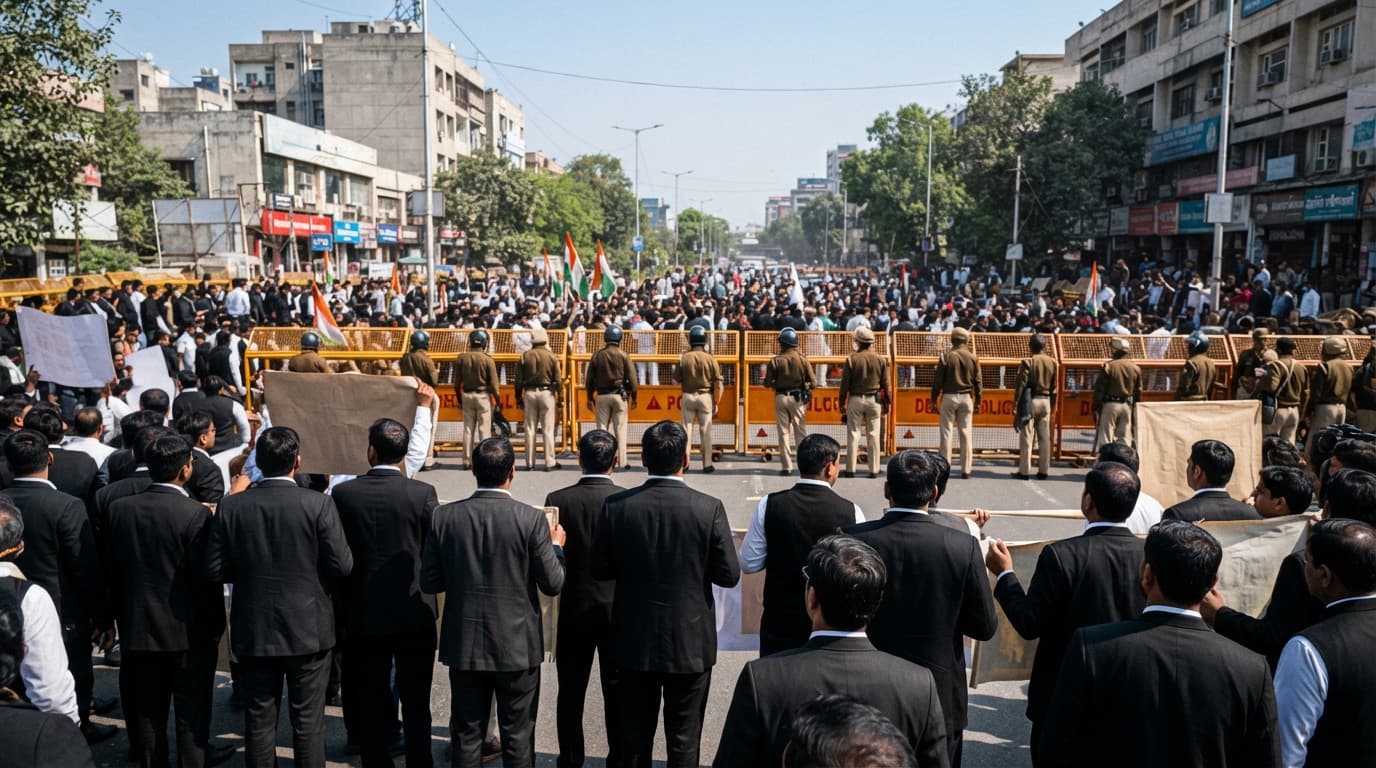
The Lawyers' Association for Constitution (LAFC) and four of its member advocates have filed a writ petition before the Supreme Court under Article 32 of the Constitution, alleging serious police misconduct during protests in Delhi on October 10 and 11, 2026. The petition raises concerns over assault, unlawful detention of advocates and other individuals, denial of timely legal assistance and medical aid, failure by police officers to display proper identification, and suspension of mobile internet services during the period.
The Supreme Court Bar Association (SCBA) has separately approached the Supreme Court under Article 32, seeking accountability for what it describes as the manhandling and detention of lawyers by Delhi Police near the Supreme Court premises on October 10, 2026. Both petitions place the court at the centre of an emerging legal dispute over the scope of police powers during public demonstrations and the rights of advocates to participate in lawful protest.
Fundamental rights violations at the core
The Supreme Court Bar Association's petition invokes breaches of Article 19(1)(a), which protects freedom of speech and expression; Article 19(1)(b), protecting the right to assemble peacefully; Article 19(1)(d), guaranteeing the right to move freely throughout the territory of India; and Article 21, which protects the right to dignity and life.
The petitioners argue that police actions during the October 10-11 period went beyond lawful exercise of authority and crossed into violation of constitutionally protected liberties. The specific allegations of denial of legal assistance strike at the core function of the legal profession and the right of citizens to access counsel during detention.
Denial of medical aid compounds the allegations of misconduct. When combined with claims of assault and unlawful detention, such denial raises questions about the treatment of detainees and compliance with established protocols for handling arrested or detained persons. The failure of police officers to display proper identification, a requirement under police regulations, suggests a breakdown in accountability mechanisms during the operation.
Internet shutdown and coordinated restrictions
The petition's reference to suspension of mobile internet services during the protests introduces a distinct dimension to the allegations. Internet shutdowns, even if temporary and geographically limited, raise questions about proportionality and necessity. While authorities may seek to restrict communications in specific circumstances, such restrictions must comply with constitutional standards and be subject to judicial scrutiny.
The timing of the internet suspension—coinciding with the detention and alleged assault allegations—creates a factual pattern suggesting coordinated action affecting multiple fundamental rights simultaneously. This layering of alleged violations forms the foundation of the petitioners' argument that the police response exceeded permissible bounds.
Government deadline and police accountability
The Union government informed a three-judge Supreme Court bench, headed by Chief Justice of India Surya Kant, that its response to petitions concerning alleged illegal detentions and the shutdown of public and rail transport, including Metro services, in Delhi on October 10, 2026, was prepared but required further refinement. The court extended the deadline for the government to submit its reply affidavit until October 15, 2026.
The court's insistence on a reply by October 15 establishes a firm deadline for the administration to address the allegations on the record. The court also requested that a senior police officer be present at the next hearing to address allegations of assault on women. This specific direction demonstrates the bench's intent to examine the conduct allegations in detail and to hear directly from police leadership about the operational decisions made during the protests.
Coordinated legal challenge and evidence preservation
The filing by the LAFC and its member advocates, combined with the separate petition by the Supreme Court Bar Association and the Supreme Court Advocate-on-Record Association, reflects a coordinated effort by the legal fraternity to bring police conduct under judicial review. Such parallel petitions are not uncommon when multiple organizations within the legal community are affected by the same alleged misconduct.
The bar associations sought specific orders for the preservation of CCTV footage and bodycam footage from police officers involved in the operations. This request aims to secure evidence before it can be lost, altered, or destroyed. The availability of video evidence could prove crucial in determining the factual accuracy of competing claims about what occurred during the detention and alleged assault.
The petitions also flagged similar alleged detentions and violations of rights concerning media personnel. This broader scope suggests that the police operations affected not only lawyers but also journalists covering the events. The inclusion of media personnel in the allegations expands the constitutional questions at stake, touching on freedom of the press alongside professional and personal liberties.
Article 32 jurisdiction and constitutional framework
The choice of Article 32 as the constitutional vehicle for these petitions is deliberate. Article 32 grants the Supreme Court original jurisdiction to issue directions, orders, or writs for the enforcement of fundamental rights. By filing directly under Article 32 rather than approaching a High Court under Article 226, the petitioners have signalled that they view the issues as requiring the Supreme Court's immediate attention.
The Supreme Court has previously addressed the relationship between Articles 32 and 226. In recent decisions, the court has directed petitioners in some cases to approach the High Court as the court of first instance for fundamental rights violations, noting that the High Court is the 'court of first instance' for such matters. However, the court retains discretion to entertain Article 32 petitions where circumstances warrant, particularly where the violations involve multiple parties, systemic issues, or matters of national importance.
The allegations in the LAFC and SCBA petitions involve state action by a major metropolitan police force, questions about the treatment of a protected class of professionals, and potential breaches of constitutional rights on a significant scale. These factors may influence the court's decision on whether to entertain the petitions directly or direct the petitioners to the High Court.
Factual record and next steps
The Supreme Court's request for CCTV and bodycam footage preservation indicates that the bench views factual determination as central to resolving the petitions. Video evidence can provide an objective record of events, though the angles, timing, and completeness of such footage will matter significantly in establishing what actually occurred.
The government's affidavit, due by October 15, will present the official account of police operations during the October 10-11 period. This response will likely address the necessity and proportionality of the actions taken, the legal basis for any detentions, and the operational reasons for any internet shutdowns or transport restrictions. The affidavit will also presumably address the specific allegations of assault and denial of legal or medical assistance.
The presence of a senior police officer at the next hearing will provide an opportunity for direct examination of police conduct and decision-making. The court's specific mention of allegations of assault on women suggests that gender-based treatment during the operations is a matter the bench considers important to explore. A substantive hearing on the merits is likely to follow the government's affidavit and the police officer's appearance.
Comments
Sign in to read the discussion and share your thoughts.
Latest from LawWorld
News
View all- Karnataka High Court Upholds Cancellation of Occupancy Certificates for 33 Incomplete Villas in Hosakote14 Oct 2026
- Supreme Court Registry Flags 14 Defects in INDIA Bloc Leaders' Electoral Roll Revision Petition14 Oct 2026
- Supreme Court Agrees to Hear Plea Seeking Ban on Political Demonstrations Within Court Premises14 Oct 2026
- Centre Seeks Extension to File Affidavit on Delhi Detentions and Transit Shutdown, Deadline Set for October 1514 Oct 2026
- Supreme Court Grants CBI Three Additional Months to Complete Custodial Death Investigation14 Oct 2026
Articles
View all- Supreme Court Refers DPDP Act Constitutional Challenge to Five-Judge Bench: RTI vs. Privacy Rights at Stake12 Oct 2026
- Supreme Court Disposes PIL on Doxxing and Deepfakes; Directs Union Ministries to Implement Remedial Measures8 Oct 2026
- Supreme Court Issues Notice on Constitutional Challenge to GST Input Tax Credit Denial Provision7 Oct 2026
Blogs
View all- Supreme Court Orders Priority Hearing for Pension Cases: A Decade-Long Wait Deemed 'Grave Injustice'12 Oct 2026
- Supreme Court Clarifies Gratuity Calculation: Monthly Wages Divided by 26 Working Days, Not 3011 Oct 2026
- Supreme Court Affirms Damages Recovery for Delayed Provident Fund Contributions Without Time Limit10 Oct 2026