
Bar Associations Challenge Delhi Police Over Alleged Lawyer Detentions in Article 32 Petition
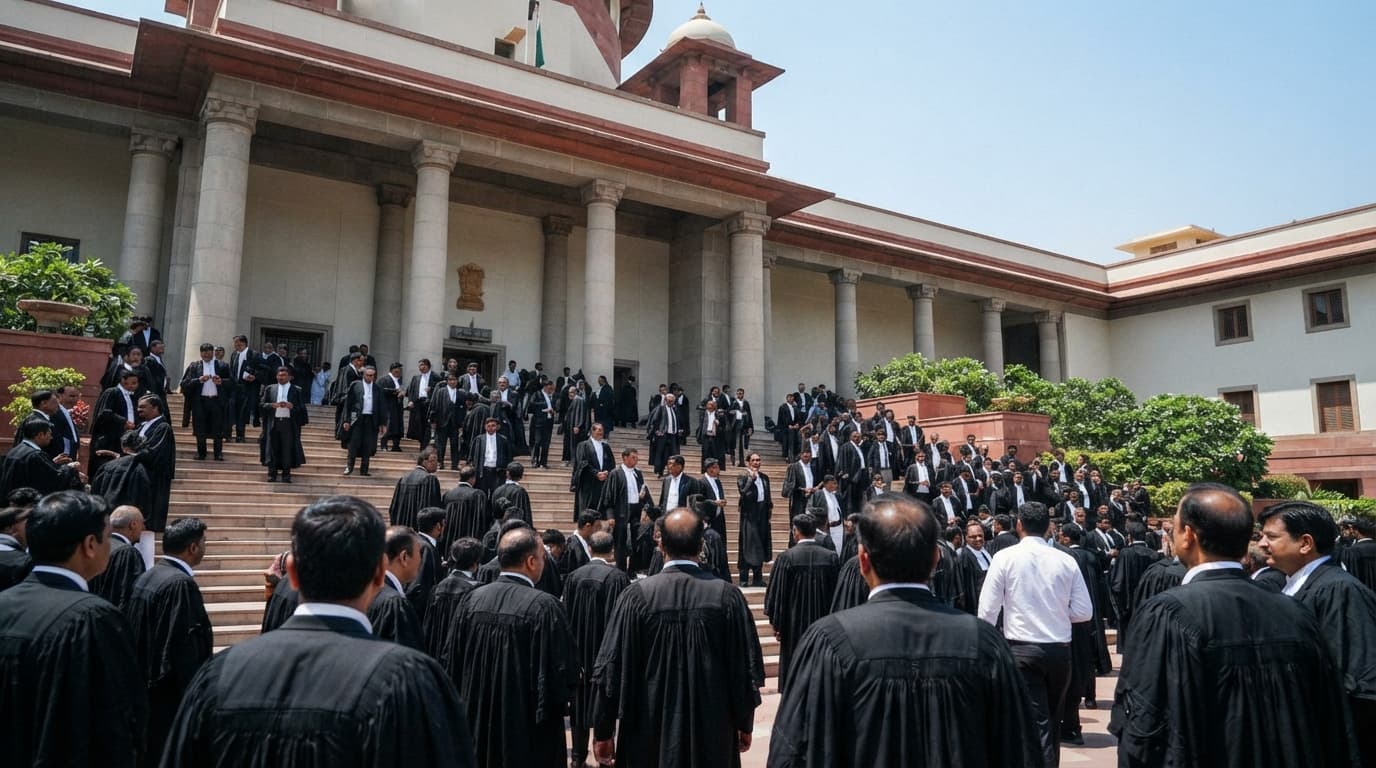
The Supreme Court Bar Association and the Supreme Court Advocate-on-Record Association have approached the Supreme Court under Article 32 of the Constitution, alleging that Delhi Police manhandled and unlawfully detained lawyers who were protesting outside the Court on October 10, 2026. The petition contends that police actions violated multiple fundamental rights and seeks immediate preservation of evidence, including CCTV footage and bodycam recordings from officers involved in the incidents.
The associations claim violations of Article 19(1)(a), which guarantees freedom of speech and expression; Article 19(1)(b), protecting the right to assemble peacefully; Article 19(1)(d), securing the right to move freely throughout India's territory; and Article 21, safeguarding the right to life and personal dignity.
Petition Seeks Evidence Preservation
The bar associations have specifically sought orders from the Supreme Court for the preservation of CCTV footage and bodycam recordings from police officers who were present at the protest site near the Court. This evidence request signals the petitioners' intent to establish a factual record of the alleged misconduct and to prevent the destruction or tampering of materials that could corroborate their claims.
Beyond the core allegations against lawyers, the petition also highlights similar alleged detentions and rights violations affecting media personnel who were covering the protests. This expansion reflects broader concerns about police conduct during the October 10 events and its impact on multiple categories of citizens attempting to exercise constitutional freedoms.
A separate writ petition was filed by the Lawyers' Association for Constitution and four of its member advocates, raising parallel concerns about alleged police excesses during protests on October 10 and 11, 2026. That petition alleges assault and unlawful detention of advocates and other individuals, denial of timely legal assistance and medical aid, failure by police officers to display proper identification, and suspension of mobile internet services during the period in question.
Government Response Delayed to October 15
The Union government has informed a three-judge Supreme Court bench, headed by Chief Justice of India Surya Kant, that its response to petitions concerning the alleged illegal detentions and the shutdown of public and rail transport, including Metro services, in Delhi on October 10 is prepared but requires further refinement. The Court extended the deadline for submission of the government's reply affidavit to October 15, 2026. Multiple petitions, including those seeking contempt proceedings, were adjourned to the same date.
The Court has also requested that a senior police officer be present at the next hearing to address specific allegations of assault on women during the protest response. This directive indicates the bench's intention to examine the conduct allegations in detail and to obtain direct responses from law enforcement representatives.
Competing Petitions Over Court Premises Access
The bar associations' Article 32 petition operates within a more complex landscape of competing petitions filed in the wake of the October 10 and 12 events. The Supreme Court has separately agreed to hear on October 15 a plea seeking a complete ban on political demonstrations within court premises and contempt proceedings against political leaders alleged to have obstructed the judicial system.
That plea, mentioned by senior advocate Gaurav Bhatia, flags a large crowd at the apex court on October 12, 2026, when Congress leader Rahul Gandhi and other opposition leaders marched to the Court to file a petition related to the Special Intensive Revision of electoral rolls. A bench comprising Chief Justice Surya Kant and Justices Joymalya Bagchi and V Mohana agreed to list this plea for hearing on October 15.
Additionally, the Supreme Court received a Public Interest Litigation filed by four advocates seeking a party-neutral framework to prevent political processions, protests, and sloganeering within constitutional court premises. That PIL also requested the Court to consider initiating suo motu criminal contempt proceedings against several opposition leaders for events on October 12, including the march towards the Court and social media posts demanding the Chief Justice's resignation.
These parallel petitions reflect the polarized nature of the October 10 and 12 events and the competing interests now before the Court. On one side, bar associations and civil liberties advocates contend that police overreached in suppressing lawful protest. On the other, some petitioners argue that political demonstrations at court premises undermine judicial independence and should be restricted.
Constitutional Questions at Issue
The bar associations' petition raises fundamental questions about the scope of Articles 19 and 21 in the context of police action during protests. Article 19(1)(a) and (b) do not provide absolute freedoms; they are subject to reasonable restrictions imposed by law. The central constitutional question will be whether the police actions fell within permissible restrictions or whether they were arbitrary, disproportionate, or undertaken without legal authority.
Article 21, the right to life and personal dignity, has been interpreted expansively by Indian courts over decades of jurisprudence. Courts have held that this right encompasses protection against torture, unlawful detention, and denial of basic procedural safeguards. The petition's invocation of Article 21 suggests that the bar associations will argue the police violated not merely procedural rights but fundamental human dignity.
The request for preservation of CCTV and bodycam footage is procedurally significant. Such evidence is often critical in establishing the factual basis for constitutional violations. Courts have repeatedly recognized that destruction or non-preservation of evidence can itself constitute a violation of due process and the right to a fair hearing.
October 15 Hearing Will Test Police Justification
The Supreme Court's role in these proceedings will be to examine whether the police actions on October 10 complied with constitutional limits on state power. The bench will need to assess whether the detentions were lawful, whether the degree of force used was justified, and whether procedural safeguards were observed. The preservation of evidence is a precondition for a fair adjudication of these questions.
The October 15 hearing will determine whether the Court accepts the bar associations' characterization of the events or whether it views the police actions as justified responses to disruption of court operations. The bench will also need to address the tension between protecting constitutional freedoms of expression and assembly on one hand and maintaining the sanctity of judicial institutions on the other. How the Court resolves this tension will shape the scope of protection afforded to lawyers, journalists, and other citizens exercising constitutional rights during political demonstrations at or near court premises.
Comments
Sign in to read the discussion and share your thoughts.
Latest from LawWorld
News
View all- Supreme Court Seeks Union Counter-Affidavit on Fruit-Themed Alcohol Packaging14 Oct 2026
- Supreme Court Grants Absolute Protection from Arrest to Journalist Reporting Ayodhya Temple Allegations14 Oct 2026
- CJI Surya Kant Declines Meeting with Opposition Leaders on Electoral Commission Allegations14 Oct 2026
- Supreme Court Advances Delhi Electoral Roll Petition Hearing to October 2814 Oct 2026
- Supreme Court Seeks Union Response on Mandatory Age Verification at Liquor Outlets14 Oct 2026
Articles
View all- Supreme Court Refers DPDP Act Constitutional Challenge to Five-Judge Bench: RTI vs. Privacy Rights at Stake12 Oct 2026
- Supreme Court Disposes PIL on Doxxing and Deepfakes; Directs Union Ministries to Implement Remedial Measures8 Oct 2026
- Supreme Court Issues Notice on Constitutional Challenge to GST Input Tax Credit Denial Provision7 Oct 2026
Blogs
View all- Supreme Court Awards Compensation for Delayed Wages of Daily-Wage Workers14 Oct 2026
- Supreme Court Orders Priority Hearing for Pension Cases: A Decade-Long Wait Deemed 'Grave Injustice'12 Oct 2026
- Supreme Court Clarifies Gratuity Calculation: Monthly Wages Divided by 26 Working Days, Not 3011 Oct 2026