
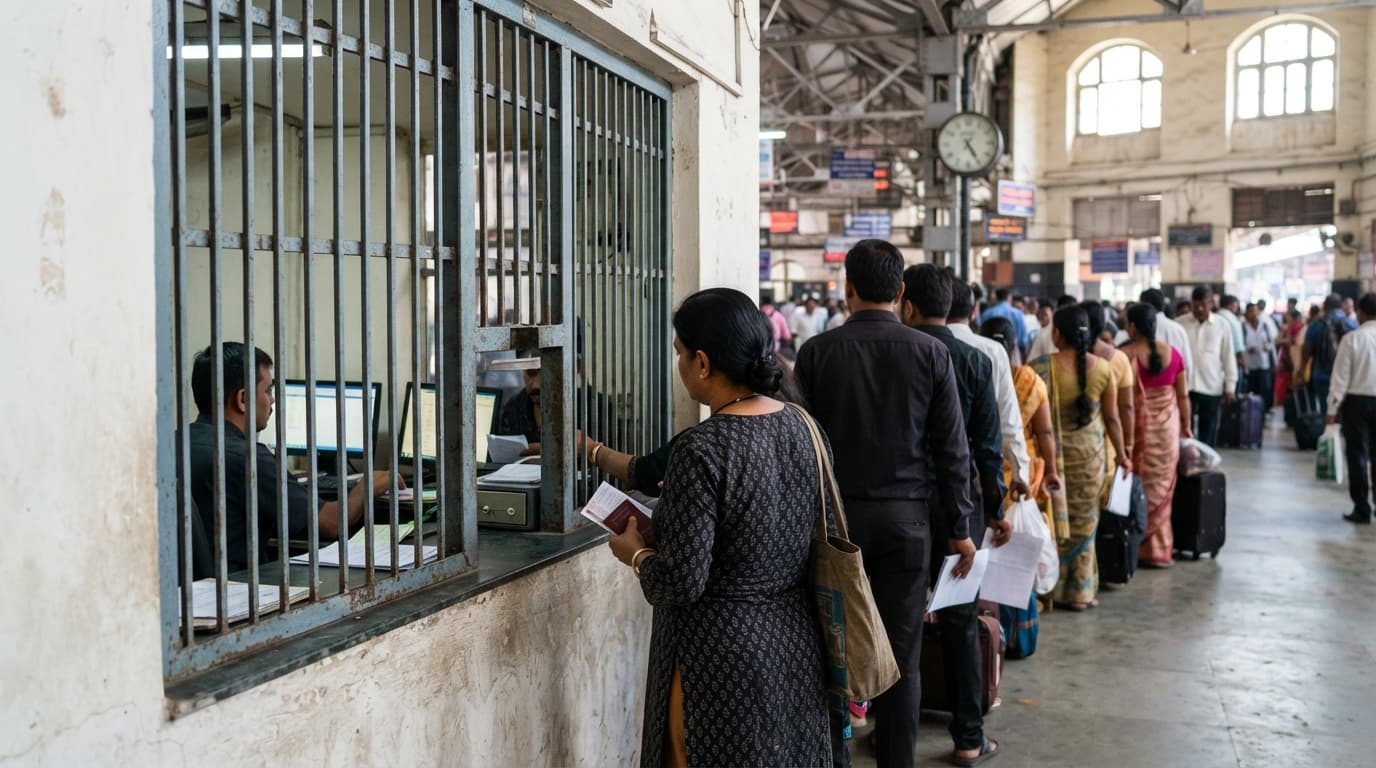
Supreme Court Orders Mandatory Insurance for All Counter-Purchased Train Tickets by October 27
The Supreme Court has directed Indian Railways to implement mandatory insurance coverage for all train tickets purchased over the counter, effective from October 27, 2026. A bench comprising Justices Ahsanuddin Amanullah and R Mahadevan issued the order with a warning that the Railway Board will be held directly responsible for any failure to comply with the directive.
The bench's decision came in response to a petition filed following the June 2023 Odisha train accident, which sought both a commission of inquiry into the crash and early implementation of the Kavach safety system. The court's order represents a step toward strengthening passenger protection mechanisms, though it also reflects judicial frustration with the pace of railway safety reforms.
Insurance requirement and enforcement
The mandatory insurance scheme will apply to all train tickets sold at railway counters across India. By making insurance coverage compulsory rather than optional, the court aims to ensure that passengers have financial protection in the event of accidents or unforeseen incidents during their journey. The Railway Board has been explicitly tasked with overseeing the implementation and will face direct accountability should the system fail to launch on schedule or operate as intended.
This directive carries particular weight because it places responsibility at the highest administrative level of the railways. The bench's decision to hold the Railway Board directly accountable signals that the court will not accept excuses related to operational delays or resource constraints. The October 27 deadline provides a clear implementation timeline, leaving no ambiguity about when the system must become operational.
Stalled safety initiatives
While the insurance mandate addresses passenger compensation, the bench expressed what it characterized as "utter disappointment" regarding the lack of progress on multiple other safety initiatives. The court highlighted three critical areas where progress has stalled: the Kavach automatic train protection system, track fencing to prevent unauthorized crossings, and the construction of foot overbridges at railway stations.
The Kavach system, which automatically applies brakes to prevent collisions and overspeeding, has been a focal point of railway modernization efforts. The system's delayed rollout has concerned both the judiciary and railway safety experts, as it represents a proven technology that could significantly reduce accident rates. The bench's frustration with the pace of implementation is evident, particularly given that the petition was filed more than three years after the Odisha accident.
Track fencing remains another unresolved issue. The construction of barriers along railway tracks can prevent unauthorized access and reduce the risk of accidents involving trespassers or animals. Similarly, foot overbridges provide safe passage for pedestrians crossing railway lines, eliminating the danger of level crossings. Both measures are relatively straightforward to implement compared to complex technological systems, yet their slow progress suggests either resource constraints or administrative lethargy within the railway system.
The Odisha accident backdrop
The June 2023 Odisha train accident served as the catalyst for this petition and the resulting court order. The accident prompted questions about railway safety protocols, accident investigation procedures, and the adequacy of existing passenger protection mechanisms. By directing mandatory insurance coverage and expressing concern over stalled safety initiatives, the court has signaled that it views these measures as necessary responses to demonstrated vulnerabilities in the railway system.
The petitioner's original request for a commission of inquiry into the accident, while not explicitly addressed in the reported order, appears to have prompted the bench to examine the broader state of railway safety. Rather than limiting its focus to a single accident investigation, the court has used the petition as an opportunity to push for systemic improvements across multiple safety domains.
Implementation challenges ahead
The October 27 deadline requires coordination between the Railway Board, insurance companies, and ticketing systems across thousands of railway stations nationwide. The implementation must cover counter sales at major stations, smaller branch lines, and intermediate booking offices. Insurance providers will need to be identified, premium structures determined, and ticketing software updated to reflect the mandatory coverage requirement.
The logistics of implementation present genuine challenges. Railway staff at ticket counters will need training on the new system, passengers will require clear communication about what the insurance covers and how to file claims, and backend systems must track which tickets include coverage. Any failure in these operational elements could result in passengers purchasing tickets without the mandated insurance, creating liability for the Railway Board.
Court's supervisory role
The bench has scheduled the next hearing for November 16, just three weeks after the October 27 implementation deadline. This timing suggests the court intends to closely monitor compliance and will likely seek reports from the Railway Board on whether the system has been successfully launched. The proximity of the hearing to the deadline indicates the court's determination to ensure that implementation occurs as ordered rather than being deferred or diluted.
The direct accountability assigned to the Railway Board means that senior railway officials may face judicial consequences should the system fail to launch on time or function as intended. This level of personal responsibility typically incentivizes compliance more effectively than general directives to departments.
What comes next
The insurance mandate, while important for passenger protection, represents only one component of a larger safety agenda that the bench has clearly articulated. The court's expressed disappointment over progress on Kavach, track fencing, and foot overbridges suggests that future hearings may produce additional orders addressing these issues. The bench's willingness to intervene directly in railway operations indicates judicial readiness to drive safety reforms when the executive branch appears to be moving too slowly.
For passengers, the mandatory insurance represents a change in how they interact with the ticketing system. Individuals purchasing tickets at railway counters will no longer have the option to decline insurance coverage. The court has determined that universal coverage serves the public interest more effectively than optional schemes, which typically suffer from low uptake rates.
The Railway Board now faces a defined deadline and clear judicial oversight for implementing this system. The November 16 hearing will provide the first opportunity for the court to assess whether the October 27 implementation has succeeded. With direct accountability assigned to the Railway Board and the bench's demonstrated impatience with slow progress on safety measures, compliance appears to be a priority for railway management.
Comments
Sign in to read the discussion and share your thoughts.
Latest from LawWorld
News
View all- Supreme Court Seeks Union Counter-Affidavit on Fruit-Themed Alcohol Packaging14 Oct 2026
- Supreme Court Grants Absolute Protection from Arrest to Journalist Reporting Ayodhya Temple Allegations14 Oct 2026
- CJI Surya Kant Declines Meeting with Opposition Leaders on Electoral Commission Allegations14 Oct 2026
- Supreme Court Advances Delhi Electoral Roll Petition Hearing to October 2814 Oct 2026
- Supreme Court Seeks Union Response on Mandatory Age Verification at Liquor Outlets14 Oct 2026
Articles
View all- Supreme Court Refers DPDP Act Constitutional Challenge to Five-Judge Bench: RTI vs. Privacy Rights at Stake12 Oct 2026
- Supreme Court Disposes PIL on Doxxing and Deepfakes; Directs Union Ministries to Implement Remedial Measures8 Oct 2026
- Supreme Court Issues Notice on Constitutional Challenge to GST Input Tax Credit Denial Provision7 Oct 2026
Blogs
View all- Supreme Court Awards Compensation for Delayed Wages of Daily-Wage Workers14 Oct 2026
- Supreme Court Orders Priority Hearing for Pension Cases: A Decade-Long Wait Deemed 'Grave Injustice'12 Oct 2026
- Supreme Court Clarifies Gratuity Calculation: Monthly Wages Divided by 26 Working Days, Not 3011 Oct 2026