
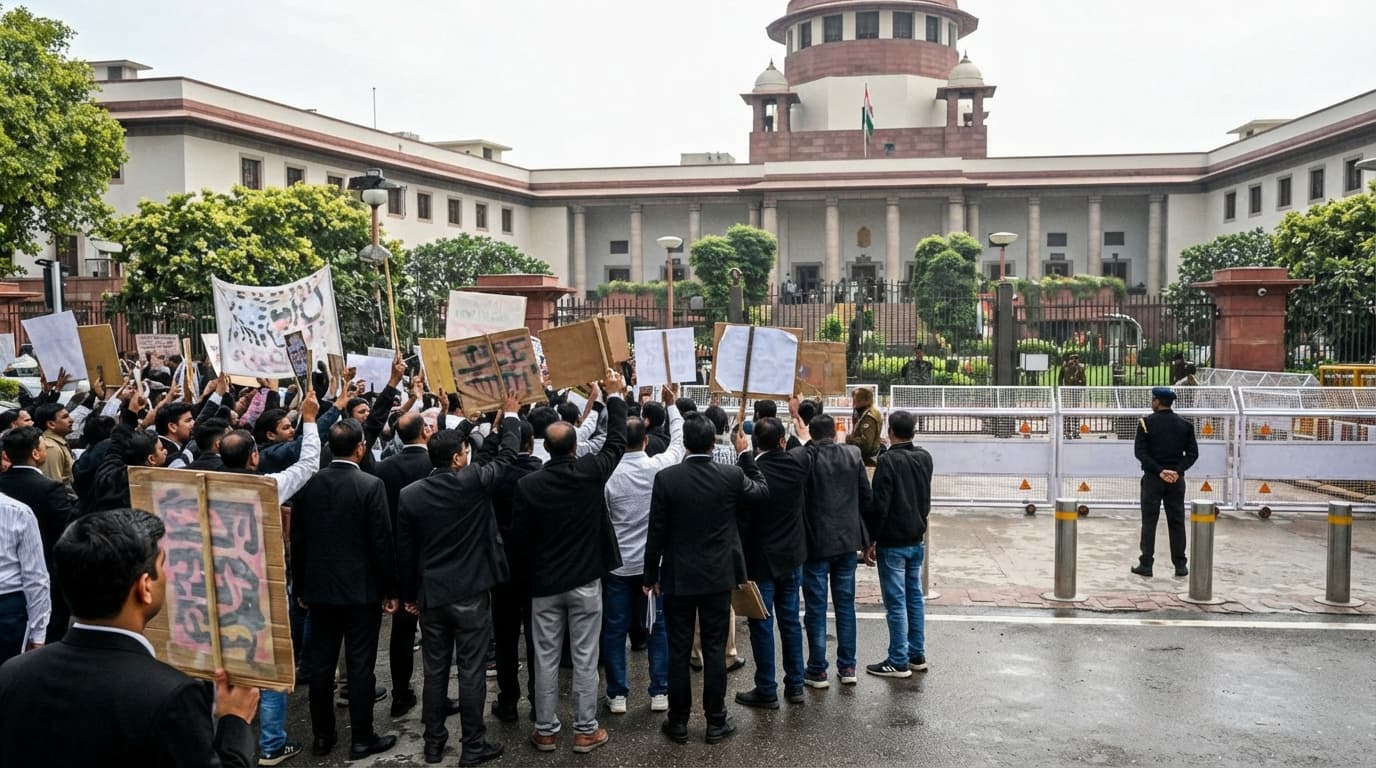
Supreme Court to Hear Plea Banning Political Protests in Court Complexes
The Supreme Court will hear on October 15, 2026, a Public Interest Litigation filed by four advocates seeking to establish a party-neutral framework prohibiting political processions, protests, and sloganeering within constitutional court premises. The plea also requests the Court to initiate suo motu criminal contempt proceedings against several opposition leaders for conduct on October 12, 2026, which the petitioners argue could prejudice pending judicial proceedings.
Senior advocate and BJP leader Gaurav Bhatia mentioned the plea before a bench comprising Chief Justice Surya Kant and Justices Joymalya Bagchi and V Mohana on October 13. He flagged the large crowd at the apex court on October 12 when Congress leader Rahul Gandhi and other opposition leaders marched to file a petition related to the Special Intensive Revision of electoral rolls.
Contempt allegations centre on October 12 march
The petitioners named Rahul Gandhi, Mallikarjun Kharge, Akhilesh Yadav, Mahua Moitra, the Indian National Congress, and the Kerala Pradesh Congress Committee as respondents. They argue that the October 12 march and associated social media posts demanding the Chief Justice of India's resignation constitute conduct prejudicial to matters listed for hearing on October 13, 2026.
The PIL relies on Article 124(4) of the Constitution, which prescribes the exclusive mechanism for removing a Supreme Court judge. The petitioners cite C. Ravichandran Iyer v. Justice A.M. Bhattacharjee, which held that Bar association pressure aimed at coercing a judge's resignation is impermissible. This precedent forms the legal foundation for the argument that public demonstrations and demands for judicial removal constitute contempt of court.
The petitioners contend that such conduct—whether through physical presence at court premises or through coordinated social media campaigns—crosses from legitimate political expression into an attempt to influence judicial decision-making through extrajudicial pressure. The timing of the march and the filing of the electoral roll petition on the same day, coupled with demands for the Chief Justice's resignation, are presented as evidence of a coordinated effort to prejudice pending proceedings.
Electoral roll petition stalled by registry defects
The Supreme Court Registry has flagged 14 defects in the joint petition filed by Rahul Gandhi and 10 other INDIA bloc leaders against the Special Intensive Revision of electoral rolls. Missing authorisations from nine petitioners, an illegible copy of Mallikarjun Kharge's identity card, small fonts in certain sections, missing coloured copies of documents, and a shortfall of ₹220 in court fees must be corrected before substantive hearing.
The petition, filed on October 12, seeks an interim suspension of the electoral roll revision across states and an independent audit of deletions. These technical deficiencies have stalled the petition's progress through the Court, even as the broader question of political conduct at court premises proceeds to hearing.
Separate petitions challenge police conduct
The October 15 hearing will take place against allegations of police excesses during protests in Delhi on October 10 and 11, 2026. The Lawyers' Association for Constitution and four of its member advocates filed a writ petition under Article 32 of the Constitution raising concerns over alleged assault and unlawful detention of advocates and other individuals.
Allegations include denial of timely legal assistance and medical aid, failure by police to display identification, and suspension of mobile internet services. The Supreme Court Bar Association separately approached the Court under Article 32, seeking accountability for alleged manhandling and detention of lawyers by police near the Supreme Court on October 10, 2026.
On October 13, the Union government informed Chief Justice Surya Kant's three-judge bench that its response to petitions concerning alleged illegal detentions and the shutdown of public and rail transport, including Metro services, in Delhi on October 10 was prepared but required further refinement. The Court extended the deadline for the government's reply affidavit until October 15, 2026, and requested a senior police officer be present at the next hearing to address allegations of assault on women.
The constitutional balance
The PIL seeking a ban on political protests within court complexes raises fundamental questions about the boundaries between legitimate democratic expression and conduct that may constitute contempt of court. The Court must balance the right to petition and protest, protected under the Constitution, against the requirement to maintain the dignity and independence of the judiciary.
C. Ravichandran Iyer v. Justice A.M. Bhattacharjee established that attempts to coerce judicial officers through pressure campaigns fall outside the scope of permissible advocacy. The Court must now determine whether the October 12 march and associated social media activity cross this threshold or fall within the bounds of political opposition to government policies, including those affecting electoral processes.
The technical defects in the electoral roll petition raise a separate question: whether the petition was filed primarily to make a political statement or to secure substantive judicial relief. The Registry's detailed identification of missing authorisations, illegible documents, and fee shortfalls suggests the petition did not meet the procedural standards required for filing at the apex court.
What the October 15 hearing must resolve
The bench will address whether a blanket ban on political protests within court premises is constitutionally permissible or whether such restrictions must be narrowly tailored to preserve court dignity without suppressing legitimate expression. It must determine whether the specific conduct on October 12 constitutes contempt of court or falls within the scope of political activity. It must also assess whether the defects in the electoral roll petition indicate deliberate disregard for procedural requirements or are merely technical oversights.
The Court will consider the allegations of police misconduct and determine whether the state response adequately addresses concerns about the detention of lawyers and the shutdown of transport services. The government's affidavit, due on October 15, will be critical in this assessment.
The hearing represents a convergence of multiple constitutional questions: the limits of contempt law, the scope of political expression, the procedural requirements for filing petitions, and the state's authority to restrict movement and communication during public unrest. The bench's decisions will affect how political opposition operates at court premises and the procedures governing the filing of public interest litigation.
Comments
Sign in to read the discussion and share your thoughts.
Latest from LawWorld
News
View all- Supreme Court Seeks Union Counter-Affidavit on Fruit-Themed Alcohol Packaging14 Oct 2026
- Supreme Court Grants Absolute Protection from Arrest to Journalist Reporting Ayodhya Temple Allegations14 Oct 2026
- CJI Surya Kant Declines Meeting with Opposition Leaders on Electoral Commission Allegations14 Oct 2026
- Supreme Court Advances Delhi Electoral Roll Petition Hearing to October 2814 Oct 2026
- Supreme Court Seeks Union Response on Mandatory Age Verification at Liquor Outlets14 Oct 2026
Articles
View all- Supreme Court Refers DPDP Act Constitutional Challenge to Five-Judge Bench: RTI vs. Privacy Rights at Stake12 Oct 2026
- Supreme Court Disposes PIL on Doxxing and Deepfakes; Directs Union Ministries to Implement Remedial Measures8 Oct 2026
- Supreme Court Issues Notice on Constitutional Challenge to GST Input Tax Credit Denial Provision7 Oct 2026