
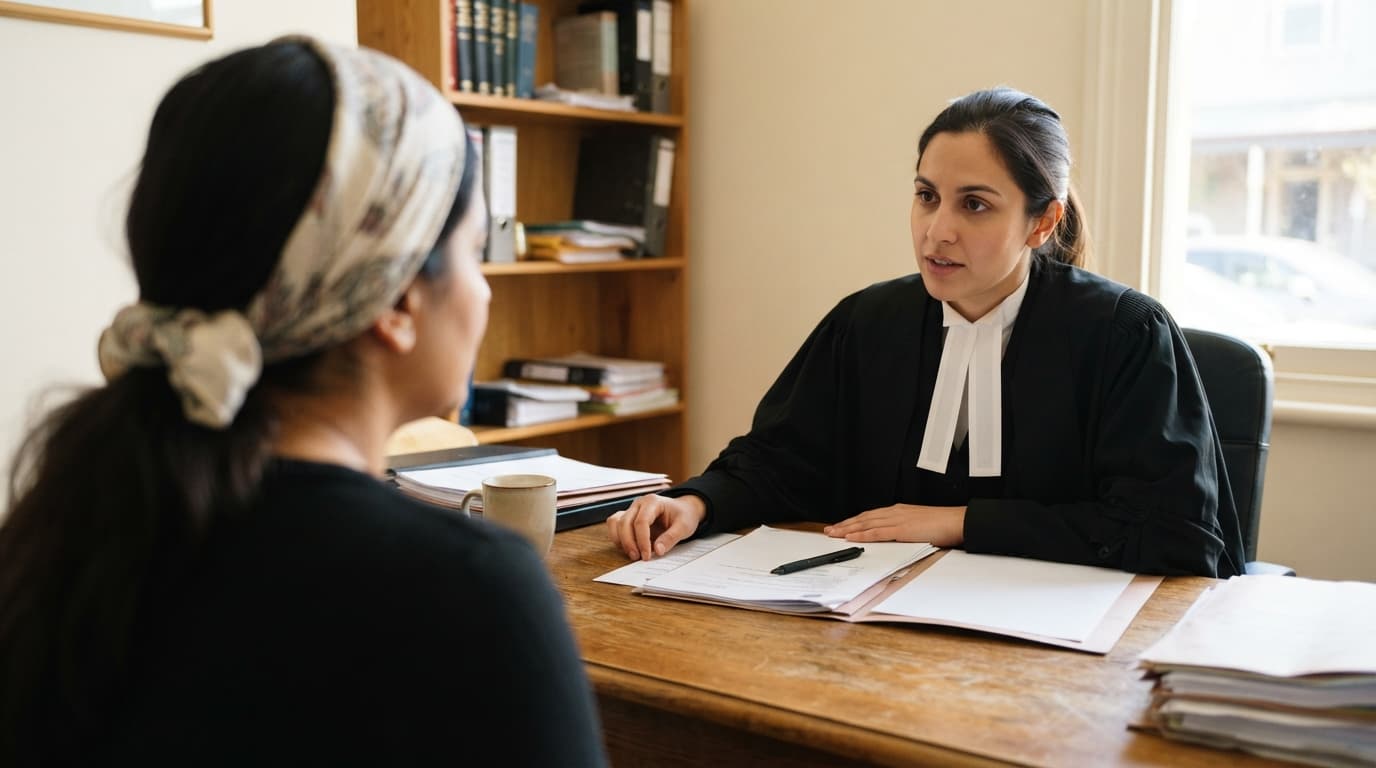
Supreme Court Calls for Response on Talaq-e-Hasan Constitutional Challenge and Divorce Safeguards
The Supreme Court on October 16 directed the Centre and other authorities to file responses to a petition that challenges the constitutional validity of Talaq-e-Hasan and seeks uniform safeguards for all forms of divorce under Muslim personal law. A bench comprising Chief Justice of India Surya Kant and Justice Joymalya Bagchi was informed by the petitioner's counsel of the challenge to this form of talaq, which the Court has now linked with a separate pending case filed by a Muslim woman contesting the Talaq-e-Hasan pronounced by her husband.
Talaq-e-Hasan involves a husband pronouncing talaq once a month over three months. The divorce becomes final after the third pronouncement if reconciliation does not occur between the spouses during this waiting period. The petitioner's challenge seeks to establish that this practice lacks constitutional validity, while simultaneously advocating for a uniform framework of protections that would apply across all forms of divorce recognised under Muslim personal law in India.
Beyond attacking Talaq-e-Hasan itself, the petition makes a broader request: that the Court impose a ban on unilateral divorce pronounced outside a court of law. This reflects concerns that have emerged in recent years regarding the manner and circumstances under which divorces are effected, particularly where one spouse may lack adequate notice, opportunity to be heard, or access to legal remedies.
Linking Cases and Systemic Questions
The bench's decision to link this petition with the separate case already pending before the Court indicates that the judiciary views these matters as interconnected. The pending case involves a specific Muslim woman who has challenged the Talaq-e-Hasan pronounced by her husband. By clubbing the two proceedings, the Court appears to be signalling that the constitutional questions raised in the petition may be informed by, or may in turn affect, the resolution of the individual woman's grievance.
This approach reflects a common judicial practice where the Court uses individual cases to examine systemic issues within a body of law. The petitioner's counsel presented the challenge during the hearing on October 16, and the bench accepted that the matter warranted a response from the Union of India and other relevant authorities before the Court could proceed with substantive consideration.
The request for responses from the Centre is significant because it places the burden on the government to articulate its position on whether Talaq-e-Hasan is constitutionally sound and whether uniform divorce safeguards should be mandated across Muslim personal law. The Union's response will likely address questions of personal law autonomy, the scope of constitutional review over religious practices, and the balance between community customs and individual rights.
Personal Law and Constitutional Scrutiny
Challenges to practices within personal law systems have historically raised complex questions about the limits of constitutional review. The Constitution of India recognises the right of religious communities to manage their personal affairs, including matters of marriage and divorce, subject to the overarching authority of the Constitution itself. Article 25 of the Constitution guarantees the right to freely profess, practise, and propagate religion, while simultaneously permitting the State to regulate or restrict religious practices in the interests of public order, morality, or health.
The petition's challenge to Talaq-e-Hasan will require the Court to examine whether this form of divorce, as currently practised and recognised, complies with constitutional guarantees of equality, dignity, and due process. The demand for uniform safeguards across all divorce forms under Muslim personal law raises the question of whether different forms of talaq—including talaq-e-hasan, talaq-e-bidah (instant talaq), and others—should be subject to identical procedural protections and substantive conditions.
The plea for a ban on unilateral divorce outside court introduces another dimension: the role of judicial intervention in what has traditionally been a matter between spouses and, in some interpretations, requiring only the pronouncement of words by the husband. If the Court were to mandate that all divorces must be effected through a court process, this would represent a significant departure from certain interpretations of Islamic personal law that have been followed in India for centuries.
The Pending Individual Case
The woman's case that is already pending before the Court provides a concrete factual foundation for these abstract constitutional questions. Her challenge to the Talaq-e-Hasan pronounced by her husband will presumably involve questions such as whether she received proper notice, whether she was afforded an opportunity to seek reconciliation, whether the pronouncements were made with proper intention, and whether she has remedies available to contest the divorce's validity or its effects.
By linking the two matters, the Court may be preparing to address both the individual woman's grievance and the constitutional questions in a coordinated manner. This could result in a judgment that not only resolves her specific dispute but also lays down principles applicable to all cases involving Talaq-e-Hasan and potentially to other forms of talaq as well.
What Comes Next
With the Court having sought responses from the Centre and other authorities, the immediate next step will be the filing of those responses. The timeline for such filings is typically set by the Court at the time of the order, though this information was not disclosed in the available account of the October 16 hearing. Once responses are filed, the Court will likely schedule a further hearing to consider the arguments presented by the petitioner, the Union, and any other parties with a stake in the outcome.
The linked status of the two cases means that the individual woman's petition will not proceed independently of the broader constitutional challenge. The Court may hear both matters together or may allow the broader petition to develop first, with the individual case following or being resolved in light of the principles established in the larger proceeding.
The Court's decision to call for responses rather than to dismiss the petition outright suggests that the bench found the challenge to have sufficient merit to warrant serious consideration. Personal law matters have sometimes been treated with judicial caution, out of respect for the autonomy of religious communities. The fact that the Court is actively seeking the Centre's position indicates that it views the constitutional questions raised as worthy of detailed examination.
The petition's dual focus—attacking Talaq-e-Hasan specifically while seeking uniform divorce safeguards across all forms—means that the Court's eventual decision may reshape the landscape of Muslim personal law in India. Whether the Court will strike down Talaq-e-Hasan, impose new procedural requirements, mandate judicial involvement in all divorces, or take some other course will have consequences for Muslim women and men across the country and may influence how other personal law systems are reviewed in future. The next substantive hearing will occur once the Centre and other authorities have filed their responses.
Comments
Sign in to read the discussion and share your thoughts.
Latest from LawWorld
News
View all- Karnataka High Court Issues Notice on Royal Fragrances' Petition Regarding KIADB IT Park Land17 Oct 2026
- Karnataka High Court Dismisses IRCTC's Delayed Appeal in Commercial Dispute17 Oct 2026
- Karnataka High Court Recalls Order in Kharge Family Trust Land Case, Schedules Fresh Hearing17 Oct 2026
- Karnataka High Court Upholds Constitutional Validity of Ancient Monuments Restrictions17 Oct 2026
- Karnataka High Court Directs Formation of District-Level Committees on Illegal Immigrants17 Oct 2026
Articles
View all- Supreme Court Issues Notice on Constitutional Validity of BNSS Section 172: Police Powers and Peaceful Assembly Rights at Stake17 Oct 2026
- Supreme Court Refers DPDP Act Constitutional Challenge to Five-Judge Bench: RTI vs. Privacy Rights at Stake12 Oct 2026
- Supreme Court Disposes PIL on Doxxing and Deepfakes; Directs Union Ministries to Implement Remedial Measures8 Oct 2026
Blogs
View all- Supreme Court Directs MEA to Publicize Compensation for Indians Killed in Russia-Ukraine War17 Oct 2026
- Contract Workers Cannot Claim Automatic Employment Despite Non-Compliance: Supreme Court Clarifies16 Oct 2026
- Supreme Court Calls for Separate Sexual Harassment Framework for Legal Professionals15 Oct 2026