
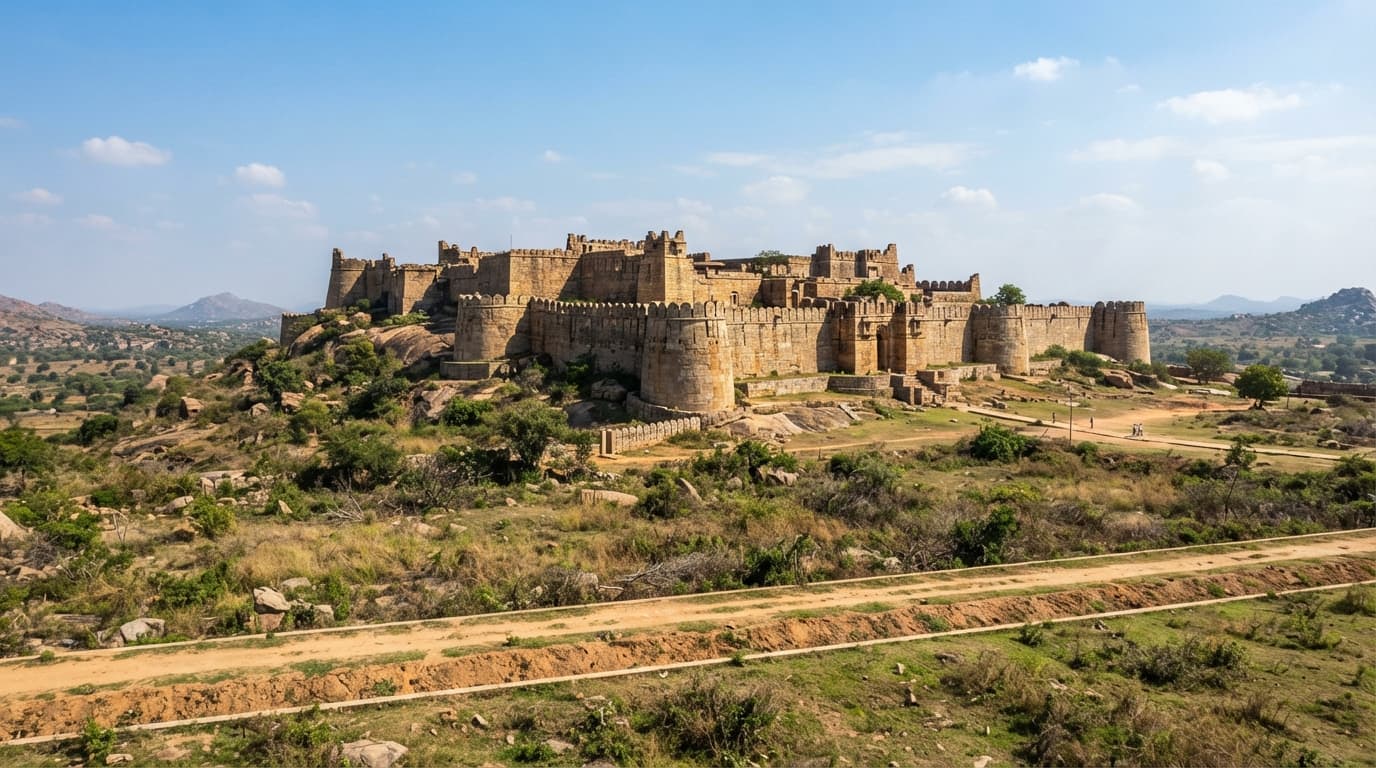
The Karnataka High Court has upheld the constitutional validity of provisions in the Ancient Monuments and Archaeological Sites and Remains Act, 1958, that restrict construction near protected heritage sites. Justice MGS Kamal, in an order dated October 9, 2026, rejected arguments that Sections 20A, 20B, and 20C of the central statute violated fundamental rights under the Indian Constitution.
The challenged provisions establish two buffer zones around protected monuments: a prohibited area extending 100 meters from the site boundary, where new construction is barred entirely, and a regulated area extending up to 200 meters, where construction is permitted only with specific approval. These classifications were introduced through amendments to the Act in 2010.
Property owner's challenge fails
BR Ramakrishna had challenged the rejection of his application for construction permission near Madhugiri Fort. His legal challenge argued that the distance-based restrictions lacked a scientific basis, were vague in their application, and violated Articles 14, 21, and 300A of the Constitution. Article 14 guarantees equality before law, Article 21 protects personal liberty and freedom from arbitrary state action, and Article 300A protects the right to property.
Justice Kamal rejected each ground. The court found that the restrictions are neither unreasonable nor ambiguous. The fixed-distance approach—100 meters for prohibition and 200 meters for regulation—provides clear, uniform application across all protected monuments, eliminating the potential for arbitrary decision-making. The court noted that such categorical restrictions serve a rational purpose: they create a predictable legal environment for property owners while ensuring that development does not compromise the structural integrity or archaeological value of monuments.
Constitutional duty to preserve heritage
The judgment emphasized that the restrictions do not operate in a constitutional vacuum. Article 51A(f) of the Constitution imposes a fundamental duty on every Indian citizen to protect and improve the natural environment and to have compassion for living creatures. The court interpreted this provision to extend to cultural and archaeological heritage as well. Preservation of ancient monuments reflects a constitutional commitment to safeguarding India's civilizational legacy for present and future generations.
The court's reasoning addressed the tension between property rights and public interest. While Article 300A protects property ownership, it is not absolute. The Constitution itself contemplates that property rights may be regulated in the public interest through valid legislation. The Ancient Monuments Act, enacted under Parliament's authority to protect national heritage, represents precisely such a regulation. The court held that the loss of development potential within the buffer zones is a permissible restriction, not an unconstitutional deprivation.
On the equality argument under Article 14, Justice Kamal observed that uniform application of distance-based rules to all protected monuments does not violate the equal protection clause. Different monuments may have different archaeological significance or structural vulnerability, but the Act's approach treats all protected sites uniformly in terms of the buffer zone framework. The court rejected the suggestion that individualized risk assessments should replace the statutory scheme, noting that such case-by-case determinations would introduce unpredictability and create opportunities for inconsistent application.
The vagueness challenge also failed. The court found that the terms "prohibited area" and "regulated area" are sufficiently defined by reference to measurable distances. Property owners can determine with certainty whether their land falls within either zone by reference to the official boundary of the protected monument. The Archaeological Survey of India maintains records of monument boundaries, making the classification objective and verifiable.
Fresh survey ordered for applicant
While dismissing the constitutional challenge, the court did not leave Ramakrishna without remedy. Justice Kamal directed the Archaeological Survey of India to reconsider his construction application after conducting a fresh survey of the site. This direction suggests that while the statutory framework is valid, individual applications must still be evaluated on their merits within that framework. The fresh survey may provide new information that could support approval of his proposal, provided it complies with the regulatory requirements for the 200-meter zone.
The order reflects a judicial approach that balances competing interests. The court acknowledged that property owners face genuine restrictions on land use and potential economic loss. However, it concluded that these burdens are justified by the constitutional commitment to heritage preservation and the rational connection between the buffer zones and the protection of monuments.
Many protected monuments face threats from uncontrolled urban development, encroachment, and structural damage caused by nearby construction. The court's validation of the statutory framework provides legal certainty to the Archaeological Survey of India and state governments in enforcing these restrictions. It removes a significant source of litigation that could have undermined heritage protection efforts.
The ruling is particularly relevant in states like Karnataka, which has numerous protected monuments ranging from ancient temples and forts to pre-historic sites. The decision ensures that the two-tier buffer zone system can be applied consistently without fear of successful constitutional challenge. Property owners and developers seeking to undertake construction near protected sites must now work within this framework, seeking approvals through the established regulatory process rather than attempting to circumvent it through constitutional litigation.
For Ramakrishna, the path forward involves the fresh survey and reconsideration of his application. The Archaeological Survey of India will need to assess whether his proposed construction can be accommodated within the regulated 200-meter zone without compromising the monument's protection. The court's direction indicates that approval is not foreclosed; rather, it must be evaluated through proper regulatory channels with current site information.
The judgment also reinforces the principle that ancient monuments are held in trust for the nation. While individual property owners have rights, those rights do not extend to unrestricted development that could damage irreplaceable cultural assets. This principle aligns with international heritage protection standards and India's obligations under UNESCO conventions on cultural heritage preservation.
The October 9 order, reported on October 16, 2026, stands as the Karnataka High Court's definitive statement on the constitutionality of the buffer zone provisions. Unless appealed to the Supreme Court, it will guide heritage protection efforts in the state and may influence similar litigation in other jurisdictions.
Comments
Sign in to read the discussion and share your thoughts.
Latest from LawWorld
News
View all- Karnataka High Court Issues Notice on Royal Fragrances' Petition Regarding KIADB IT Park Land17 Oct 2026
- Karnataka High Court Dismisses IRCTC's Delayed Appeal in Commercial Dispute17 Oct 2026
- Karnataka High Court Recalls Order in Kharge Family Trust Land Case, Schedules Fresh Hearing17 Oct 2026
- Karnataka High Court Directs Formation of District-Level Committees on Illegal Immigrants17 Oct 2026
- Karnataka High Court Quashes FIR Against Amit Malviya Over X Posts on Rahul Gandhi17 Oct 2026
Articles
View all- Supreme Court Issues Notice on Constitutional Validity of BNSS Section 172: Police Powers and Peaceful Assembly Rights at Stake17 Oct 2026
- Supreme Court Refers DPDP Act Constitutional Challenge to Five-Judge Bench: RTI vs. Privacy Rights at Stake12 Oct 2026
- Supreme Court Disposes PIL on Doxxing and Deepfakes; Directs Union Ministries to Implement Remedial Measures8 Oct 2026
Blogs
View all- Supreme Court Directs MEA to Publicize Compensation for Indians Killed in Russia-Ukraine War17 Oct 2026
- Contract Workers Cannot Claim Automatic Employment Despite Non-Compliance: Supreme Court Clarifies16 Oct 2026
- Supreme Court Calls for Separate Sexual Harassment Framework for Legal Professionals15 Oct 2026