
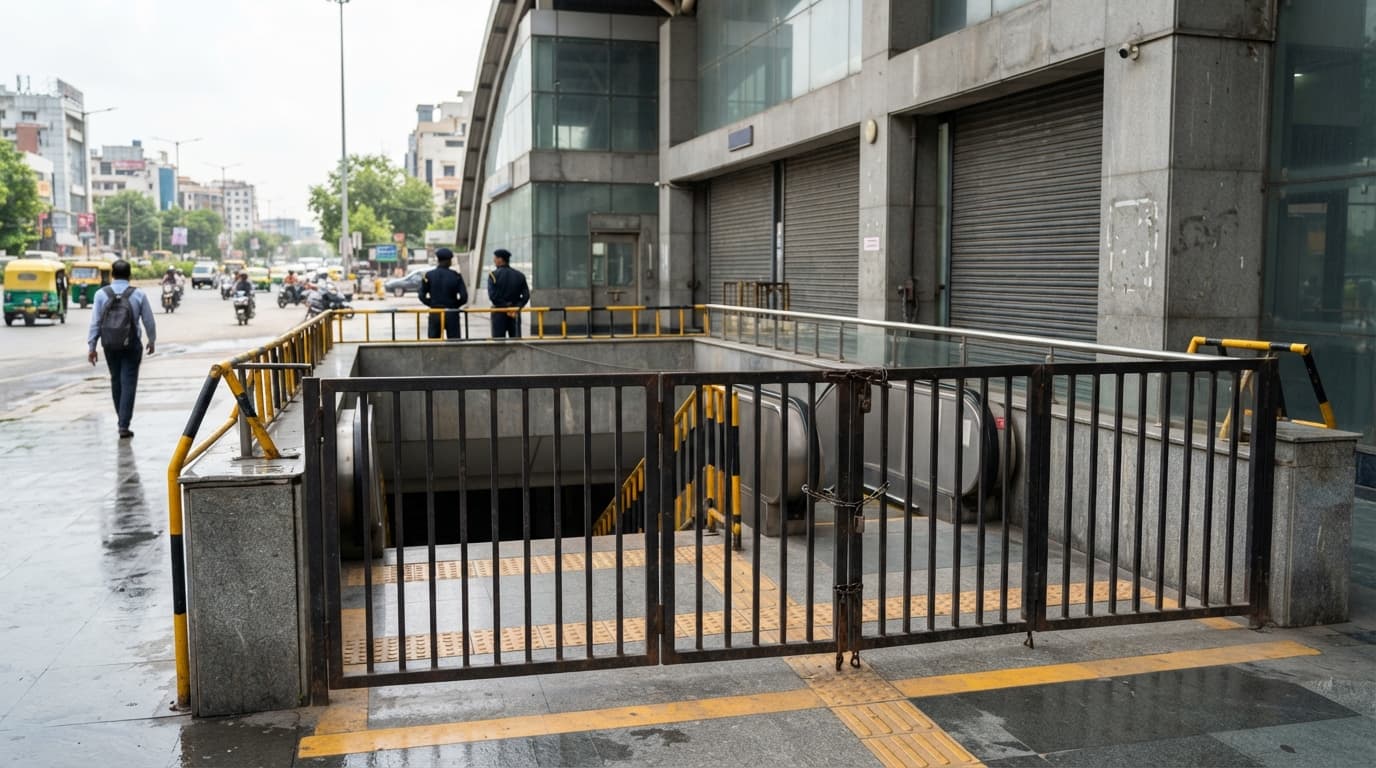
The Supreme Court of India issued contempt notices to several senior government officials, including Delhi's police commissioner, on October 11, 2026. The notices alleged violations of an October 9 order that had restricted metro and railway closures during protests in the national capital. A Division Bench of Justices Joymalya Bagchi and V. Mohana heard habeas corpus petitions that day, examining claims of unlawful detentions and breaches of the Court's directives.
The October 9 order had directed authorities to reconsider metro closures and ensure that any restrictions on public transportation remained proportionate rather than constituting an outright prohibition. The Court had required authorities to justify such measures on grounds of public order, publicize their decisions widely, issue fresh traffic advisories, and submit compliance reports.
Petitioners alleged that on October 10, authorities closed metro stations and disrupted railway services in violation of these directions. They also claimed that individuals were detained beyond the scope of prohibitory orders issued under Section 163 of the Bharatiya Nagarik Suraksha Sanhita, 2023 (BNSS). The bench noted allegations of metro station closures, widespread disruption of public movement, and detentions that appeared to exceed what the law permitted.
Government's Selective Closure Defence
The Solicitor General, appearing for the Centre, disputed the violation allegations. He stated that 45 of 303 metro stations were closed for law and order purposes, characterizing the closures as selective rather than comprehensive. He also indicated that detained individuals had been released, suggesting the government viewed the detention issue as substantially resolved.
The bench's decision to issue contempt notices nonetheless signals that the Court found the government's explanation insufficient. Contempt notices represent a serious enforcement mechanism deployed when a court believes its orders have been deliberately or recklessly disregarded. The notices against high-ranking officials demonstrate the Court's resolve to enforce its directions and protect citizens' rights during civil unrest.
The October 10 Protests
Demonstrators on October 10 demanded the resignation of Chief Election Commissioner Gyanesh Kumar. The scale of agitation prompted authorities to impose restrictions on public movement and services, citing law and order concerns. The Supreme Court's October 9 order attempted to balance the government's legitimate interest in maintaining public order with citizens' constitutional rights to move freely and access essential services.
The Court had directed that no person be detained except in accordance with law, that metro and railway services operate normally, and that internet services remain uninterrupted. These directions reflected the Court's view that fundamental rights and access to public services cannot be arbitrarily suspended, even during protests.
Adjournment and Response Deadline
On October 13, 2026, the Supreme Court adjourned the hearing to October 15 due to Justice V. Mohana's indisposition. The Solicitor General requested an extension to file a response affidavit to the contempt plea, stating the document required further refinement. The Court accepted this submission without opposition from other counsel and granted the Centre additional time to respond to non-compliance allegations.
Lawyers' Access to Courts Disrupted
The protests and restrictions created significant difficulties for the legal community. The Supreme Court Bar Association (SCBA) filed a petition highlighting hardships faced by lawyers, including internet service restrictions and alleged obstructions to their movement. SCBA president Pradeep Rai submitted that lawyers faced impediments in reaching court and accessing essential services.
Chief Justice of India Surya Kant acknowledged that democratic activities should proceed smoothly but emphasized that the functioning of the Supreme Court and the movement of lawyers, court staff, and litigants must not be obstructed. The bench agreed to hear SCBA petitions and took note of complaints regarding alleged excessive force against lawyers en route to protest sites.
On October 12, 2026, the Supreme Court directed the Delhi Police to conduct a Special Investigation Team (SIT) probe into allegations of assault on lawyers during the demonstrations. This directive underscored the Court's serious approach to allegations of misconduct by law enforcement against members of the legal profession.
Constitutional Limits on Restrictions
The Court's intervention reflects established constitutional principles governing restrictions on fundamental rights. Article 19(2) of the Constitution permits reasonable restrictions on the right to move freely, but only when necessary for public order. The October 9 order attempted to ensure that any restrictions imposed remained within this constitutional framework and did not become blanket prohibitions.
The distinction between selective closure of 45 metro stations and a complete shutdown carries legal weight. A selective approach may be more readily justified as proportionate to the threat posed, whereas a comprehensive closure might exceed what is necessary for public order. The Court's subsequent issuance of contempt notices suggests that even the selective closures may have been implemented inconsistently with the Court's directions or that authorities imposed additional restrictions beyond what the order permitted.
Press Freedom and Police Conduct
During the October 13 adjournment, the Court agreed to urgently hear new petitions seeking an independent investigation into police action against journalists covering the protests. These petitions raised concerns about press freedom and the ability of media personnel to report on public events without facing obstruction or violence.
The Court also directed authorities to remove any boards related to the imposition of Section 163 of the BNSS around the Supreme Court premises if not already done. This direction aimed to ensure unimpeded access to justice and symbolized the Court's determination that the functioning of courts and access to justice must not be compromised, even during law and order operations.
October 15 Hearing and Enforcement
The hearing scheduled for October 15, 2026 will determine the Court's response to the government's affidavit and its final stance on the contempt charges. The notices already issued signal that the Court views the alleged violations seriously and expects a satisfactory explanation or corrective action from the government.
The case reflects the ongoing tension between maintaining public order during civil unrest and protecting constitutional rights. While governments have legitimate tools to address law and order threats, the exercise of these powers remains subject to judicial scrutiny and must adhere to principles of proportionality and necessity. The contempt notices issued against senior officials underscore that these principles are enforceable through the Court's contempt jurisdiction.
For citizens, lawyers, journalists, and other professionals affected by the restrictions, the Court's intervention provides a mechanism for challenging what they view as excessive or unlawful measures. The October 15 hearing will clarify whether the Court considers the government's conduct sufficiently serious to warrant contempt findings and what remedies or directions it will impose to prevent similar violations in future instances of civil unrest.
Comments
Sign in to read the discussion and share your thoughts.
Latest from LawWorld
News
View all- Karnataka High Court Grants Six-Day Interim Bail to KPSC Scam Accused for Daughter's Naming Ceremony13 Oct 2026
- Karnataka High Court Disposes Petition After State Notifies SOP for Underage Pregnancies13 Oct 2026
- Karnataka High Court Directs Police to Issue Look Out Circular in Dowry and Cruelty Case13 Oct 2026
- Karnataka High Court Strikes Down SC/ST Quota Law Exceeding 50% Constitutional Ceiling13 Oct 2026
- Opposition Leaders File Supreme Court Petition Against Election Commission Over Electoral Roll Irregularities13 Oct 2026
Articles
View all- Supreme Court Refers DPDP Act Constitutional Challenge to Five-Judge Bench: RTI vs. Privacy Rights at Stake12 Oct 2026
- Supreme Court Disposes PIL on Doxxing and Deepfakes; Directs Union Ministries to Implement Remedial Measures8 Oct 2026
- Supreme Court Issues Notice on Constitutional Challenge to GST Input Tax Credit Denial Provision7 Oct 2026
Blogs
View all- Supreme Court Orders Priority Hearing for Pension Cases: A Decade-Long Wait Deemed 'Grave Injustice'12 Oct 2026
- Supreme Court Clarifies Gratuity Calculation: Monthly Wages Divided by 26 Working Days, Not 3011 Oct 2026
- Supreme Court Affirms Damages Recovery for Delayed Provident Fund Contributions Without Time Limit10 Oct 2026