
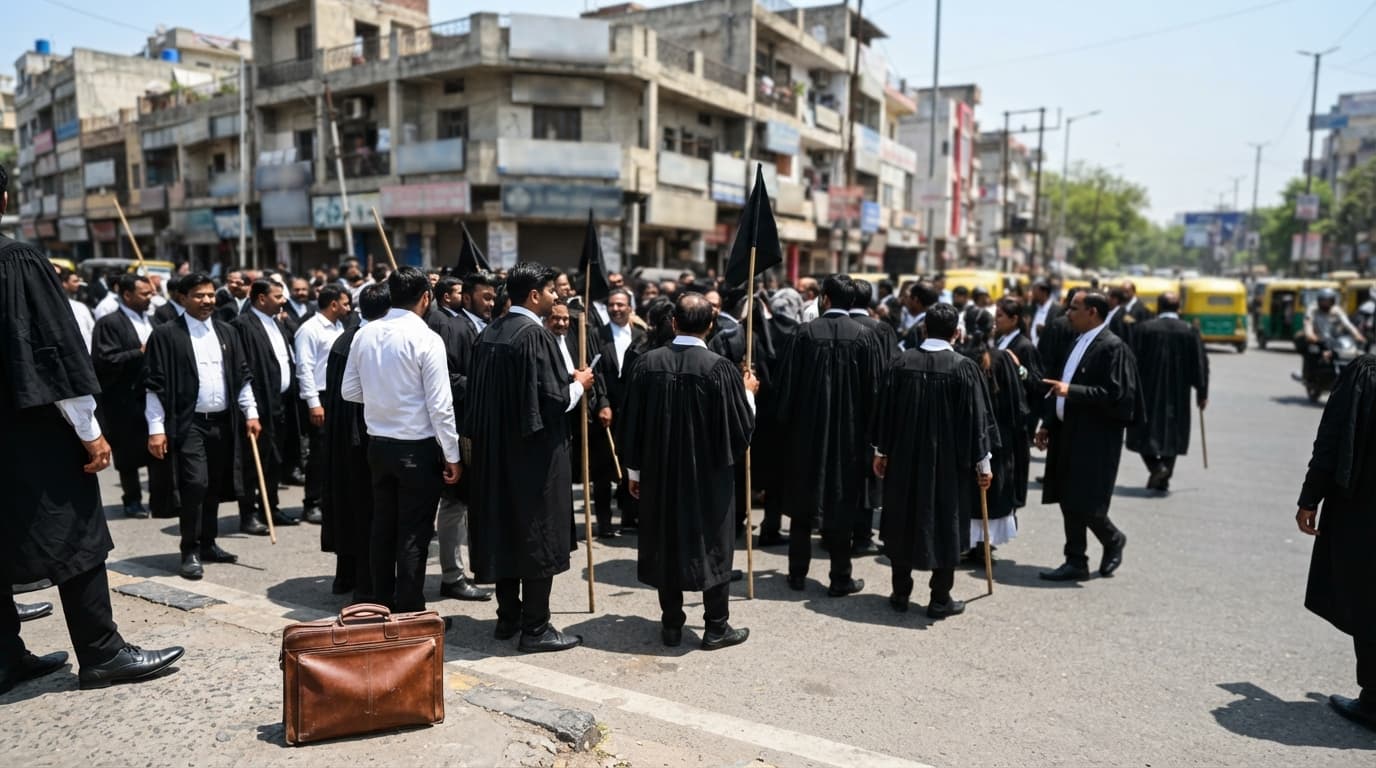
The Supreme Court of India on October 12, 2026, directed the Delhi Police to conduct a Special Investigation Team (SIT) probe into allegations of assault against lawyers who were protesting against BCI Chairman Manan Kumar Mishra. The directive came as the Court examined concerns raised by the legal fraternity regarding the treatment of members of the bar during recent demonstrations in the capital. The order underscores the seriousness with which the Court views allegations of misconduct against law enforcement agencies, particularly when such allegations involve members of the legal profession.
The Supreme Court Bar Association (SCBA) had previously brought the matter to the Court's attention, with SCBA president Pradeep Rai highlighting the difficulties faced by lawyers during the ongoing protests. The SCBA had condemned the alleged use of excessive force against lawyers en route to a protest, raising concerns about the safety and rights of legal professionals during the demonstrations. The Court acknowledged these submissions and agreed to take up the matter with urgency.
The protests in Delhi, which intensified around October 10, 2026, were directed against Chief Election Commissioner Gyanesh Kumar, with demonstrators demanding his resignation. During these agitations, the movement of lawyers, court staff, and litigants faced significant obstruction, and allegations emerged of police action against various groups, including journalists and legal professionals. The Supreme Court, in its previous orders, had emphasised that while democratic activities should proceed smoothly, the functioning of courts and the movement of lawyers and other professionals must not be hindered.
Chief Justice of India Surya Kant, alongside Justices Joymalya Bagchi and V Mohana, presided over hearings related to the protests. The bench made clear that restrictions on public movement and services must be proportionate and not constitute an outright prohibition. In an October 9, 2026 order, the Court had directed that no person should be detained except in accordance with law, metro and railway services should operate normally, and internet services remain uninterrupted. The Court also explicitly stated that lawyers, journalists, and other professionals should not be obstructed in their duties.
When compliance with these orders came into question, the Court took serious notice. On October 11, 2026, the Supreme Court addressed habeas corpus petitions concerning alleged violations of its earlier directives. The Division Bench noted allegations of metro station closures, disruption of public movement, and detentions extending beyond prohibitory orders under Section 163 of the Nagarik Suraksha Sanhita, 2023 (BNSS). The Solicitor General disputed some of these allegations, stating that 45 of 303 metro stations were closed for law and order purposes and that detained individuals had been released. However, the Court issued contempt notices to several senior government functionaries, including Delhi's police commissioner, for allegedly disregarding its October 9 order.
The direction for an SIT probe into the assault allegations against lawyers represents an escalation of the Court's intervention. A SIT, typically comprising senior police officers or officials from central agencies, is tasked with conducting an impartial investigation into sensitive matters. The decision to order such a probe signals the Court's determination to ensure that allegations of police misconduct are investigated thoroughly and independently, away from the potential influence of local police hierarchy.
The timing of the directive is significant. The Court has been actively monitoring the situation in Delhi, deferring hearings on related petitions to allow for proper examination of the issues. On October 13, 2026, the Supreme Court adjourned a batch of pleas related to the protests to October 15, citing the illness of Justice V Mohana. The Centre was granted an extension to file its response affidavit to a contempt plea alleging violations of the Supreme Court's directions concerning public transport. The Solicitor General Tushar Mehta indicated that the affidavit was prepared but required further refinement.
The Court also agreed to urgently hear new petitions seeking an independent investigation and contempt proceedings against authorities for alleged police action against journalists covering the protests. This indicates that the assault allegations against lawyers are part of a broader pattern of concerns about police conduct during the demonstrations. The legal profession, as an integral part of the justice system, occupies a special position in the eyes of the Court. Any interference with the rights and safety of lawyers strikes at the heart of the administration of justice.
The Supreme Court's role in this matter reflects a fundamental principle of Indian constitutional law: the independence of the judiciary and the legal profession. Lawyers are officers of the court, essential to the functioning of the justice system. When they are prevented from performing their duties or subjected to assault during lawful protests, it raises questions about the state's respect for the rule of law. The Court's directive for an SIT probe is a clear message that such conduct will not be tolerated.
The investigation ordered by the Court will likely examine the circumstances under which the alleged assault took place, the identity of the police personnel involved, and whether the force used was proportionate and justified. The SIT will also need to establish whether there was any deliberate targeting of lawyers or whether the incidents were isolated occurrences. The findings of the SIT will have implications not only for the individuals involved but also for police training and protocols in handling protests involving members of the legal profession.
The broader context of the Delhi protests adds weight to the Court's intervention. The demonstrations, while lawful expressions of democratic dissent, led to significant disruptions to public life, including restrictions on metro services and internet connectivity. The Supreme Court's orders sought to balance the right to protest with the need to maintain normal functioning of essential services and protect the rights of citizens. The alleged assault on lawyers represents a failure to maintain this balance and a potential violation of the Court's own orders.
As the investigation proceeds, the Supreme Court will continue to monitor the situation. The hearings scheduled for October 15 and beyond will provide an opportunity for the Court to review the compliance of authorities with its orders and to examine the findings of the SIT once they become available. The matter is expected to remain on the Court's active list, with regular updates required from the investigating agency.
The directive for an SIT probe serves as a reminder of the Court's commitment to protecting the rights of the legal profession and ensuring that law enforcement agencies are held accountable for their actions. It also sends a signal to the police that interference with lawyers during protests or at any other time will result in serious consequences, including independent investigation and potential contempt proceedings. For the legal fraternity, the order provides some assurance that their concerns are being taken seriously at the highest level of the judiciary.
Comments
Sign in to read the discussion and share your thoughts.
Latest from LawWorld
News
View all- Karnataka High Court Grants Six-Day Interim Bail to KPSC Scam Accused for Daughter's Naming Ceremony13 Oct 2026
- Karnataka High Court Disposes Petition After State Notifies SOP for Underage Pregnancies13 Oct 2026
- Karnataka High Court Directs Police to Issue Look Out Circular in Dowry and Cruelty Case13 Oct 2026
- Karnataka High Court Strikes Down SC/ST Quota Law Exceeding 50% Constitutional Ceiling13 Oct 2026
- Supreme Court Issues Contempt Notices Over Metro Restrictions and Detentions During Delhi Protests13 Oct 2026
Articles
View all- Supreme Court Refers DPDP Act Constitutional Challenge to Five-Judge Bench: RTI vs. Privacy Rights at Stake12 Oct 2026
- Supreme Court Disposes PIL on Doxxing and Deepfakes; Directs Union Ministries to Implement Remedial Measures8 Oct 2026
- Supreme Court Issues Notice on Constitutional Challenge to GST Input Tax Credit Denial Provision7 Oct 2026
Blogs
View all- Supreme Court Orders Priority Hearing for Pension Cases: A Decade-Long Wait Deemed 'Grave Injustice'12 Oct 2026
- Supreme Court Clarifies Gratuity Calculation: Monthly Wages Divided by 26 Working Days, Not 3011 Oct 2026
- Supreme Court Affirms Damages Recovery for Delayed Provident Fund Contributions Without Time Limit10 Oct 2026