
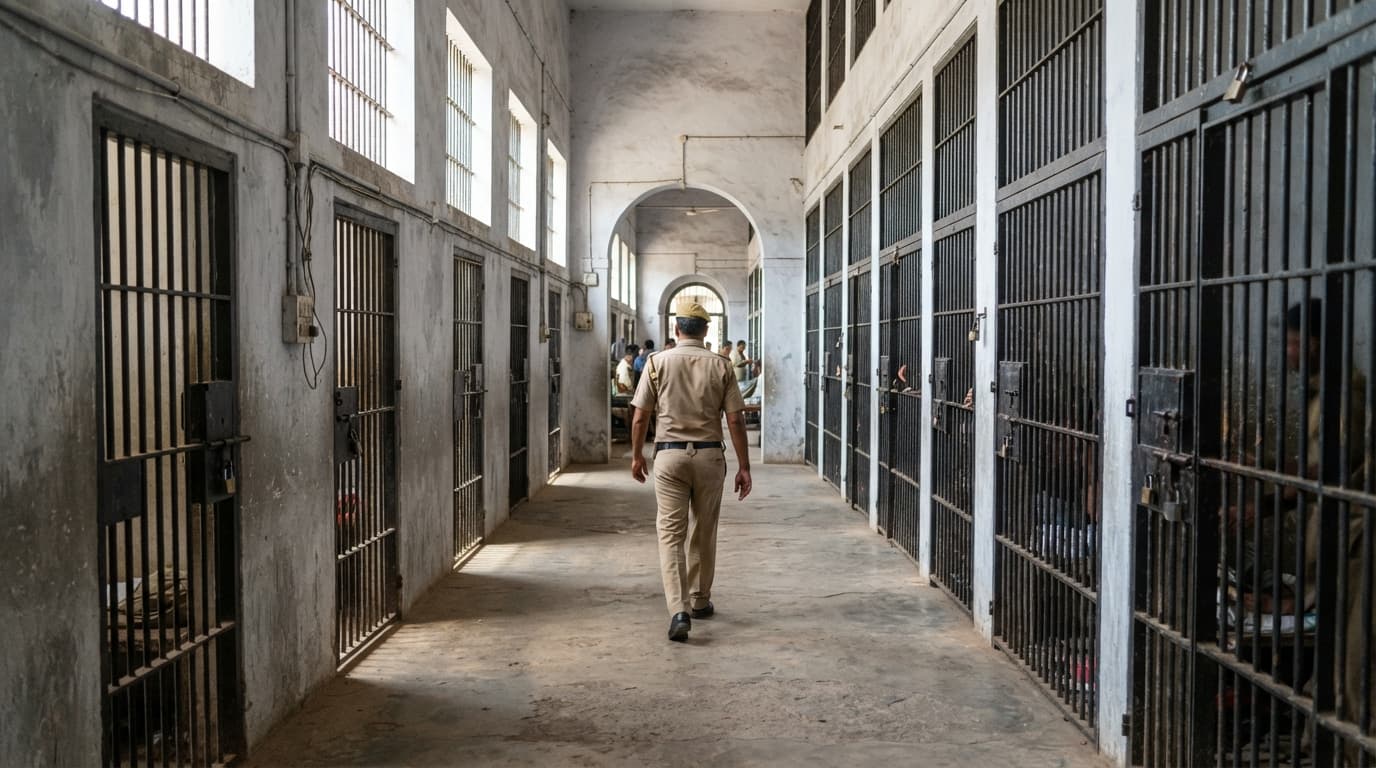
The Supreme Court has clarified the constitutional distribution of powers governing prisons, holding that the subject of prisons and persons detained therein falls exclusively within the legislative domain of States under Schedule VII List II of the Constitution. The judgment in National Legal Services Authority v. Union of India, (2026) 8 SCC 52, establishes that primary responsibility for framing and implementing prison laws and policies rests with respective State Governments and Union Territory Administrations, not the central government.
This pronouncement resolves a significant area of constitutional ambiguity that has long affected prison administration across India. The decision clarifies which tier of government holds legislative authority over detention facilities, the treatment of prisoners, prison conditions, and related regulatory frameworks. By placing prisons squarely within the State List, the Court has drawn a firm boundary that prevents federal overreach into an area traditionally managed by States.
Constitutional Framework and Legislative Distribution
The Indian Constitution distributes legislative powers between Parliament and State Legislatures through three lists in the Seventh Schedule. The Union List contains subjects on which only Parliament can legislate. The State List comprises subjects reserved for State Legislatures. The Concurrent List permits both Parliament and State Legislatures to legislate, though parliamentary laws prevail in case of conflict.
The Supreme Court's holding places prisons firmly within the State List. This means that States possess exclusive power to enact laws governing prison administration, prisoner rights, prison discipline, conditions of confinement, and related matters. Union Territories, which are administered under central control, exercise similar authority through their respective administrations. The placement of prisons in the State List reflects a constitutional design that recognizes States as the primary custodians of law and order within their territories.
This constitutional arrangement has practical implications. It means that prison legislation cannot be uniformly imposed across all States by the central government through parliamentary statute. Instead, each State must develop its own prison laws tailored to its specific needs, resources, and circumstances. The Model Prisons Act, which many States have adopted or adapted, provides a reference framework rather than binding legislation.
Scope of State Authority
The judgment emphasizes that the primary responsibility for framing prison laws and policies rests with State Governments and Union Territory Administrations. This responsibility encompasses multiple dimensions of prison management and regulation. States must establish the legal framework governing the operation of prisons, including rules for admission, classification of prisoners, discipline, and release procedures.
State authority extends to determining prison conditions and standards, subject to constitutional protections and judicial review. While the Constitution guarantees fundamental rights to all persons, including prisoners, States retain the power to legislate on how prisons are organized and operated within those constitutional constraints. States also bear responsibility for allocating resources to prison systems, determining staffing levels, and implementing prison policies.
The decision clarifies that policy decisions regarding prison administration fall within the State domain. These include decisions about prison security levels, prisoner classification systems, rehabilitation programs, and internal prison discipline. States determine how to balance security concerns with prisoner welfare, how to manage overcrowding, and how to implement reforms aimed at reducing recidivism.
Implications for Federal-State Relations
The Supreme Court's clarification has important implications for the relationship between the central government and States in matters of criminal justice and detention. While the central government retains authority over certain subjects—such as the Indian Penal Code and the Code of Criminal Procedure, which fall within the Concurrent List—it cannot directly legislate on prison administration as an exclusive matter.
This does not mean the central government has no role. Parliament can legislate on matters that intersect with prisons when those matters fall within its constitutional authority. For instance, Parliament can create new crimes or alter criminal procedure. However, the implementation of those laws through prison systems remains a State responsibility.
The central government may provide guidance, technical assistance, and coordination through bodies like the Bureau of Police Research and Development or through national-level prison policy frameworks. Such guidance operates within the constitutional framework established by the Supreme Court's judgment. States remain free to accept, modify, or reject central guidance based on their own assessment of what serves their prison systems best.
Practical Implementation and Compliance
The Supreme Court's holding requires States to ensure that their prison laws and policies comply with constitutional requirements. Prisoners retain fundamental rights guaranteed under the Constitution, including the right to life and personal liberty under Article 21. Courts can scrutinize prison conditions and practices to ensure they do not violate these rights, even though prisons fall within the State legislative domain.
This creates a framework where States have primary authority but operate within constitutional boundaries policed by courts. A State cannot use its exclusive legislative authority to enact prison laws that violate fundamental rights or deny prisoners basic protections. The Supreme Court and High Courts retain power to review prison conditions and practices through habeas corpus petitions and other constitutional remedies.
States must also ensure that their prison laws and policies do not discriminate or violate any other constitutional guarantee. The exclusive legislative authority granted to States is not absolute; it is exercised within the constitutional structure. While States decide how to run prisons, they must do so in a manner consistent with the Constitution.
Alignment with Constitutional Federalism
The judgment reflects the constitutional principle of federalism embedded in the Indian Constitution. Federalism contemplates a division of powers between the central government and States, with each level exercising authority over matters assigned to it. The placement of prisons in the State List reflects a judgment that prison administration is fundamentally a local matter best managed by State governments closer to the ground.
This allocation recognizes that prison systems serve local criminal justice systems. Prisons hold persons convicted under laws enforced by State police and prosecuted in State courts. The conditions and management of these facilities directly affect the functioning of State criminal justice systems. Placing authority over prisons with States ensures that prison administration can be coordinated with broader State law enforcement and criminal justice policies.
The Supreme Court's clarification strengthens the federal structure by preventing the center from encroaching on State authority in this domain. It also places responsibility clearly on States to develop and implement effective prison policies. States cannot defer to central direction on matters within their exclusive legislative domain; they must take active responsibility for prison administration.
Future Implications for Prison Reform
The judgment has implications for prison reform initiatives in India. Any reform aimed at improving prison conditions, prisoner rehabilitation, or prison administration must work through State legislatures and administrations. National standards for prisons can be recommended and promoted, but they must ultimately be implemented through State legislative and administrative action.
This places emphasis on State-level prison reform efforts. States that wish to adopt modern prison practices, implement rehabilitation programs, or improve prisoner conditions must do so through their own legislative and policy processes. The Supreme Court's clarification does not prevent reform; rather, it channels reform efforts through the appropriate constitutional actors.
The decision also means that challenges to prison conditions or practices must address themselves to State governments and State legislatures as the primary responsible entities. While courts retain power to intervene to protect constitutional rights, the primary responsibility for addressing systemic prison issues rests with States. This allocation of responsibility encourages States to take ownership of their prison systems and to develop solutions tailored to their specific contexts and needs.
The Supreme Court's holding in National Legal Services Authority v. Union of India establishes clear constitutional boundaries in an area that had previously lacked definitive guidance. By placing prisons exclusively within the State legislative domain, the Court has provided clarity to governments, courts, and citizens about which level of government bears primary responsibility for prison administration and policy. This clarity should facilitate more effective prison governance and clearer accountability for prison conditions and practices across India's federal system.
Comments
Sign in to read the discussion and share your thoughts.
Latest from LawWorld
News
View all- Officials Committee to Be Formed for Establishing Karnataka High Court Bench for Coastal Development12 Oct 2026
- Karnataka High Court Grants Bail to Two Accused in Money Laundering Case, Citing Investigation Completion and Trial Delays12 Oct 2026
- Karnataka High Court Sets Aside Tax Revision Proceedings Against Mukesh Bansal in ESOP Classification Case12 Oct 2026
- Supreme Court Launches 'Jan Soochna Seva' Initiative for Public Access to Judgments12 Oct 2026
- Supreme Court to Hear Petition on Lawyers' Difficulties During Delhi Protests12 Oct 2026
Articles
View all- Supreme Court Refers DPDP Act Constitutional Challenge to Five-Judge Bench: RTI vs. Privacy Rights at Stake12 Oct 2026
- Supreme Court Disposes PIL on Doxxing and Deepfakes; Directs Union Ministries to Implement Remedial Measures8 Oct 2026
- Supreme Court Issues Notice on Constitutional Challenge to GST Input Tax Credit Denial Provision7 Oct 2026
Blogs
View all- Supreme Court Orders Priority Hearing for Pension Cases: A Decade-Long Wait Deemed 'Grave Injustice'12 Oct 2026
- Supreme Court Clarifies Gratuity Calculation: Monthly Wages Divided by 26 Working Days, Not 3011 Oct 2026
- Supreme Court Affirms Damages Recovery for Delayed Provident Fund Contributions Without Time Limit10 Oct 2026