
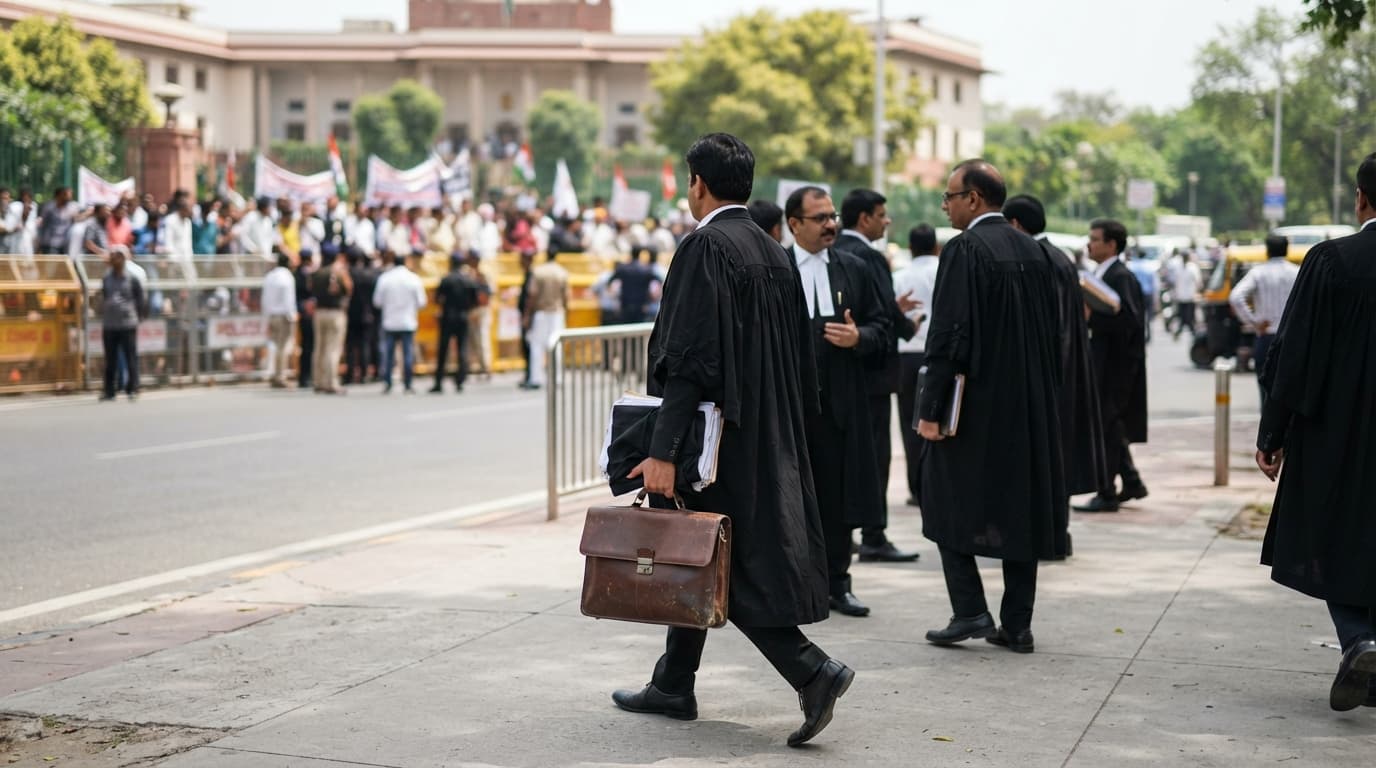
The Supreme Court will hear petitions on October 13, 2026, addressing the difficulties faced by lawyers and court staff due to ongoing protests in Delhi and associated internet service restrictions. Chief Justice of India Surya Kant, alongside Justice Joymalya Bagchi and Justice V. Mohana, will preside. The Supreme Court Bar Association filed one of the petitions, raising concerns about practical challenges created by protest-related disruptions affecting the legal community and the court's functioning.
The bench noted that while democratic activities must proceed smoothly, they cannot obstruct the Supreme Court's functioning or impede the movement of lawyers, court staff, and litigants. This framing suggests the court intends to balance the right to protest with the necessity of maintaining access to justice.
Protests and connectivity collapse
Delhi has experienced ongoing protests demanding the resignation of Chief Election Commissioner Gyanesh Kumar. These demonstrations prompted internet service restrictions in the national capital, creating cascading difficulties for the legal profession. Lawyers depend on reliable internet connectivity for case research, document preparation, client communication, and access to court portals and digital filing systems. The combination of protest-related mobility challenges and connectivity issues has compounded the problem beyond inconvenience to potentially affecting the delivery of legal services.
The Supreme Court Bar Association's decision to file a petition reflects the organised bar's assessment that judicial intervention is necessary. The bar association represents lawyers practising before the Supreme Court and has historically served as a voice for the profession on matters affecting its functioning. The association's approach to the apex court suggests the difficulties have reached a level where self-regulation or administrative measures alone have proven insufficient.
What lawyers face on the ground
The specific challenges include restricted access to court premises, delayed or cancelled hearings, inability to meet clients or witnesses, and compromised access to legal databases and court management systems. For lawyers with time-sensitive matters—bail applications, interim relief, urgent injunctions—such restrictions can have serious consequences for their clients' interests. Court staff members face similar challenges, affecting their ability to process cases, maintain records, and assist the judiciary.
Internet service restrictions, though sometimes imposed during civil unrest to prevent coordination of illegal activities, create significant collateral damage to essential services. The legal system's increasing reliance on digital infrastructure means that internet outages directly impair the court's ability to function. Case management systems, electronic filing platforms, video conferencing facilities for remote hearings, and access to legal research tools all depend on reliable connectivity. For lawyers working from offices outside the court premises, internet restrictions can make effective work impossible.
The court's balancing act
Chief Justice Kant's comment that democratic activities should proceed smoothly while not obstructing court functioning presents a nuanced position. It acknowledges that India's constitutional framework protects the right to protest and freedom of expression, even when the protest targets government officials. Simultaneously, it asserts that these rights cannot be exercised in a manner that prevents the court system from delivering justice.
The hearing on October 13 will likely explore several questions. First, what specific relief can the court grant to mitigate lawyers' difficulties without intervening in the protest itself or the government's decision to restrict internet services. Second, whether the court can direct the administration to create corridors or mechanisms allowing lawyers and court staff to access the court despite the protests. Third, whether alternative working arrangements, such as expanded remote hearing facilities or temporary relocation of certain court functions, might be feasible. Fourth, the timeline for when normal functioning is expected to resume and what interim measures should apply until then.
The court's willingness to hear the petition does not signal a predetermined outcome. However, the Chief Justice's prior statements about transparency and accountability in judicial functioning suggest the court takes seriously the institutional implications of prolonged disruptions. The Chief Justice has recently emphasised the judiciary's commitment to accessibility and public engagement, including through initiatives like the newly launched Jan Soochna Seva programme, which aims to make judicial decisions more accessible to citizens. A court focused on accessibility cannot ignore obstacles that prevent lawyers and litigants from reaching it.
Proportionality and precedent
The petition raises broader questions about the limits of protest and the state's responsibility to balance competing rights. While the government has legitimate reasons to impose restrictions during civil unrest, the proportionality of such measures must be examined. Internet shutdowns are blunt instruments that affect not only the protest's targets but also hospitals, businesses, educational institutions, and the legal system. The Supreme Court has previously held that internet shutdowns must be justified, necessary, and proportionate to the threat posed. The bar association's petition implicitly raises whether the current restrictions meet these standards, at least insofar as they affect essential services like the judiciary.
For the legal community, the outcome of this hearing will clarify the court's position on the relationship between democratic protest and institutional functioning. If the court grants relief, it may establish that lawyers' access to courts cannot be indefinitely disrupted, even during civil unrest. This could set a precedent for future protests or emergencies. If the court takes a more cautious approach, it may signal that the profession must develop greater resilience to such disruptions through remote working capabilities and alternative arrangements.
The October 13 hearing comes at a time when Indian courts are grappling with how to maintain functionality in an increasingly connected but also increasingly disrupted society. The pandemic demonstrated that courts could adapt to remote functioning, yet that adaptation was incomplete and uneven. The current protest-related disruptions test whether those lessons have been retained and whether courts are prepared to insist on their institutional necessity even when doing so requires balancing competing constitutional values.
Comments
Sign in to read the discussion and share your thoughts.
Latest from LawWorld
News
View all- Officials Committee to Be Formed for Establishing Karnataka High Court Bench for Coastal Development12 Oct 2026
- Karnataka High Court Grants Bail to Two Accused in Money Laundering Case, Citing Investigation Completion and Trial Delays12 Oct 2026
- Karnataka High Court Sets Aside Tax Revision Proceedings Against Mukesh Bansal in ESOP Classification Case12 Oct 2026
- Supreme Court Launches 'Jan Soochna Seva' Initiative for Public Access to Judgments12 Oct 2026
- Supreme Court Directs UGC to Issue Public Advisories Against Fake Educational Institutions12 Oct 2026
Articles
View all- Supreme Court Refers DPDP Act Constitutional Challenge to Five-Judge Bench: RTI vs. Privacy Rights at Stake12 Oct 2026
- Supreme Court Disposes PIL on Doxxing and Deepfakes; Directs Union Ministries to Implement Remedial Measures8 Oct 2026
- Supreme Court Issues Notice on Constitutional Challenge to GST Input Tax Credit Denial Provision7 Oct 2026
Blogs
View all- Supreme Court Orders Priority Hearing for Pension Cases: A Decade-Long Wait Deemed 'Grave Injustice'12 Oct 2026
- Supreme Court Clarifies Gratuity Calculation: Monthly Wages Divided by 26 Working Days, Not 3011 Oct 2026
- Supreme Court Affirms Damages Recovery for Delayed Provident Fund Contributions Without Time Limit10 Oct 2026