
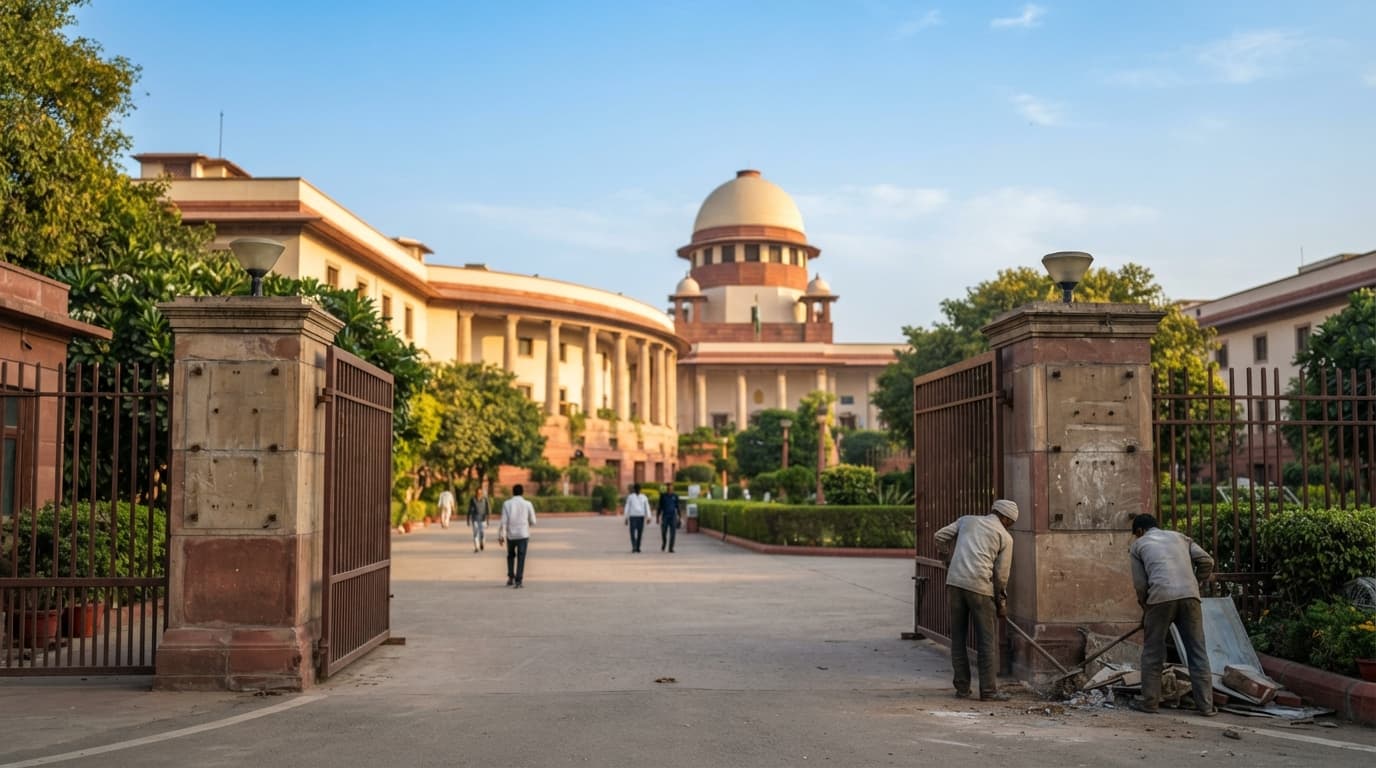
The Supreme Court of India on October 13, 2026, adjourned a batch of pleas concerning the ongoing Delhi protests to October 15, citing the indisposition of Justice V Mohana. A three-judge bench comprising Chief Justice Surya Kant, Justice Joymalya Bagchi, and Justice V Mohana issued critical directions to authorities regarding the removal of restriction boards and the resumption of public transport services. The Court signalled its commitment to ensuring unobstructed access to justice and the protection of constitutional freedoms during the demonstrations.
The adjournment came as the Court granted an extension to the Centre to file a refined response affidavit addressing allegations of non-compliance with its earlier orders. Solicitor General Tushar Mehta requested the deferment on behalf of the government, informing the bench that the affidavit had been prepared but required further refinement. The request was not opposed by other counsel appearing before the court.
The petitions before the Court relate to alleged violations of the Supreme Court's October 9, 2026, order concerning restrictions on metro and railway services, internet suspensions, and the detention of individuals during the October 10 demonstrations. These protests, which occurred ahead of agitations against Chief Election Commissioner Gyanesh Kumar, prompted widespread concerns about the proportionality of government restrictions and their compliance with constitutional safeguards.
Access to Justice and Public Transport
In its order on October 13, the bench directed authorities to remove any boards related to the imposition of Section 163 of the Bharatiya Nagarik Suraksha Sanhita (BNSS) around the Supreme Court premises, if not already done, to ensure unimpeded access to justice. Physical access to the judicial system is fundamental to the rule of law and cannot be compromised by administrative measures, even those framed in the interest of public order.
The Court further ordered that metro and railway services should operate normally unless restrictions are necessary due to genuine public order disturbances, as permitted under Article 19(2) of the Constitution of India. This directive addresses the core grievance in the petitions: that blanket closures of public transport had disrupted the movement of citizens, lawyers, journalists, and court staff without adequate justification or proportionality assessment.
During the October 11 special hearing, a Division Bench of Justices Joymalya Bagchi and V Mohana had noted allegations that 303 metro stations had been closed and that detentions had continued beyond the scope of prohibitory orders. The Solicitor General disputed these claims, stating that only 45 of 303 metro stations were closed for law and order purposes and that detained individuals had been released. The Court's continued engagement with the matter and the adjournment to October 15 suggest that the bench remains unconvinced by the government's position and intends to undertake a more detailed examination of compliance.
Contempt Notices and Alleged Violations
The Supreme Court has already served contempt notices to several senior government functionaries, including Delhi's police commissioner, for allegedly disregarding the October 9 order. The gravity with which the Court views the alleged breaches reflects the institutional importance of ensuring that executive authorities comply with judicial directions, particularly those concerning fundamental rights.
The case, formally titled Shailendra Mani Tripathi v. Govind Mohan (Diary No. 63858-2026), represents one of several interconnected petitions addressing different aspects of the government's response to the protests. The Court has been seized of habeas corpus petitions concerning illegal detentions, petitions from the Supreme Court Bar Association regarding hardships faced by lawyers, and new petitions seeking independent investigations and contempt proceedings against authorities for alleged police action against journalists.
Constitutional Balance
Chief Justice Surya Kant has emphasized that while democratic activities should proceed smoothly, the functioning of the Supreme Court and the unobstructed movement of lawyers, court staff, and litigants must not be compromised. The Court is attempting to strike a delicate balance: acknowledging the government's legitimate interest in maintaining public order while protecting the constitutional rights of citizens to protest, access justice, and move freely.
The Supreme Court Bar Association, through its president Pradeep Rai, had highlighted issues including internet service restrictions that had affected lawyers' ability to communicate and prepare cases. The SCBA had also condemned the alleged use of excessive force against lawyers en route to a protest, raising questions about the proportionality and targeting of restrictions.
On October 12, the Court agreed to hear petitions from the SCBA addressing the difficulties faced by legal professionals due to the protests. The bench's receptiveness to these submissions indicates that the Court views the protection of the legal profession's functioning as integral to access to justice itself.
Related Petitions and Election Commission Immunity
During the October 13 hearing, the Court also issued notice on a new petition filed by the Association for Democratic Reforms challenging Section 16 of the Chief Election Commissioners and Other Election Commissioners Act 2023, which grants immunity to Election Commissioners from legal action. This petition, filed in the context of the broader agitation against Chief Election Commissioner Gyanesh Kumar, raises separate constitutional questions about the scope of immunity granted to constitutional functionaries.
Separately, on October 12, five opposition leaders including Rahul Gandhi, Mallikarjun Kharge, Saugata Roy, Akhilesh Yadav, and Tejashwi Prasad Yadav filed a writ petition titled "Rahul Gandhi v. Election Commission of India" alleging irregularities in the Special Intensive Revision (SIR) process of electoral rolls. The petition seeks the constitution of an independent committee, headed by a retired apex court judge and assisted by technical experts, to audit deletions and modifications made during the SIR. Chief Justice Surya Kant advised the opposition leaders to pursue the matter through judicial proceedings, noting that similar issues were already listed for hearing.
What Comes Next
The adjournment to October 15 provides the government with additional time to refine its response affidavit while allowing the Court to receive comprehensive submissions on the alleged violations. The bench's directions on October 13 are not merely procedural; they represent substantive assertions of the Court's view that restrictions must be proportionate, narrowly tailored, and subject to ongoing judicial scrutiny.
The removal of Section 163 boards around the Supreme Court is particularly symbolic. It signals that the Court will not permit administrative measures to create physical barriers to access to justice, regardless of the public order justification offered. The directive to operate metro and railway services normally unless restrictions are strictly necessary reflects a presumption in favor of freedom of movement and against blanket restrictions.
When the matter comes up again on October 15, the bench will likely examine the government's refined affidavit in detail, assess compliance with its earlier directions, and determine whether contempt proceedings against the named officials should proceed. The Court's handling of these interconnected petitions will set important precedents regarding the balance between public order concerns and the protection of fundamental rights during periods of civil unrest.
Comments
Sign in to read the discussion and share your thoughts.
Latest from LawWorld
News
View all- Karnataka High Court Grants Six-Day Interim Bail to KPSC Scam Accused for Daughter's Naming Ceremony13 Oct 2026
- Karnataka High Court Disposes Petition After State Notifies SOP for Underage Pregnancies13 Oct 2026
- Karnataka High Court Directs Police to Issue Look Out Circular in Dowry and Cruelty Case13 Oct 2026
- Karnataka High Court Strikes Down SC/ST Quota Law Exceeding 50% Constitutional Ceiling13 Oct 2026
- Supreme Court Issues Contempt Notices Over Metro Restrictions and Detentions During Delhi Protests13 Oct 2026
Articles
View all- Supreme Court Refers DPDP Act Constitutional Challenge to Five-Judge Bench: RTI vs. Privacy Rights at Stake12 Oct 2026
- Supreme Court Disposes PIL on Doxxing and Deepfakes; Directs Union Ministries to Implement Remedial Measures8 Oct 2026
- Supreme Court Issues Notice on Constitutional Challenge to GST Input Tax Credit Denial Provision7 Oct 2026
Blogs
View all- Supreme Court Orders Priority Hearing for Pension Cases: A Decade-Long Wait Deemed 'Grave Injustice'12 Oct 2026
- Supreme Court Clarifies Gratuity Calculation: Monthly Wages Divided by 26 Working Days, Not 3011 Oct 2026
- Supreme Court Affirms Damages Recovery for Delayed Provident Fund Contributions Without Time Limit10 Oct 2026