
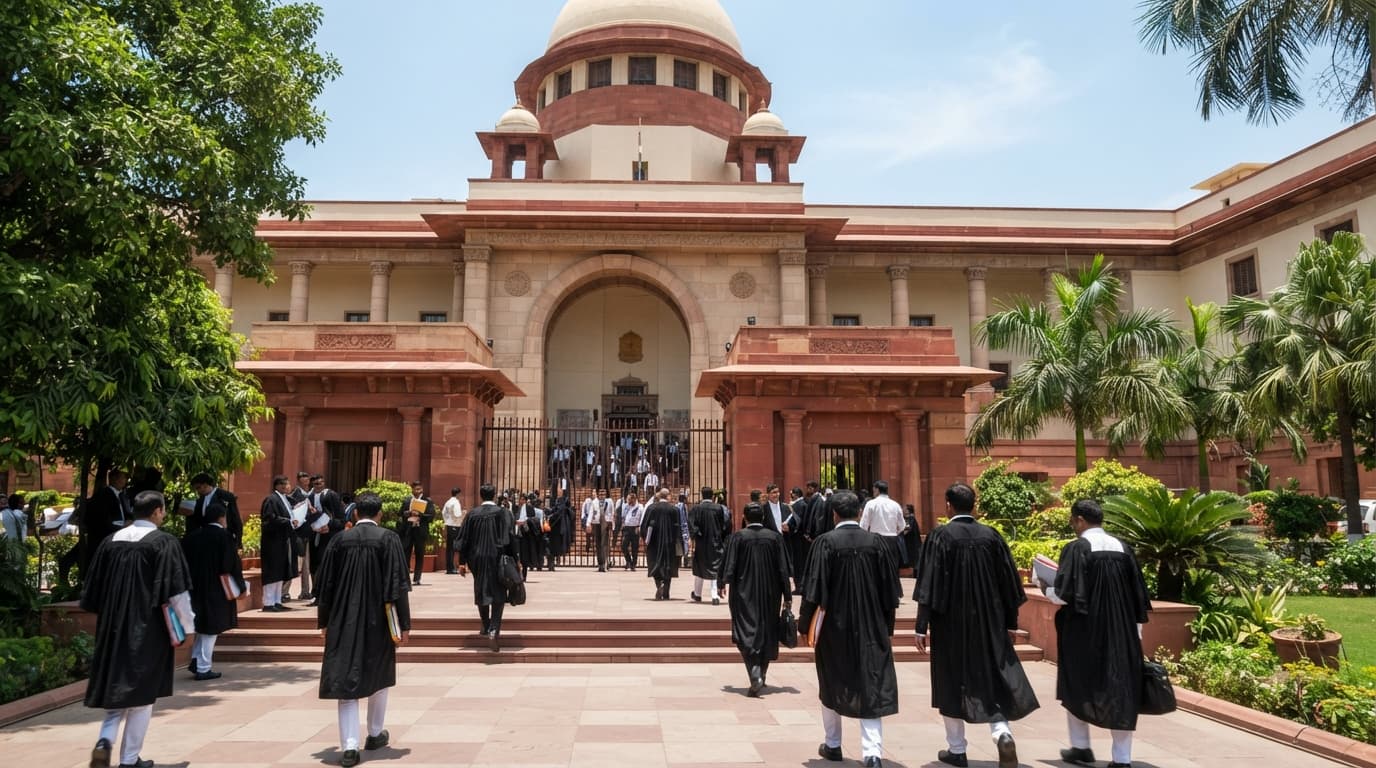
The Supreme Court of India uploaded an order on October 14, 2026, in the criminal special leave petition filed by Durga Raghuwanshi against Shyam Sunder, bearing case number SLP(Crl) No. 16806/2026 with diary number 46058/2026. The order was pronounced on October 13, 2026, and made publicly accessible through the court's official website at 10:37:53 on the following day. The filing reflects the ongoing volume of criminal matters brought before the apex court through the special leave petition procedure, a mechanism that allows parties to seek extraordinary relief from the Supreme Court when they believe a lower court's decision violates fundamental rights or principles of justice.
Criminal special leave petitions and the Supreme Court
Special leave petitions form a critical part of India's appellate framework. When a party believes that a decision by a High Court or other competent authority has resulted in grave injustice or violated constitutional principles, they may approach the Supreme Court seeking special leave to appeal. In criminal matters, this procedure becomes particularly important, as it offers a final avenue for challenging convictions, sentences, or procedural irregularities that may have occurred during trial or appellate proceedings.
The Supreme Court's discretion in admitting special leave petitions is guided by the principle that such petitions should be granted only when the case presents questions of general importance or when there are exceptional circumstances warranting the court's intervention. The threshold for admission is deliberately high, ensuring that the apex court focuses its limited resources on cases that affect criminal jurisprudence or individual rights across multiple jurisdictions.
The case details and procedural context
The case of Durga Raghuwanshi v. Shyam Sunder falls within this framework of criminal special leave petitions. While the specific details of the underlying dispute, the grounds on which the petition was filed, and the nature of the relief sought are not disclosed in the publicly available information at this stage, the very fact that the Supreme Court pronounced an order indicates that the petition underwent the standard examination process. The court would have considered whether the case met the criteria for admission, whether there were substantial questions of law or fact involved, and whether the circumstances justified the court's intervention.
The diary number 46058/2026 assigned to the petition is part of the Supreme Court's internal case management system, which allows the institution to track and organize the thousands of petitions filed annually. The upload of the order to the court's website within a day of its pronouncement reflects the Supreme Court's commitment to transparency and timely dissemination of judicial decisions to the legal community and the public.
Significance of order uploads and public access
The Supreme Court's practice of uploading orders to its official website serves multiple purposes in India's legal ecosystem. It ensures that parties to the litigation can immediately access the court's decision and understand the basis for the order. Legal practitioners can study the court's reasoning and keep abreast of developments in criminal law. The practice also contributes to the broader principle of open justice, whereby judicial proceedings and decisions are accessible to the public, thereby maintaining accountability and public confidence in the judiciary.
For practitioners specializing in criminal law, the availability of Supreme Court orders in special leave petitions provides valuable guidance on how the apex court approaches various categories of criminal cases. Even when an order does not contain a detailed judgment, the mere fact of admission or rejection, along with any reasons provided, can offer insights into the court's current thinking on criminal procedure, sentencing principles, or constitutional protections.
The volume and nature of criminal petitions
The Supreme Court receives a substantial number of criminal special leave petitions each year. Many raise issues arising from convictions in trials conducted under the Indian Penal Code, the Code of Criminal Procedure, or specialized criminal statutes. Others concern procedural questions, bail matters, or challenges to orders passed by High Courts in their appellate or revisional jurisdiction over criminal cases.
The case of Durga Raghuwanshi v. Shyam Sunder, identified by its diary number as one among thousands of petitions filed in 2026, represents just one instance of the continuous stream of criminal matters flowing through the Supreme Court. The fact that an order was pronounced on October 13, 2026, and uploaded the next day demonstrates the court's operational efficiency in managing its docket, even as it grapples with cases of varying complexity and urgency.
Judicial activity in October 2026
The period in which this order was uploaded was marked by significant judicial activity at the Supreme Court. Around the same time, the court was seized with urgent matters concerning public order and fundamental rights. A Division Bench took up habeas corpus petitions on October 10, 2026, relating to restrictions on public transportation during a protest, examining allegations that metro station closures and detentions had exceeded the scope of prohibitory orders issued under Section 163 of the Bharatiya Nyaya Sanhita, 2023. Such concurrent matters illustrate the range of issues occupying the Supreme Court's attention.
Additionally, the court was managing its bench schedules to ensure that critical cases received appropriate judicial attention. On October 14, 2026, the day the Durga Raghuwanshi order was uploaded, the Chief Justice of India and Justice K.V. Viswanathan were constituted as a special bench to hear a civil appeal, demonstrating how the court allocates its senior judicial resources to matters of importance.
What comes next for the parties
With the order now uploaded and publicly available, the parties to the petition have access to the Supreme Court's decision. Depending on the nature of the order, the petition may have been admitted for full hearing on merits, admitted and decided on the basis of written submissions, or rejected at the admission stage. Each outcome carries different consequences for the parties involved and may necessitate different courses of action.
If the petition was admitted, the case will proceed to a substantive hearing before a bench of the Supreme Court, where the parties will present their arguments on the criminal issues in dispute. If the petition was rejected at the admission stage, the parties may explore other legal remedies available to them, depending on the nature of the case and the grounds for rejection. The uploading of this order marks a formal step in the judicial process and ensures that the parties, their legal representatives, and the broader legal community have timely access to the Supreme Court's decision.
Comments
Sign in to read the discussion and share your thoughts.
Latest from LawWorld
News
View all- Karnataka High Court Orders ₹1 Lakh Compensation to Centenarian for Land Acquisition Officer's Negligence14 Oct 2026
- Karnataka High Court Halts Investigation Against BJP Leader Ravi Patil in Voter Deletion Case14 Oct 2026
- Karnataka High Court Examines Sex Discrimination in Spousal Gift Tax Exemption for Same-Sex Couples14 Oct 2026
- Supreme Court Uploads Order in Criminal Special Leave Petition Indradeo Mistry v. State of Jharkhand14 Oct 2026
- Supreme Court Issues Notice in Habeas Corpus Petition Over Delhi Metro Shutdown During Protest14 Oct 2026
Articles
View all- Supreme Court Refers DPDP Act Constitutional Challenge to Five-Judge Bench: RTI vs. Privacy Rights at Stake12 Oct 2026
- Supreme Court Disposes PIL on Doxxing and Deepfakes; Directs Union Ministries to Implement Remedial Measures8 Oct 2026
- Supreme Court Issues Notice on Constitutional Challenge to GST Input Tax Credit Denial Provision7 Oct 2026
Blogs
View all- Supreme Court Awards Compensation for Delayed Wages of Daily-Wage Workers14 Oct 2026
- Supreme Court Orders Priority Hearing for Pension Cases: A Decade-Long Wait Deemed 'Grave Injustice'12 Oct 2026
- Supreme Court Clarifies Gratuity Calculation: Monthly Wages Divided by 26 Working Days, Not 3011 Oct 2026