
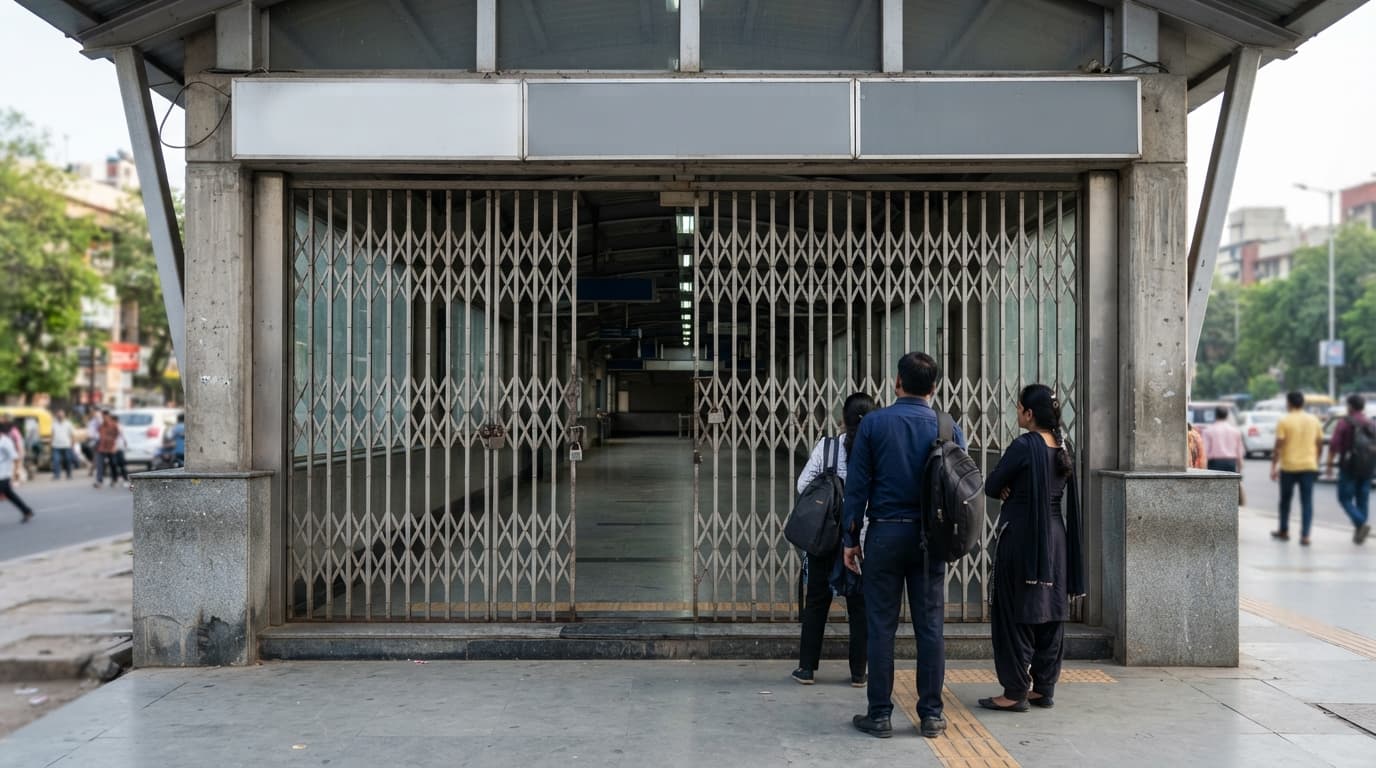
The Supreme Court of India took up an urgent habeas corpus petition on October 11, 2026, addressing allegations of illegal detention and metro station closures during a protest in Delhi on October 10. A Division Bench heard the case of Shailendra Mani Tripathi v. Govind Mohan (Contempt Petition (Civil) Diary No. 63801/2026) and issued notice to the alleged contemnors, directing them to file a counter-affidavit with a compliance report by October 13, 2026.
The petition raised serious concerns about the restriction of public transportation and the detention of individuals beyond the geographical area specified in a prohibitory order. According to the Court's examination of the matter, prima facie allegations emerged that metro station closures and related detentions may have exceeded the scope of authority granted under Section 163 of the Nagarik Suraksha Sanhita, 2023 (BNSS), the new criminal procedure code that replaced the earlier Code of Criminal Procedure.
Metro Closures and Alleged Detention Beyond Legal Limits
On October 10, 2026, during a protest identified as a CJP demonstration, authorities closed multiple metro stations in Delhi, disrupting public movement across the capital. The habeas corpus petition contended that individuals were detained in areas not covered by the prohibitory order that authorities relied upon to justify the shutdown. This raised a fundamental question about the legality and proportionality of the restrictions imposed on citizens' freedom of movement and liberty.
The Nagarik Suraksha Sanhita, 2023, which came into effect in 2023, provides the statutory framework for criminal procedure in India. Section 163 of the BNSS empowers authorities to issue prohibitory orders in specific circumstances, but the scope of such orders is limited to defined geographical areas and prescribed purposes. The Court's prima facie observation suggested that the detentions in question may have strayed beyond these defined boundaries, raising concerns about the exercise of state power.
Court's Immediate Response and Procedural Direction
The Supreme Court's decision to hear the petition on an urgent basis reflects the gravity of allegations involving restrictions on public transportation and personal liberty. By issuing notice to the alleged contemnors—the officials and authorities responsible for the metro closures and detentions—the Court initiated a formal process to examine whether contempt of court or abuse of authority had occurred.
The Court's directive requiring a counter-affidavit and compliance report by October 13, 2026, set a tight timeline for authorities to respond. This procedural step is standard in habeas corpus matters, where the respondent must justify the detention or restriction by filing a detailed affidavit explaining the legal basis and factual circumstances. A compliance report, in this context, would require authorities to document the specific measures taken, the areas covered, and the persons affected by the metro shutdown.
Statutory Framework Under the Nagarik Suraksha Sanhita, 2023
The BNSS represents a comprehensive overhaul of India's criminal procedure law. Section 163 specifically addresses prohibitory orders, commonly known as Section 144 orders (the equivalent provision under the old Code of Criminal Procedure). These orders are issued to prevent imminent danger to human life, health, or safety, or a disturbance to the public tranquility. However, such orders must be limited in scope—both geographically and temporally—and must not be used as a blanket tool to restrict fundamental rights beyond what is necessary.
The Court's reference to Section 163 BNSS in the context of the metro shutdown suggests that authorities may have relied on such an order to justify closing the stations. However, the petitioner's allegation that detentions occurred outside the area covered by the order raises a critical issue: whether the exercise of power under Section 163 was confined to its statutory limits or whether it was used arbitrarily to restrict liberty beyond the scope authorized by law.
Habeas Corpus and Detention Beyond Authority
Habeas corpus petitions are among the most important constitutional remedies available to Indian citizens. The writ of habeas corpus, enshrined in Article 32 of the Constitution, protects the right to personal liberty by requiring authorities to justify any detention or restriction. When a person is detained or their movement is restricted, the burden falls on the state to demonstrate that the action was lawful and proportionate.
In this case, the petitioner's reliance on habeas corpus jurisdiction suggests that the metro closures and accompanying detentions were not merely administrative inconveniences but amounted to unlawful restrictions on freedom of movement. The fact that detentions allegedly occurred in areas not covered by the prohibitory order strengthens this argument, as it suggests the authorities acted beyond their legal authority.
Contempt Petition and Judicial Accountability
The case is styled as a Contempt Petition, which indicates that the petitioner may also be alleging contempt of court. This dimension could arise if authorities violated a prior court order or acted in defiance of judicial directions regarding the scope of restrictions. Contempt proceedings serve as a mechanism to ensure that state officials comply with court orders and do not abuse their authority under the guise of law enforcement.
The Supreme Court's willingness to entertain the petition on an urgent basis and direct immediate responses from authorities reflects the Court's commitment to protecting individual liberty and ensuring that executive action remains within constitutional and statutory bounds. The short deadline for filing counter-affidavits indicates the Court's view that the matter requires expedited resolution.
Public Order Management and Proportionality
The petition touches on a recurring tension in Indian law: balancing the state's legitimate need to maintain public order during protests with citizens' fundamental rights to freedom of movement, assembly, and liberty. Metro shutdowns, while sometimes justified during emergencies or serious public disorder, can become tools of mass restriction if not carefully circumscribed. How courts scrutinize such measures affects the scope of state authority in managing public order.
The Court's examination of whether detentions exceeded the geographical scope of the prohibitory order sends a signal that vague or overly broad restrictions will not withstand judicial scrutiny. Authorities must demonstrate that any limitation on public services or personal liberty is necessary, proportionate, and confined to the defined area and duration specified in the relevant order.
Next Steps and October 13 Deadline
With the Court directing the alleged contemnors to file a counter-affidavit and compliance report by October 13, 2026, the matter is now in a critical phase. The authorities' response will be crucial in determining whether the Court finds merit in the allegations or whether it is satisfied that the restrictions were lawfully imposed and properly limited in scope.
The Supreme Court's decision to issue notice and demand detailed responses demonstrates that questions about detention and restrictions on movement cannot be dismissed as routine administrative actions. Each such restriction must be justified, documented, and shown to fall within the legal authority granted by statute and by any court order. The outcome of this petition will likely provide guidance on the permissible scope of Section 163 orders under the Nagarik Suraksha Sanhita, 2023, and the limits of state authority in restricting public services during protests.
Comments
Sign in to read the discussion and share your thoughts.
Latest from LawWorld
News
View all- Karnataka High Court Orders ₹1 Lakh Compensation to Centenarian for Land Acquisition Officer's Negligence14 Oct 2026
- Karnataka High Court Halts Investigation Against BJP Leader Ravi Patil in Voter Deletion Case14 Oct 2026
- Karnataka High Court Examines Sex Discrimination in Spousal Gift Tax Exemption for Same-Sex Couples14 Oct 2026
- Supreme Court Uploads Order in Criminal Special Leave Petition Indradeo Mistry v. State of Jharkhand14 Oct 2026
- Supreme Court Uploads Order in Criminal Special Leave Petition Durga Raghuwanshi v. Shyam Sunder14 Oct 2026
Articles
View all- Supreme Court Refers DPDP Act Constitutional Challenge to Five-Judge Bench: RTI vs. Privacy Rights at Stake12 Oct 2026
- Supreme Court Disposes PIL on Doxxing and Deepfakes; Directs Union Ministries to Implement Remedial Measures8 Oct 2026
- Supreme Court Issues Notice on Constitutional Challenge to GST Input Tax Credit Denial Provision7 Oct 2026
Blogs
View all- Supreme Court Awards Compensation for Delayed Wages of Daily-Wage Workers14 Oct 2026
- Supreme Court Orders Priority Hearing for Pension Cases: A Decade-Long Wait Deemed 'Grave Injustice'12 Oct 2026
- Supreme Court Clarifies Gratuity Calculation: Monthly Wages Divided by 26 Working Days, Not 3011 Oct 2026