
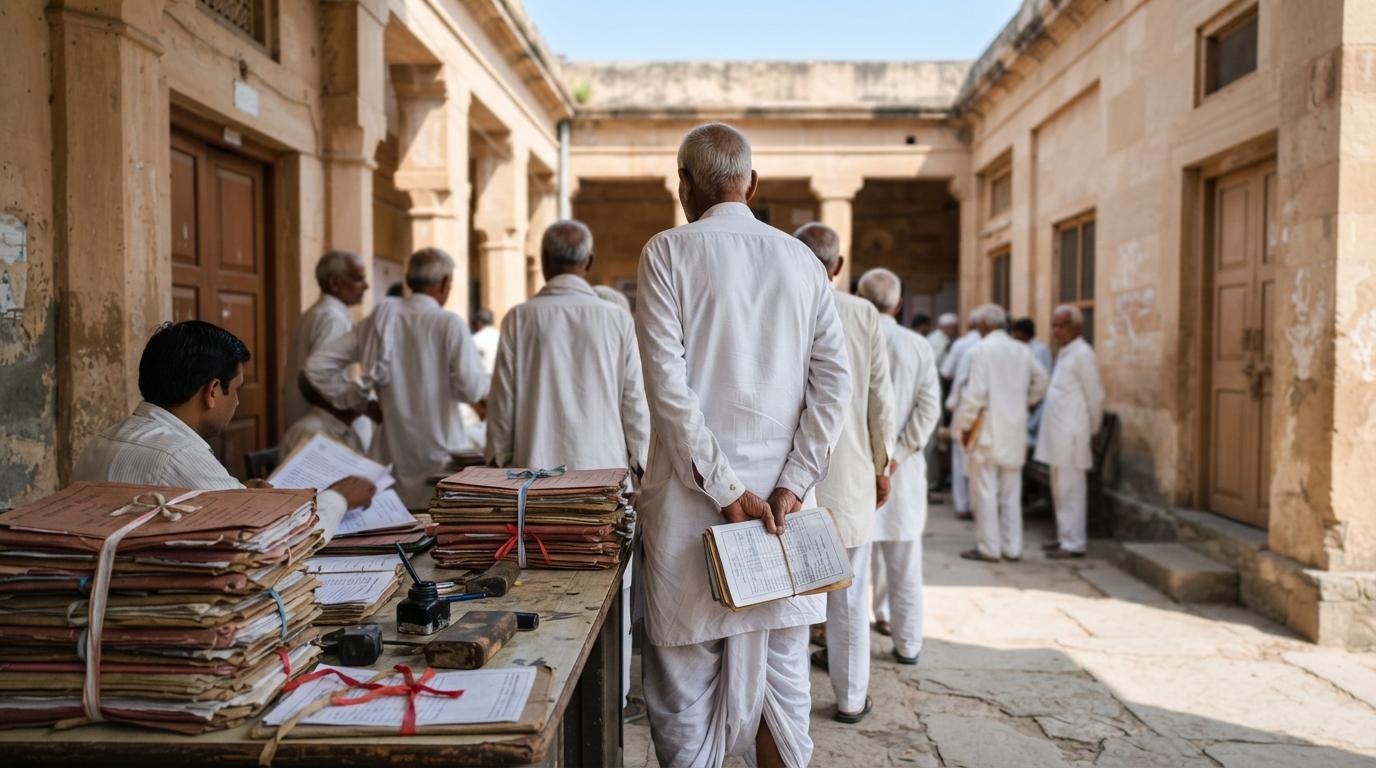
The Supreme Court bench of Justices Dipankar Datta and Satish Chandra Sharma declared the Uttar Pradesh Qualifying Service for Pension and Validation Act, 2021 and the Uttar Pradesh Entitlement to Pension and Validation Act, 2025 unconstitutional. Justice Datta wrote the 89-page judgment. It was delivered on November 18.
Under those laws, service rendered in work-charged, temporary, daily-wage or muster-roll capacities was retrospectively excluded from qualifying service for pension after regularisation. They introduced fresh definitions and validation clauses to sustain that exclusion after the Court's 2019 decision in Prem Singh v. State of Uttar Pradesh. That decision had read down Rule 3(8) of the Uttar Pradesh Retirement Benefits Rules, 1961 to hold that service in a work-charged establishment must count toward pension once the employee was regularised.
Regularisation, the bench said, marks integration into the regular establishment and “obliterates the birthmark of the initial appointment.” Once that change occurred under a duly framed scheme, the original mode of engagement could not be used to deny retiral benefits available to regular staff. The judgment said the State could not repackage an exclusion already held impermissible by altering statutory language without curing the constitutional defect. Exercising judicial review, the Court held both validation Acts ultra vires.
Six-month deadline for pension claims
Eligible pension claims of work charged employees will now be considered in accordance with the principles laid down in that 2019 decision. Retired staff covered by the ruling may file claims with complete service particulars before the competent authority. That authority must decide each claim within six months, and no rejection can be made without an opportunity of hearing. Arrears will ordinarily be limited to three years, with a narrow exception for heirs of staff who died before the 2019 decision on furnishing unimpeachable proof. Any delayed payment will carry simple interest at 9 per cent per annum.
Comments
Sign in to read the discussion and share your thoughts.
Latest from LawWorld
News
View all- Supreme Court Refers SARFAESI Priority Dispute With Depositor Law To Larger Bench27 Nov 2026
- Supreme Court Rules Mere Objections In Protest Petition Are Not A Complaint27 Nov 2026
- Supreme Court Quashes Bihar Remission To Anand Mohan In IAS Officer Murder Case27 Nov 2026
- Supreme Court Acquits Rape Accused For Lack Of Medical Evidence27 Nov 2026
- Supreme Court Mandates Separate Hexagonal Warnings For Fat, Sugar, Salt26 Nov 2026